
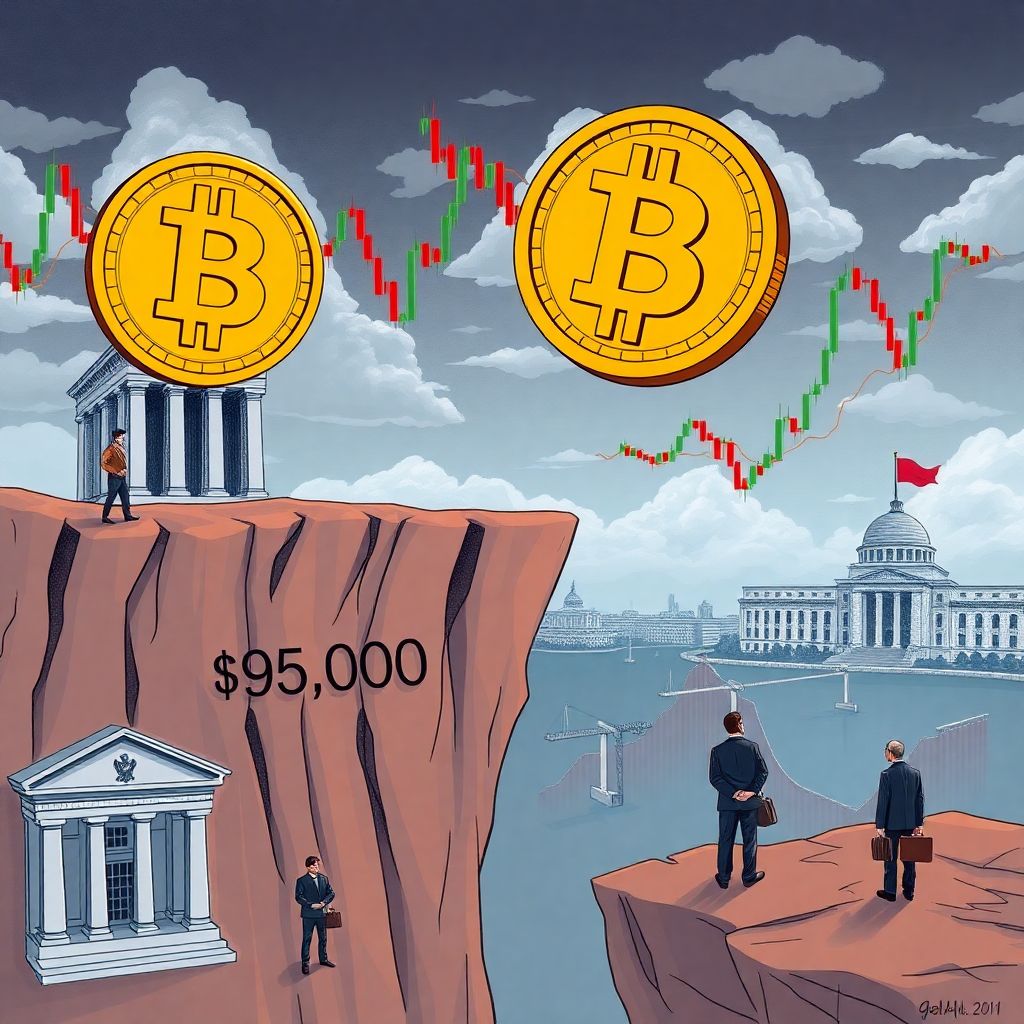
Bitcoin’s recent dip below the $95,000 mark has sparked concern among investors, but leading analysts caution against labeling the current market downturn as a full-fledged bear market. While the flagship cryptocurrency saw sharp price fluctuations this week, experts argue that the broader context suggests a more nuanced situation than a simple bearish trend.
On Friday morning, Bitcoin briefly fell beneath $95,000 before staging a modest recovery. However, by the afternoon, it slipped below that level again, triggering renewed anxiety among traders. This pattern of volatility, according to analysts, is primarily driven by panic selling from short-term holders reacting to recent macroeconomic shifts—particularly changes in expectations regarding U.S. Federal Reserve interest rate policies.
CrazzyBlockk, a well-known pseudonymous analyst from CryptoQuant, emphasized that the behavior of new market entrants plays a crucial role in determining Bitcoin’s short-term price action. “The Bitcoin market is heavily influenced by the profitability of recent investors. When these participants are in profit, market sentiment improves, which supports upward momentum,” the analyst explained.
However, when newer investors begin facing substantial losses—typically in the range of 20% to 40%—a wave of fear often ensues, resulting in widespread sell-offs. This panic behavior can trigger sharp declines, but it doesn’t necessarily mark the onset of a bear market.
“It’s important to distinguish between a healthy correction and a structural market reversal,” said CrazzyBlockk. “Corrections are normal, especially after strong rallies. What we’re seeing now is more indicative of a short-term recalibration than a collapse.”
The analyst also pointed out that long-term holders, or so-called “diamond hands,” remain largely unfazed by the recent volatility. These investors, who tend to accumulate during dips and hold through turbulence, are not showing signs of panic. Their behavior helps provide a degree of price floor stability, even amid short-term selloffs.
Additionally, on-chain data suggests that the selling pressure is not widespread across the entire investor base. Metrics such as the Spent Output Profit Ratio (SOPR) indicate that most transactions are still occurring in profit, underscoring the resilience of the current cycle compared to historical bear markets, where SOPR dips below 1 for extended periods.
Another stabilizing factor is the growing institutional interest in Bitcoin. Despite the recent price drop, large-scale buyers and financial institutions continue to accumulate, viewing the downturn as a buying opportunity rather than a signal to exit. This steady inflow of capital is helping to cushion the impact of retail-driven panic selling.
Moreover, the macroeconomic environment remains complex. The Federal Reserve’s evolving stance on interest rates has injected uncertainty into all asset classes, not just cryptocurrencies. As traders recalibrate their expectations regarding inflation and monetary policy, risk assets like Bitcoin are naturally subject to increased volatility.
Yet, unlike previous cycles, Bitcoin now benefits from a more mature market infrastructure. The presence of ETFs, regulated custodians, and more sophisticated risk management tools allows for greater resilience during volatile periods. This maturity may help prevent sharp downturns from spiraling into prolonged bear markets.
Looking forward, analysts recommend watching key technical levels and sentiment indicators. If Bitcoin can hold above its 200-day moving average and maintain a relatively high level of network activity, it would argue in favor of continued strength despite short-term turbulence.
Investors should also monitor the behavior of miners, whose selling patterns can significantly impact price momentum. So far, miner outflows remain within normal ranges, suggesting that there is no major capitulation event underway.
In conclusion, while Bitcoin has certainly experienced notable price pressure in recent days, the broader indicators do not yet support the classification of the current market as bearish. Instead, many signs point to a temporary correction driven by short-term psychology and external economic developments. Long-term fundamentals remain intact, and the market may stabilize once macro uncertainties subside and investor confidence returns.