
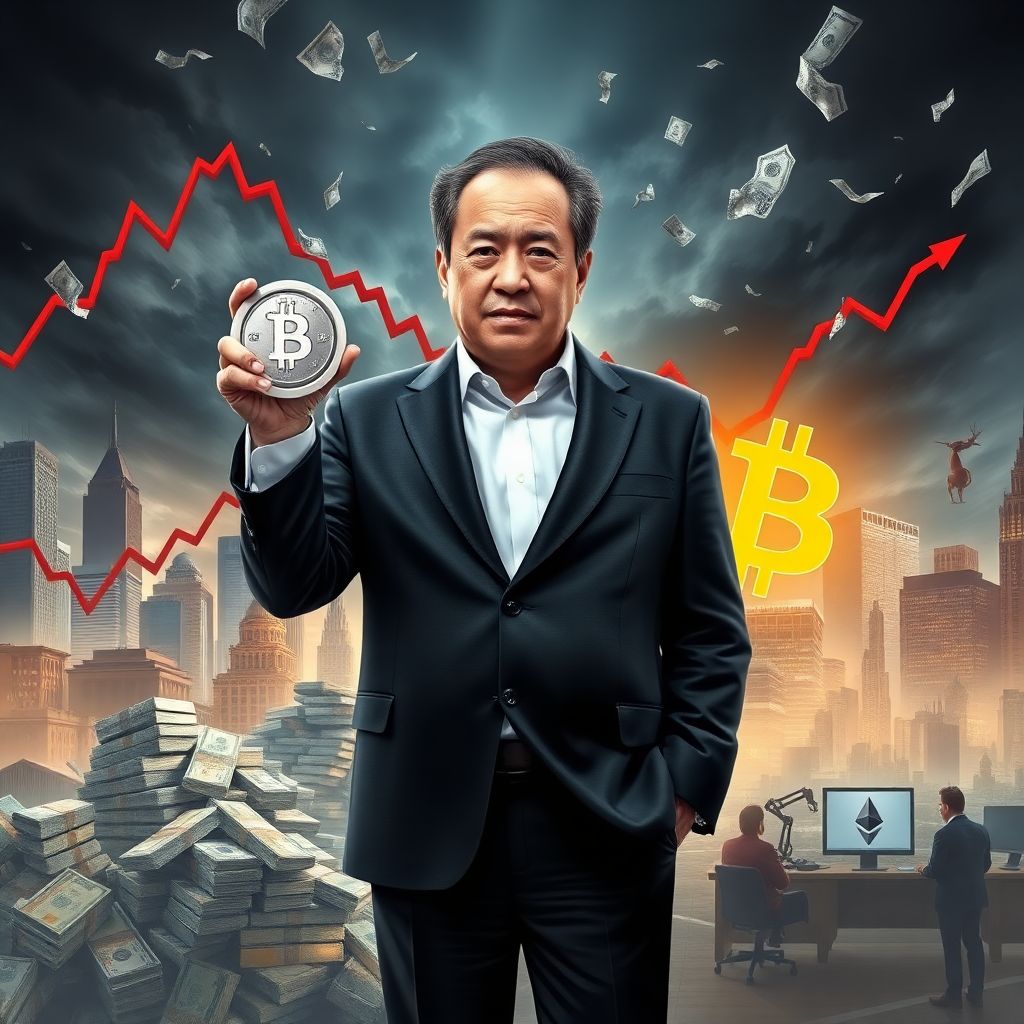
Robert Kiyosaki: Why Silver Is His “Safest Bet” As He Warns Of The Biggest Market Crash
Robert Kiyosaki, the influential author of “Rich Dad Poor Dad,” says the financial reckoning he has warned about for years is no longer a distant threat – it is already unfolding. According to him, the “biggest crash in world history” has begun, hitting not only the United States but also Europe and Asia, and reshaping how investors should protect and grow their wealth.
Against this backdrop, Kiyosaki is doubling down on hard assets. While he remains bullish on Bitcoin and other cryptocurrencies, he now calls one particular asset “the best and the safest” bet in the current environment: silver.
Silver at $200 by 2026? Kiyosaki’s bold forecast
Kiyosaki believes silver is dramatically undervalued relative to the scale of the ongoing crisis. He argues that, as traditional financial markets unravel and confidence in fiat currencies continues to erode, demand for precious metals will surge.
He lays out a specific price path for silver:
– In the short term, he expects silver to reach around $70.
– Looking ahead, he predicts silver could climb to $200 by 2026.
In his view, current prices leave room for what he sees as a “once in a generation” opportunity. Silver, he says, is still affordable for everyday investors, unlike gold, which has already priced in much of the fear and uncertainty in global markets.
Why silver, and why now?
Kiyosaki’s conviction about silver is based on a combination of factors:
1. Safe haven status
Like gold, silver has historically acted as a store of value during times of inflation, currency debasement and financial instability. When trust in paper assets falls, investors traditionally turn to tangible, scarce commodities.
2. Industrial demand
Beyond its role as money, silver is critical in many industries – from electronics and solar panels to medical devices. If technological and green energy sectors expand, industrial demand for silver could put further upward pressure on prices, even in a weak macroeconomic environment.
3. Relative affordability
Compared with gold, silver is far cheaper per ounce. Kiyosaki sees this as an advantage: retail investors, young savers and those with smaller portfolios can still accumulate meaningful amounts of silver without needing large amounts of capital.
4. Perceived mispricing
He argues that silver’s price does not currently reflect its strategic and industrial importance. In his narrative, this gap between price and perceived value is exactly what creates the potential for large upside.
This combination of defensive and growth characteristics is why Kiyosaki calls silver “the best and the safest” among the assets he recommends.
“The crash has arrived”: from prophecy to reality
Kiyosaki has been warning about a systemic financial meltdown for more than a decade. In his 2013 book “Rich Dad’s Prophecy,” he outlined a scenario in which massive debt loads, aging populations, and overextended financial markets would ultimately lead to a historic collapse.
He now claims that this scenario is playing out in real time. According to his recent comments:
– The downturn is global, not confined to the United States.
– Europe and Asia are also facing serious financial and economic stress.
– Traditional assets like office and residential real estate are at risk of sharp repricing.
He also stresses that this is not merely a short-term correction, but a structural shift that could redefine work, investment and retirement for millions of people.
The AI factor: jobs, real estate and cascading risk
A major element of Kiyosaki’s warning is the impact of artificial intelligence on the labor market. He believes AI will eliminate a substantial number of jobs across white-collar and blue-collar sectors, which could trigger further declines in key asset classes.
In his view, the chain reaction looks like this:
– AI reduces employment opportunities and undermines income stability.
– Lower incomes and rising uncertainty weaken demand for housing and office space.
– As a result, both commercial and residential real estate markets suffer significant declines.
– Falling real estate values then put pressure on banks, lenders and investors heavily exposed to property markets.
For Kiyosaki, this interplay between technology, employment and asset prices is a core reason why the current crash is so deep and far-reaching.
“Buy more gold, silver, Bitcoin and Ethereum”
Despite his dire warnings, Kiyosaki does not present himself as a pessimist. Instead, he frames the crisis as a massive transfer of wealth – away from those who remain unprepared and toward those who understand the new rules of the game.
He repeatedly urges investors to accumulate:
– Gold – as a traditional hedge against inflation and currency risk.
– Silver – which he calls “the best and the safest” due to its price and potential.
– Bitcoin (BTC) – as digital hard money and a hedge against centralized monetary policy.
– Ethereum (ETH) – as a core asset within the broader digital economy.
“The good news,” he says, “is while millions will lose everything… if you are prepared… this crash will make you richer.” For him, preparation means repositioning away from purely paper-based wealth and toward real assets with limited supply.
Selling $2.25 million in Bitcoin – and why he’s still bullish
Kiyosaki’s recent actions show how he applies his own advice. Just days before reiterating his crash warning, he announced that he had sold $2.25 million worth of Bitcoin at around $90,000 per coin.
He originally bought this Bitcoin years ago at roughly $6,000, locking in a large profit. However, the sale was not a vote of no confidence in Bitcoin. Instead, he framed it as a tactical move:
– The capital freed from the Bitcoin sale is being redirected into cashflow-producing businesses.
– Specifically, he is investing in two surgery centers and a billboard business.
According to his estimates, these investments should generate around $27,500 per month in tax-free income by February 2026.
In other words, he is using the gains from a highly volatile, high-growth asset (Bitcoin) to buy stable, income-generating enterprises – a classic wealth-building strategy in his teaching.
Turning speculation into permanent cashflow
Kiyosaki’s broader philosophy is not about trading in and out of markets for quick wins. His model is:
1. Acquire assets with strong upside potential (such as Bitcoin or undervalued metals).
2. When those assets appreciate significantly, take profits strategically.
3. Reinvest the proceeds into businesses and real estate that produce reliable cashflow.
4. Use that ongoing income to accumulate more growth assets over time.
He describes this as his personal “get rich plan.” The goal is to build a portfolio that blends:
– Appreciating assets (like Bitcoin or silver, in his view).
– Cashflow assets (like businesses and certain types of real estate).
By doing so, he aims to benefit both from rising asset prices and from the stability of regular, often tax-advantaged income.
Why he remains optimistic on Bitcoin
Even after selling a significant portion of his Bitcoin holdings, Kiyosaki says he remains “very bullish and optimistic” about the cryptocurrency. He has made it clear that he intends to accumulate more Bitcoin using the positive cashflow from his new investments.
For him, Bitcoin plays a specific role:
– It is a long-term hedge against what he sees as irresponsible central bank policies and currency debasement.
– It represents a form of decentralized money beyond the direct control of governments and traditional financial institutions.
– Its fixed supply aligns with his preference for scarce, hard assets.
His recent sale, therefore, is not an exit from crypto but part of a larger strategy to diversify and solidify his wealth base while keeping exposure to high-potential assets.
Transparency, criticism and security concerns
Kiyosaki has stated that some advisers urged him not to publicly disclose details of his Bitcoin sale and subsequent investments. He alluded to “too many sickos out there” as part of the reason they were concerned about his transparency.
Nonetheless, he chose to share the information, consistent with his long-standing approach of openly discussing both his successes and his strategies. This openness is meant to show readers and followers how he applies his own principles in real markets, not just in theory.
At the same time, his comments underline an important modern reality: public figures who talk openly about large holdings in crypto or other assets may face heightened security and privacy risks.
What Kiyosaki’s views mean for individual investors
For everyday investors, Kiyosaki’s message can be distilled into a few practical themes:
1. Prepare for volatility, not stability
He believes the era of smooth, predictable growth in traditional markets is over. Planning under the assumption of larger swings and structural changes becomes essential.
2. Prioritize hard and scarce assets
Precious metals, productive businesses and certain forms of real estate are central to his strategy. Silver, in particular, is highlighted as his top “safest” choice right now.
3. Blend growth and income
Rather than choosing between speculation and income, his approach is to use speculative gains to build long-term cashflow, then use that cashflow to keep accumulating strategic assets.
4. Think globally, not just locally
Since he sees the crash as global, he believes investors should pay attention to developments in Europe, Asia and emerging markets, not just their home country.
5. Adapt to AI and technological disruption
With AI threatening many traditional job categories, he suggests people should focus on assets and skills that are harder to automate and on income streams that do not depend on a single employer or industry.
Is silver really the “safest bet”?
Even if one accepts Kiyosaki’s broader thesis, the idea that silver is the single “safest” asset is a strong claim. In practice, no investment is without risk. Silver prices can be volatile and are influenced by macroeconomic conditions, industrial demand, investor sentiment and monetary policy.
However, within Kiyosaki’s framework, silver stands out because:
– It is tangible and finite.
– It has both monetary and industrial uses.
– It is still accessible to smaller investors.
– He sees its current price as failing to reflect its long-term importance.
For those who share his concerns about debt, inflation and currency stability, silver can be seen as a way to diversify away from purely paper assets while retaining significant upside potential.
Navigating the “biggest crash”: Kiyosaki’s core takeaways
Kiyosaki’s current message combines alarm with opportunity:
– He believes the largest crash in financial history has already started, accelerated by debt, demographics, AI disruption and global economic imbalances.
– He expects real estate, especially office space and overleveraged residential markets, to face serious headwinds.
– He urges individuals to protect themselves with gold, silver, Bitcoin and Ethereum, with particular emphasis on silver as his favored safe asset.
– He personally is transforming Bitcoin gains into real-world businesses, aiming for tax-advantaged monthly cashflow by 2026.
– Despite booking large profits, he remains committed to Bitcoin as part of his long-term wealth strategy.
For investors, his stance is less about panic and more about repositioning: away from dependence on salaries and traditional financial products, and toward ownership of real assets, diversified income streams and hedges against systemic risk.
Whether one agrees with his timeline or specific predictions – such as silver hitting $200 by 2026 – his overarching message is clear: the rules of the financial game are changing, and those who adapt early, in his view, will be in the best position not just to survive the upheaval, but to grow wealth through it.