
Naver’s $14.5B mega-deal puts Upbit on Nasdaq track and reshapes Asia’s crypto race
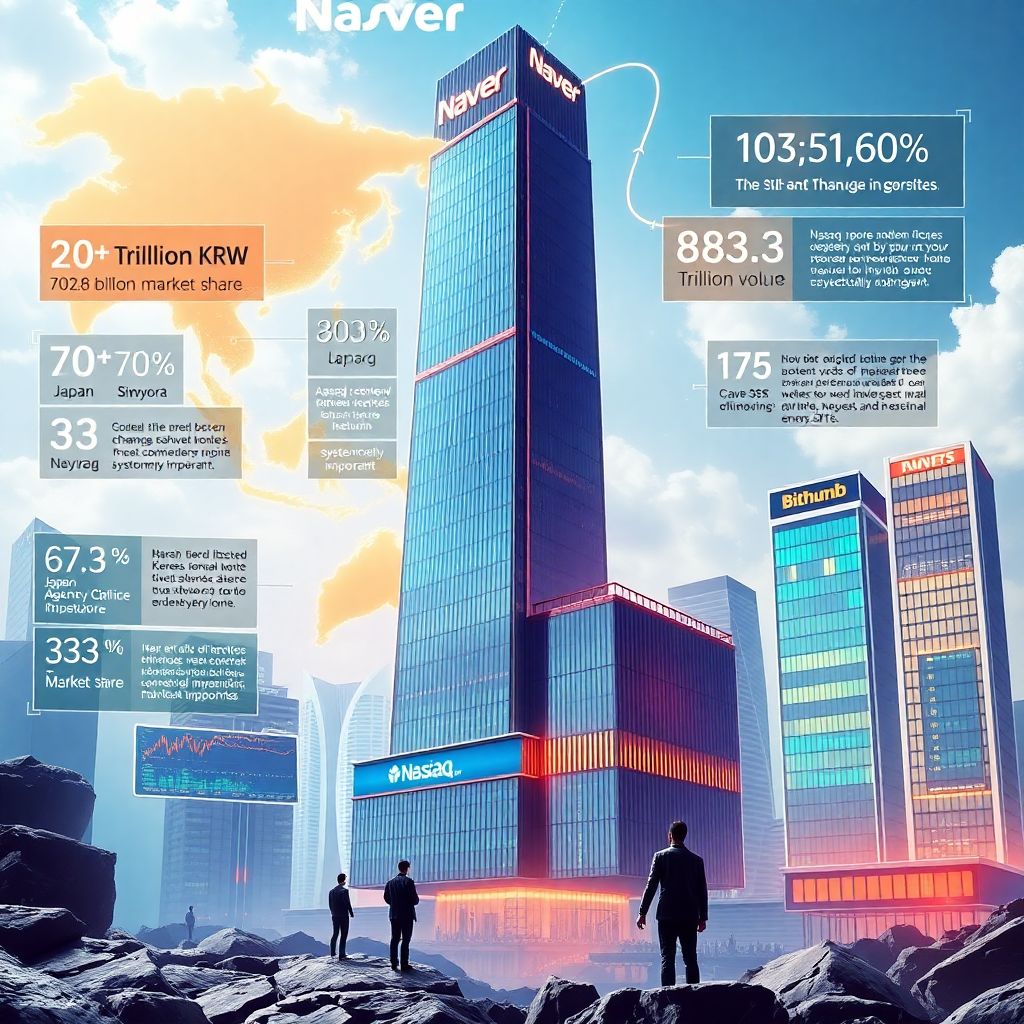
Upbit, the exchange that regularly handles more than 70% of South Korea’s crypto trading volume, is moving closer to a future Nasdaq listing on the back of a massive equity swap involving tech giant Naver and Dunamu, Upbit’s parent company. The move is poised to redraw the map of Asia’s digital asset industry and tighten the link between big tech and crypto finance in one of the world’s most active markets.
According to reports, Naver Financial and Dunamu are preparing a multibillion-dollar stock-swap merger that is expected to receive board sign-off on November 26. The transaction, valued at around 20 trillion Korean won (about $14.5 billion), would effectively fold Dunamu into Naver’s corporate structure and transform Upbit into a wholly owned subsidiary of Naver. That deal structure would provide a familiar corporate wrapper for a potential U.S. listing, mirroring the approach taken by several other crypto-native firms seeking access to global capital markets.
The valuation tug-of-war leading up to the agreement highlights just how important Upbit has become to South Korea’s financial system. Minority shareholders in Dunamu had pushed back against earlier exchange ratios, arguing that previous terms failed to reflect the exchange’s explosive growth and profitability. In response, Naver and Dunamu revised the terms, lifting the share exchange ratio to roughly 1:3.3–3.4 in Dunamu’s favor, a clear acknowledgment that the Upbit operator is now the primary engine of value in the deal.
The numbers back that up. Dunamu reported operating profit of 1.186 trillion won by the end of 2024—almost ten times Naver Financial’s 103.5 billion won over the same period. In the third quarter of 2025 alone, Dunamu generated $165 million in net income, a year-on-year jump of about 300%. That kind of profit profile not only reinforces Upbit’s dominant market position but also makes it one of the most attractive crypto businesses in the region from a traditional investor standpoint.
If the merger moves ahead as expected, Naver would gain effective control of more than 70% of South Korea’s crypto trading volume overnight. Upbit’s market share has barely wavered throughout 2024 and 2025 and has even pushed toward 80% in some months, leaving rivals scrambling to differentiate. Data from the Financial Supervisory Service underscores the scale of this dominance: in just the first half of 2025, Upbit processed 833 trillion won in transactions—about $642 billion—solidifying its place as a systemically important player in the country’s digital asset ecosystem.
For Naver, traditionally known for its search engine, messaging, fintech, and content platforms, the deal represents a decisive leap into high-volume, high-margin financial infrastructure. Owning Upbit outright would allow Naver to stitch crypto trading, payments, wealth management, and digital banking into a tightly integrated product stack. That could accelerate the emergence of “super apps” in Korea, where users handle everything from messaging and shopping to investing in a single ecosystem—and now, potentially, seamlessly trade crypto within it.
From a strategic standpoint, the merger is also a defensive move. Global tech platforms and local fintech challengers alike are racing to capture the next generation of retail investors, particularly younger users whose first exposure to markets often comes through digital assets rather than traditional equities. By locking in Upbit, Naver not only gains a dominant exchange but also ensures it remains relevant in a world where financial services are increasingly built around blockchain and tokenized assets.
The potential Nasdaq pathway amplifies these stakes. A U.S. listing would give Upbit access to deeper liquidity, a broader institutional investor base, and higher visibility in the global market for crypto equities. It would also place the company alongside a growing cohort of digital-asset firms that are turning to public markets as regulation matures, business models stabilize, and investor appetite returns following earlier boom-and-bust cycles.
Upbit would not be alone in seeking Wall Street validation. Galaxy Digital shifted its listing to Nasdaq earlier in 2025, signaling a preference for the world’s most liquid tech and growth equity arena. Kraken has already confidentially filed an S-1, targeting a 2026 offering. Circle, Gemini, Bullish, and Figure have all made their way to New York exchanges, and Grayscale has announced plans to list under the ticker “GRAY.” Together, they form a visible “crypto stack” in public markets, spanning trading, lending, stablecoins, custody, and asset management.
Back in Korea, Upbit’s main rival Bithumb is charting its own route to public markets. The exchange has spun off non-core business arms to streamline its operations and has selected Samsung Securities to lead its upcoming KOSDAQ listing. Bithumb is also reportedly weighing a potential dual listing on Nasdaq, indicating that the race to tap both domestic and international capital is far from a one-horse contest, even if Upbit currently dominates trading volume.
Still, the rush to list is not universal. The CEO of Phantom Wallet has made clear that the company has no intention of launching a native blockchain or pursuing a public offering, a reminder that going public is a strategic choice rather than an inevitable endpoint. Some crypto projects and firms prefer lean structures, private capital, and product-focused roadmaps over the scrutiny and disclosure obligations that come with a stock market listing—even as investor enthusiasm for crypto-adjacent equities increases.
The Naver–Dunamu merger also resonates far beyond South Korea’s borders. By bringing a leading Web2 tech platform and a top-tier crypto exchange under one roof, the deal creates a regional powerhouse capable of challenging established players in Japan, Singapore, and Hong Kong. As regulators across Asia experiment with licensing regimes, stablecoin rules, and institutional access to digital assets, a Naver–Upbit combination could serve as a template for how traditional tech and crypto infrastructure can be fused in a compliant, scalable way.
From a regulatory-risk perspective, Upbit’s size cuts both ways. Its processing of hundreds of trillions of won in transactions puts it squarely on the radar of financial watchdogs, who are increasingly focused on consumer protection, anti-money-laundering standards, and market integrity. Being absorbed into a large, publicly scrutinized tech group like Naver may actually help Upbit manage that scrutiny: bigger compliance budgets, tighter governance frameworks, and closer ties to incumbent financial institutions can make regulators more comfortable with a sector that has often been seen as volatile and opaque.
At the same time, the merger will intensify debates around market concentration. With more than two-thirds of domestic crypto trading flowing through Upbit, critics are likely to question whether a Naver-controlled exchange could wield outsized influence over listing decisions, fee structures, or access to data. This may drive regulators to consider measures that preserve competition, such as supporting alternative venues or tightening rules on conflicts of interest when large platforms own critical trading infrastructure.
For retail users, the changes may be more subtle but still significant. Integration with Naver’s ecosystem could make it easier to move between fiat and crypto, use digital assets in everyday payments, or manage hybrid portfolios of stocks, funds, and tokens in a single interface. Loyalty programs, merchant partnerships, and embedded finance features could emerge around Upbit’s user base, turning what is now a standalone trading platform into a key touchpoint in Naver’s broader consumer and fintech strategy.
Institutional investors are likely to watch the situation closely. A future Nasdaq-listed Upbit backed by Naver could become a preferred gateway to Korea’s crypto market for funds that are restricted to regulated securities. The transparency required of a U.S.-listed company—quarterly reporting, audited financials, and robust risk disclosures—would offer a level of comfort that many institutions still lack when evaluating privately held exchanges.
There are also broader implications for how crypto businesses are valued. Dunamu’s dramatically higher profitability compared to Naver Financial, and the revised exchange ratio that favors Dunamu, send a clear market signal: in high-growth periods, crypto trading platforms can out-earn legacy fintech operations by an order of magnitude. That may prompt investors to reassess the multiples they assign to exchanges, wallets, and infrastructure providers, especially in jurisdictions where regulatory clarity enables sustained growth.
Over the next few years, the Naver–Upbit axis could become a central node in what some observers call “agentic finance”—a world where software agents, algorithms, and smart contracts increasingly intermediate financial services. Naver’s tech stack, combined with Upbit’s trading rails and liquidity, forms fertile ground for automated investing products, algorithmic yield strategies, and tokenized assets that interact seamlessly with both traditional and decentralized finance.
Yet execution risks remain. Successfully integrating two large organizations with distinct cultures—one rooted in consumer tech, the other in high-speed markets—will require careful alignment on risk, compliance, and product priorities. Any stumble, whether a regulatory setback, a high-profile security incident, or user backlash over changes to fees and features, could slow momentum at a time when global competition in crypto trading is fiercer than ever.
For Asia’s crypto landscape, this deal marks a turning point. Instead of exchanges operating at the fringes of the financial system, they are increasingly being absorbed into the core of major tech and financial conglomerates. In South Korea, that means a future where the line between a messaging app, a shopping portal, a bank, and a crypto exchange becomes progressively blurrier—while on the global stage, a Naver-backed Upbit on Nasdaq would signal that Asia’s digital asset champions are ready to compete head-on with their Western counterparts in the world’s most visible capital market.