
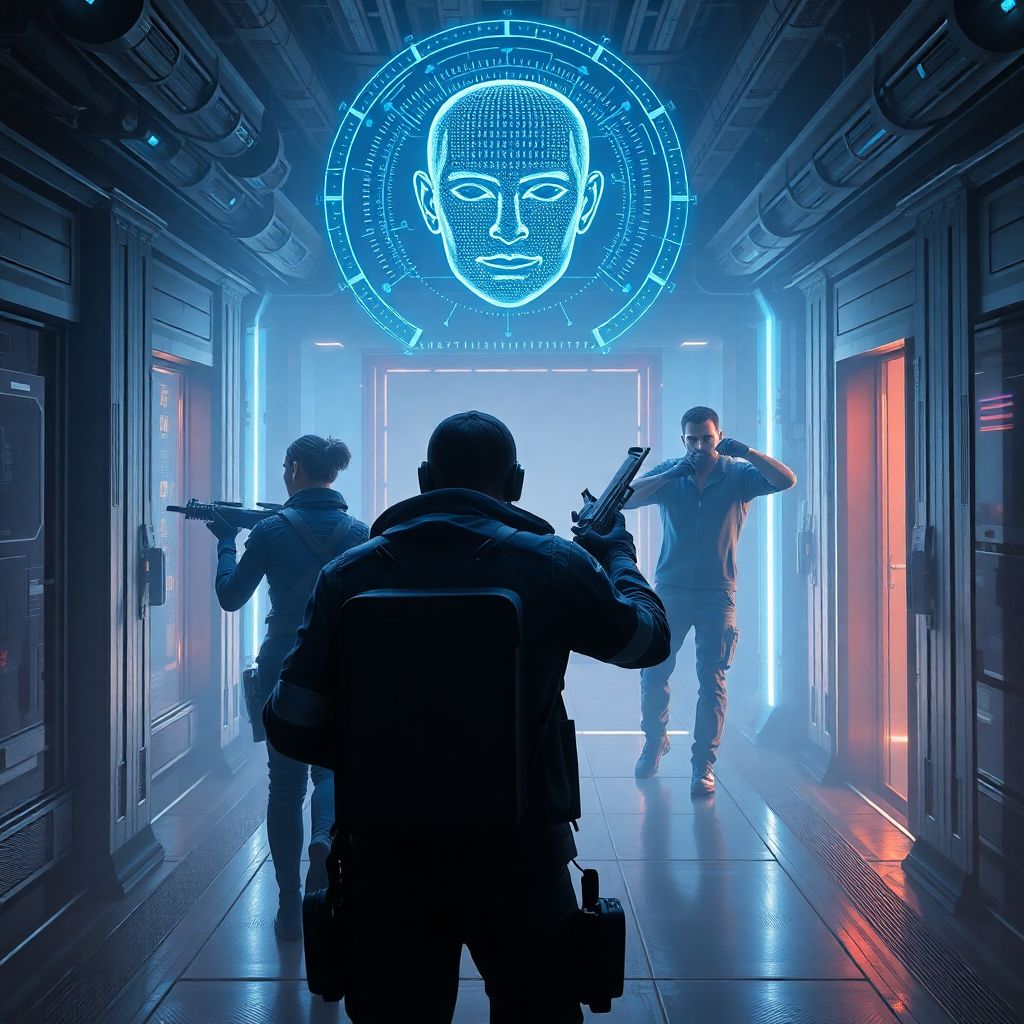
“Assassin’s Creed” publisher Ubisoft has taken a major step toward AI-native games, unveiling its first playable prototype built around generative AI. The experimental project, titled Teammates, uses real-time speech recognition and AI-generated dialogue to let players talk naturally to in-game characters and receive improvised responses on the fly.
Teammates builds directly on Ubisoft’s Neo NPC experiment showcased last year, but pushes the concept further. Instead of relying solely on pre-written dialogue trees and scripted triggers, the demo uses generative AI to power live voice commands, allowing characters to react dynamically to what the player says, not just which button they press. The goal, according to Ubisoft, is to create deeper immersion by making interactions feel less like pre-programmed lines and more like a conversation.
The demo is set in a dystopian future and plays out as a first-person shooter mission. You take on the role of a resistance fighter infiltrating an enemy facility to locate five missing teammates. The narrative setup is familiar, but the way you progress is not: instead of selecting dialogue options from a wheel, you simply speak into your microphone to coordinate with your squad, ask questions, or give orders.
Within this experimental level, Ubisoft has built out three AI-enhanced characters. The first is Jaspar, an AI voice assistant who acts as your guide and mission support. Jaspar can respond to spoken queries, remind you of objectives, clarify mission details, or provide tactical suggestions based on what you’re doing. In effect, Jaspar is the in-universe interface between the player and the game’s systems, wrapped in a character rather than a static UI.
Alongside Jaspar are two AI-supported NPC squad members, Sofia and Pablo. These characters are designed to respond to natural language commands and conversational prompts: you might ask Sofia to cover a doorway, tell Pablo to check a room, or query both about what they’ve seen so far. Rather than selecting “Follow me” or “Hold position” from a short list, you can phrase your instructions in your own words, and the AI system interprets and turns them into in-game actions.
This is where generative AI changes the traditional formula. In a conventional shooter, squadmates operate on rails: they cycle through a handful of voice lines, follow predetermined paths, and only react to specific triggers. In Teammates, Ubisoft is experimenting with NPCs that listen and adapt in real time, generating new lines of dialogue rather than pulling from a fixed library. The company argues this could make every playthrough feel less scripted and more personal.
Under the hood, the system ties together several technologies. Speech recognition turns the player’s spoken words into text; a generative language model interprets the intent and crafts a response appropriate to the situation; then voice synthesis brings that response to life in the character’s voice. All of that has to happen quickly enough that it feels like a natural exchange instead of a laggy back-and-forth, which is one of the central technical challenges Ubisoft is exploring with this project.
Teammates is explicitly framed as a research prototype, not a full commercial game. Ubisoft is using it as a testbed to understand how players actually use voice-driven systems, where the technology enhances the experience, and where it breaks immersion. Issues such as tone consistency, character personality, and narrative coherence become crucial when dialogue is not fully hand-authored. The studio needs to ensure that Sofia still sounds like Sofia—even when the AI is improvising her lines.
The choice of a resistance mission in a hostile base is also deliberate. It provides a controlled environment with clear stakes—stealth, combat, search and rescue—where voice commands make intuitive sense. In stressful or fast-paced scenarios, players might naturally shout instructions like “Take cover!” or “Watch that corridor!” Teammates turns those impulses into actual gameplay inputs, testing whether this feels empowering or chaotic in practice.
From a design perspective, generative AI opens both opportunities and new problems. On the positive side, it promises more reactive allies, richer banter, and the possibility of NPCs who remember what you said earlier and reference it later in the mission. It could reduce reliance on rigid dialogue trees and allow writers to focus on defining character rules, motivations, and boundaries instead of manually scripting every single line.
On the other hand, there are big creative and ethical questions. How do you prevent AI-driven characters from going off-theme or breaking the lore? How do you moderate what the player can say and what the game will respond to? Ubisoft must implement strong guardrails so that generative systems stay within age ratings, narrative constraints, and the studio’s standards for tone and safety. That means blending AI generation with curated prompts, style guides, and human-authored anchors.
Voice acting is another sensitive area. Teammates shows that AI can plausibly generate dialogue at scale, raising questions about how this technology will coexist with human performers. Studios may choose hybrid models where actors define a character’s core identity—recording key lines, emotions, and reference performances—while AI handles low-stakes chatter or reactive lines that would otherwise be too expensive to handcraft. How this balance is struck will shape the future of narrative production in games.
Technically, latency and reliability will determine whether systems like Teammates are truly viable. A delayed response from Sofia or Pablo can be more immersion-breaking than a simple button prompt. Ubisoft’s experiment has to prove that quick, contextually accurate replies are possible even on consumer hardware and variable connections. If it works smoothly, players may come to expect this level of responsiveness in more genres, from open-world adventures to tactical strategy games.
Accessibility and inclusivity are also part of the conversation. Voice-based systems could offer new ways for players with limited mobility to control games, replacing complex button combinations with natural commands. At the same time, they must account for different accents, speech patterns, and environments where speaking aloud isn’t practical. Ubisoft will likely need multiple input modes so that AI-enhanced NPCs are helpful extras, not mandatory gatekeepers to core features.
Looking forward, projects like Teammates hint at a future where NPCs become collaborators rather than scripted props. Imagine open-world games where guards remember prior encounters with you in more than a binary “hostile/friendly” way, or party members in RPGs who discuss your choices without needing thousands of pre-written lines. Ubisoft’s prototype doesn’t solve all of that yet, but it demonstrates a tangible step: characters that respond not to fixed menus, but to what you actually say.
By debuting Teammates, Ubisoft is signaling that generative AI will not just live in backend tools and content pipelines—it will increasingly shape the moment-to-moment feel of playing a game. This first-person resistance mission, with its AI assistant Jaspar and improvising squadmates Sofia and Pablo, serves as an early glimpse of how AI-driven dialogue could redefine immersion, agency, and the relationship between players and the worlds they explore.
Комментарии