
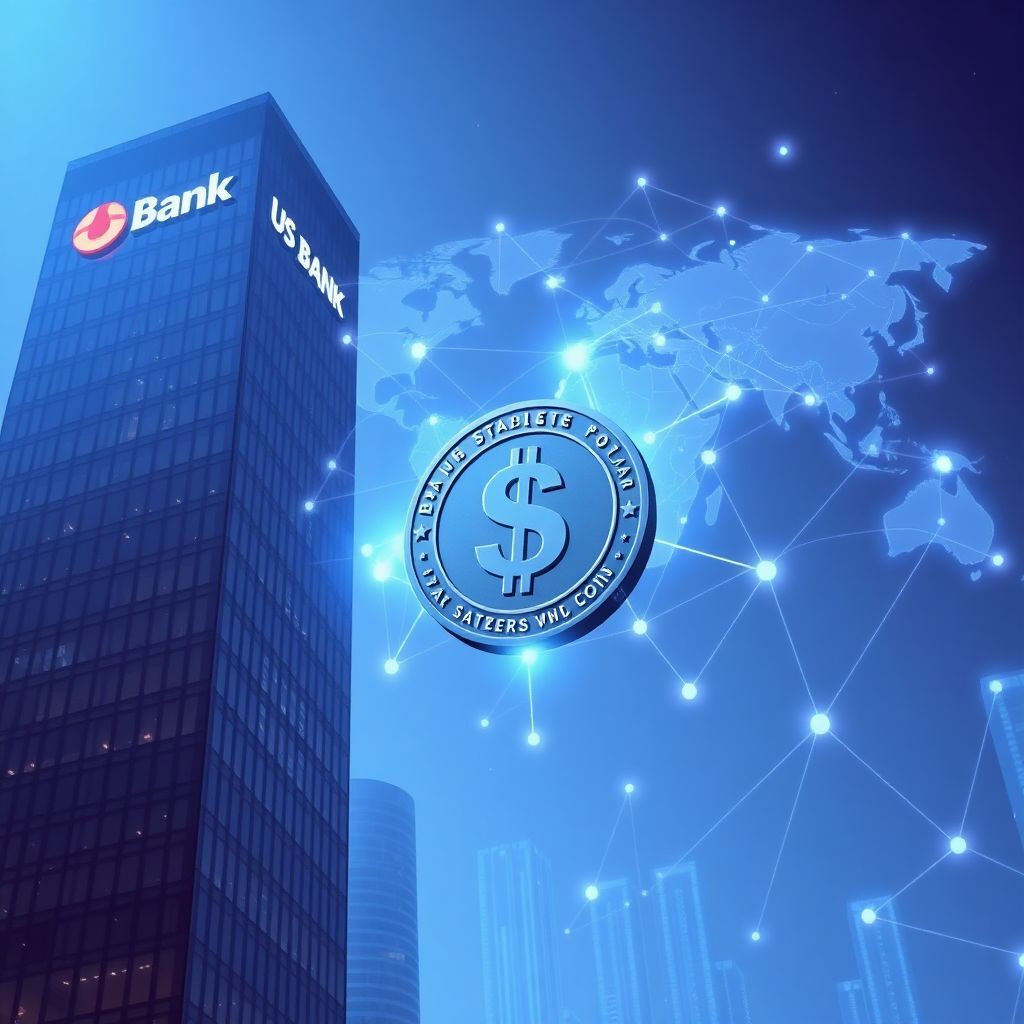
US Bank, one of the largest publicly traded banks in the United States, has begun testing its own stablecoin on the Stellar blockchain, signaling another significant step by traditional finance into blockchain-based payments.
The pilot project is being developed in partnership with consulting heavyweight PwC and the Stellar Development Foundation, the organization behind the Stellar network. The initiative aims to explore how a bank-issued stablecoin can streamline payments and settlement, using blockchain as an alternative to legacy payment rails.
Mike Villano, senior vice president and head of digital asset products at US Bank, described the effort as part of a broader strategy to integrate blockchain into the bank’s core services. Speaking on the Future of Finance podcast, he said the bank views blockchain “as an alternative payment rail” and is focused on understanding “what use cases are going to manifest from that and what customers are going to be most interested in.”
By building and testing a stablecoin rather than simply integrating existing ones, US Bank is positioning itself to retain control over key aspects of compliance, settlement, and customer experience. A bank-issued token could be directly linked to deposits held at the bank, making it potentially more attractive to corporate clients, fintech partners, and institutions that already trust traditional banks as custodians of their funds.
This move places US Bank among a growing cohort of major banks exploring stablecoin issuance and blockchain infrastructure, particularly in the wake of the GENIUS Act. The new law creates a regulatory framework for the issuance and trading of stablecoins, reducing some of the legal ambiguity that previously discouraged banks from entering the space. With clearer rules, institutional interest has accelerated, and established financial institutions now see an opportunity to compete with crypto-native stablecoin issuers.
Stellar, the blockchain chosen for this pilot, is known for its focus on fast, low-cost transfers and cross-border payments. Its architecture was designed with financial institutions and remittances in mind, making it a logical testbed for a bank experimenting with digital money movement. For US Bank, Stellar’s emphasis on interoperability and compliance-friendly features may be more appealing than public chains that prioritize programmability over settlement finality and regulatory alignment.
From a practical perspective, a US Bank stablecoin on Stellar could enable near-instant settlement between the bank and its clients or partners, reducing reliance on slower systems like wire transfers or ACH. Corporate treasurers, for example, could use such a token to move liquidity between accounts, subsidiaries, or counterparties in minutes instead of days, with full on-chain traceability.
The pilot also gives US Bank a controlled environment to examine operational questions: how to handle issuance and redemption, how on-chain transfers reconcile with core banking ledgers, how compliance checks such as KYC and AML are enforced in real time, and how customers might interact with tokenized bank money through existing or new interfaces.
At the same time, the collaboration with PwC and the Stellar Development Foundation suggests that US Bank is not approaching this purely as a technical experiment. PwC can help map regulatory, risk, and accounting implications, while the Stellar team can advise on network-level integration, smart contract design (where applicable), and best practices for asset issuance on the chain.
The timing of this initiative reflects a broader strategic recalibration in traditional finance. For years, many large banks watched the stablecoin market from the sidelines, while private firms built multi-billion-dollar tokens used across exchanges and decentralized finance. Now, with regulation catching up and enterprise demand for tokenized money growing, banks are increasingly unwilling to leave this territory uncontested.
If the US Bank pilot proves successful, it could lay the groundwork for a suite of products built around tokenized deposits and on-chain settlement. Potential use cases include:
– Real-time domestic and cross-border payments for corporate clients.
– On-chain escrow and programmable payouts for trade finance or supply chains.
– Faster settlement between fintech platforms and the bank’s infrastructure.
– Tokenized cash management tools for institutional investors.
There are also strategic defensive reasons for a bank to move into stablecoins. As more value circulates in tokenized form, institutions that lack a native on-chain asset risk becoming less relevant to clients who expect instant, programmable money. A bank-issued stablecoin provides a bridge between existing regulated deposit systems and emerging blockchain-based financial rails.
However, the project is not without challenges. US Bank must ensure that its stablecoin design aligns with the GENIUS Act’s requirements on reserves, disclosures, and consumer protections. It also needs to address cybersecurity, smart contract risk, and operational resilience, given that any failure in a bank-backed token would have reputational and possibly systemic consequences.
Another open question is interoperability. While the pilot is on Stellar, customers may expect the ability to move value across multiple chains and platforms. That raises considerations about whether the stablecoin remains native to Stellar, is bridged or wrapped to other networks, or integrated into broader tokenization platforms that support many blockchains.
In addition, US Bank will need to carefully manage how this on-chain asset fits into its balance sheet and capital requirements. Depending on how regulators classify bank-issued stablecoins—whether as tokenized deposits, payment instruments, or something else—different prudential rules could apply, influencing the scale and structure of any future rollout.
For customers, the immediate impact of the pilot may be limited, as banks typically test such products with selected partners first. But over time, if US Bank moves from testing to production, clients could gain access to faster payments, improved transparency into settlement, and potentially lower transaction costs, especially in high-volume or cross-border contexts.
The initiative also sends a signal to the broader market: blockchain-based payment rails are no longer a niche curiosity for crypto startups alone. As more large banks like US Bank invest in stablecoin pilots, the line between traditional finance and digital asset infrastructure will continue to blur, accelerating the shift toward programmable, always-on money.
For now, US Bank is in exploration mode, using the Stellar network to understand what a bank-grade stablecoin might look like in practice. The results of this pilot—both the technical findings and the customer feedback—are likely to influence how other institutions approach their own digital money strategies in the era shaped by the GENIUS Act and expanding institutional demand for regulated stablecoins.