
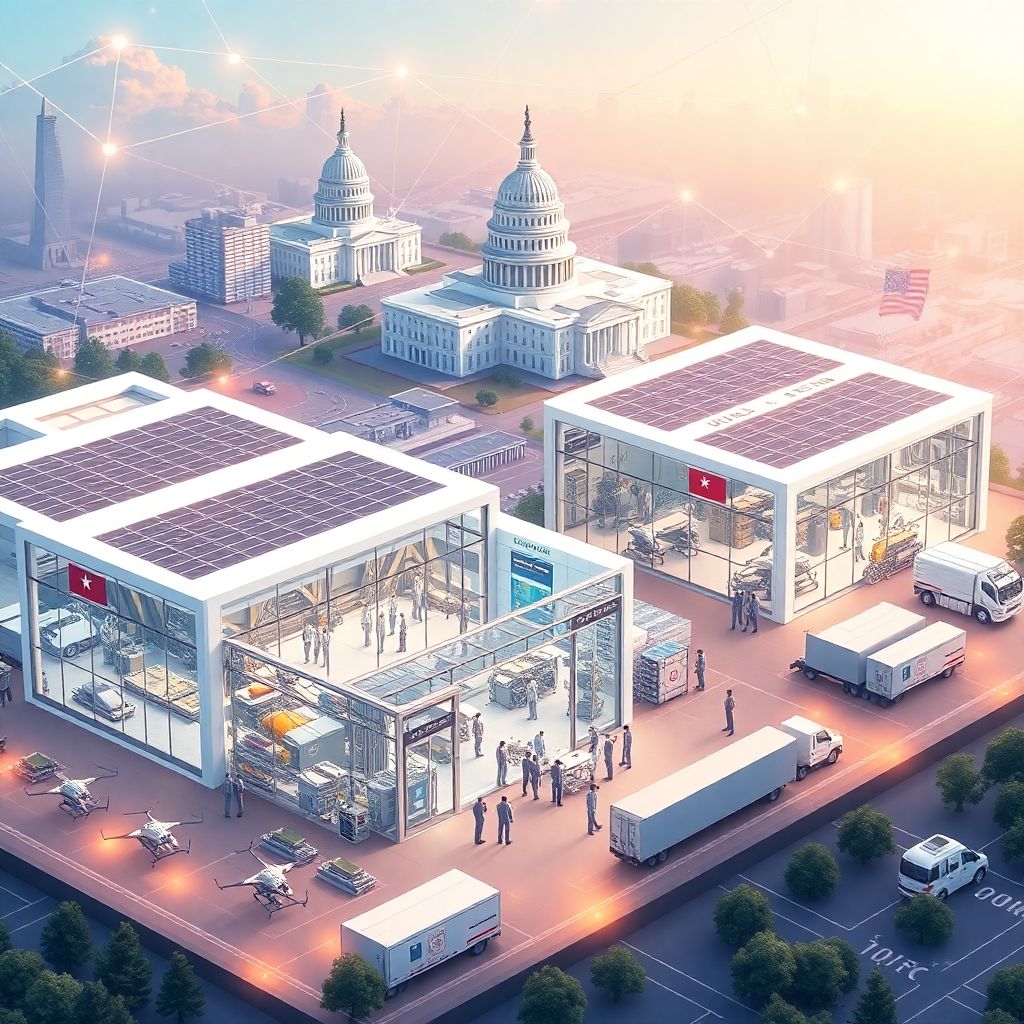
Trump administration officials are exploring a trade agreement with Taiwan that could reshape the geography of the global chip industry by pulling a significant slice of Taiwanese semiconductor production onto U.S. soil. The core idea behind the talks is straightforward: if more cutting‑edge chips are manufactured inside the United States, the country’s dependence on foreign fabrication plants for critical technology would decline, strengthening both economic resilience and national security.
According to people familiar with the negotiations, the draft framework envisions Taiwanese semiconductor companies building and operating manufacturing facilities in the U.S. on a large scale. These operations would not be symbolic outposts, but capital‑intensive plants involving investments worth billions of dollars. Along with money, Taiwan would also export talent: technical specialists and engineers would relocate to the U.S. to stand up new fabs, run advanced production lines, and train American workers to maintain and eventually lead these operations.
In essence, Washington is trying to buy time and know‑how. Rather than waiting years for a purely domestic ecosystem to mature, the U.S. would import Taiwan’s decades of experience in mass‑producing high‑end chips. If successful, this approach could accelerate the development of a robust American semiconductor manufacturing base and help close the gap with Asian production hubs that currently dominate the market.
The structure under discussion aims at one central goal: building meaningful domestic capacity in advanced chipmaking. U.S. companies are global leaders in chip design and semiconductor equipment, but much of the actual fabrication takes place abroad, particularly in Taiwan. By hosting Taiwanese fabs and integrating their operations with U.S. suppliers and talent, the administration hopes to create a more self‑sufficient supply chain for everything from smartphones and data centers to military hardware and critical infrastructure.
This initiative is part of a wider push by Washington to secure supply chains for strategically important technologies. The global chip shortage of recent years, compounded by pandemic disruptions and geopolitical tensions, exposed the fragility of a system where a handful of foreign facilities produce components that power vast swaths of the U.S. economy. The Trump administration sees closer industrial cooperation with Taiwan as one lever to reduce the risks of future bottlenecks, export controls, or geopolitical flare‑ups affecting chip flows.
Yet, beyond the broad vision, nearly all specifics remain unsettled. Negotiators have not finalized how much capital will ultimately be committed, which particular Taiwanese semiconductor firms will sign on, or where in the U.S. any new plants would be built. Timelines for breaking ground, ramping up production, and achieving meaningful output are still vague, with insiders likening current roadmaps to aspirational product slides rather than firm construction schedules.
From an industrial perspective, the stakes are enormous. Building an advanced semiconductor fab is among the most complex and expensive manufacturing projects in the world. Facilities can cost tens of billions of dollars, take years to construct, and require stable policy, reliable energy, abundant water, and a highly trained workforce. Any trade deal that attempts to transplant such an operation will have to grapple with land use, regulation, tax incentives, environmental standards, and long‑term commitments on both sides of the Pacific.
For the United States, success would mean more than just new buildings and jobs. If Taiwanese manufacturers bring leading‑edge process technology, the U.S. could regain influence over the standards and roadmaps that define future chip generations. Co‑locating fabs with American designers and equipment suppliers could nurture innovation clusters where new architectures, materials, and production techniques are conceived and tested more quickly.
However, this strategy also faces structural challenges. U.S. manufacturing costs—labor, construction, compliance—are generally higher than in many parts of Asia. To persuade Taiwanese firms to shift substantial production capacity, Washington will almost certainly have to offer an aggressive mix of subsidies, tax breaks, and regulatory guarantees. Even then, companies will carefully weigh U.S. incentives against the benefits of staying closer to their existing supply networks and domestic workforce in Taiwan.
There is also a geopolitical calculus. Taiwan’s semiconductor industry is not just an economic engine; it is widely viewed as a strategic asset that underpins the island’s role in the global economy. Moving too much capacity offshore could be politically sensitive in Taipei, raising debates about jobs, technological sovereignty, and national leverage. Any agreement will need to walk a narrow line: deepening U.S.–Taiwan industrial ties without appearing to hollow out Taiwan’s own manufacturing base.
A related signal of Taiwan’s evolving economic strategy came earlier this month, when legislator Dr. Ko Ju‑chun announced that the Executive Yuan and the central bank had agreed to study whether Bitcoin could be incorporated into the nation’s strategic reserves. While only an exploratory move, it underscores Taipei’s willingness to consider unconventional financial and technological tools as it navigates a more contested global landscape. In this context, closer cooperation with the U.S. on semiconductors can be seen as part of a broader effort by Taiwan to diversify its strategic options.
For the U.S. semiconductor sector, the potential upside of the proposed trade deal is significant but conditional. In the short to medium term, American firms could gain better access to advanced fabrication capacity located within the country’s borders, easing supply constraints and lowering geopolitical risk. Over time, knowledge transfer from Taiwanese engineers could help build a stronger native workforce proficient in the day‑to‑day realities of running leading‑edge fabs, from yield optimization to process control.
At the same time, the initiative does not automatically guarantee a renaissance of fully homegrown U.S. chipmaking. If the new facilities remain tightly controlled by foreign parent companies, with key process innovations still centralized abroad, the domestic ecosystem could end up dependent on external decision‑making even as production volumes rise. The true test will be whether American engineers, managers, and suppliers are deeply integrated into the core of these operations rather than relegated to supporting roles.
There are also risk factors that U.S. policymakers cannot ignore. Heavy reliance on subsidies to attract foreign fabs may trigger a competition among states and countries to offer ever‑larger incentive packages, distorting markets without necessarily delivering sustainable advantages. Additionally, if future U.S. administrations change course or if political frictions grow, Taiwanese investors might question the durability of any commitments made today.
From the Taiwanese side, expanding in the U.S. could bring valuable strategic cover. A more geographically diversified manufacturing footprint can serve as a hedge against regional instability, natural disasters, or trade disruptions. Aligning more closely with U.S. industrial policy may also strengthen political ties at a time when security questions around the Taiwan Strait loom large. Still, companies must balance these benefits against complex logistical, cultural, and regulatory challenges of operating in a very different environment.
Another factor that could shape perceptions of the proposed deal is the broader financial and technological posture of figures associated with the Trump orbit. Reports that the Trump family’s crypto holdings have recently suffered a sharp decline in value, and that a Bitcoin reserve linked to Trump is currently underwater and not subject to formal audits, highlight how volatile and opaque parts of the digital asset world can be. While not directly tied to semiconductor policy, these developments may color how markets and foreign partners view the risk appetite and financial transparency norms surrounding U.S. political leadership.
Looking ahead, whether a Taiwan trade agreement can truly boost the U.S. semiconductor sector will depend less on headline announcements and more on execution. If the deal yields functioning, high‑volume fabs in the United States, staffed by a growing cadre of skilled American workers and integrated into a competitive domestic supply network, it could mark a turning point. The U.S. would still operate within an interdependent global system, but with a stronger foundation at home.
If, however, the negotiations stall, the incentives prove inadequate, or the projects shrink into modest pilot operations, the impact will be far more limited. In that scenario, the U.S. might still gain some marginal resilience, but not the transformative shift in manufacturing capacity that policymakers are hoping for.
In practical terms, the prospective agreement should be seen as a necessary but not sufficient condition for revitalizing America’s semiconductor manufacturing base. It can import expertise, accelerate facility build‑out, and tighten strategic links with a crucial partner. Yet long‑term success will also require sustained domestic investment in education, research, infrastructure, and supply‑chain depth, far beyond a single bilateral deal.
So the answer to whether this trade arrangement can boost the U.S. semiconductor sector is: it can, if designed and implemented with clear long‑term commitments on both sides. The combination of Taiwanese manufacturing excellence and U.S. technological strength offers genuine potential. Realizing that potential, however, will demand more than aspirational frameworks—it will require concrete projects, predictable policy, and a willingness to shoulder the enormous costs and complexities of building the future’s factories at home.