
Solana price flashes bullish technical signals as ETF demand offsets market weakness
Solana’s recent price action is drawing attention from traders as several key indicators hint at growing buyer interest, even while the asset hovers near a critical support zone. The combination of a bullish momentum divergence, improving money flow, and persistent ETF inflows is creating the groundwork for a potential reversal — but confirmation still hinges on a decisive move above resistance.
Bullish RSI divergence at a critical juncture
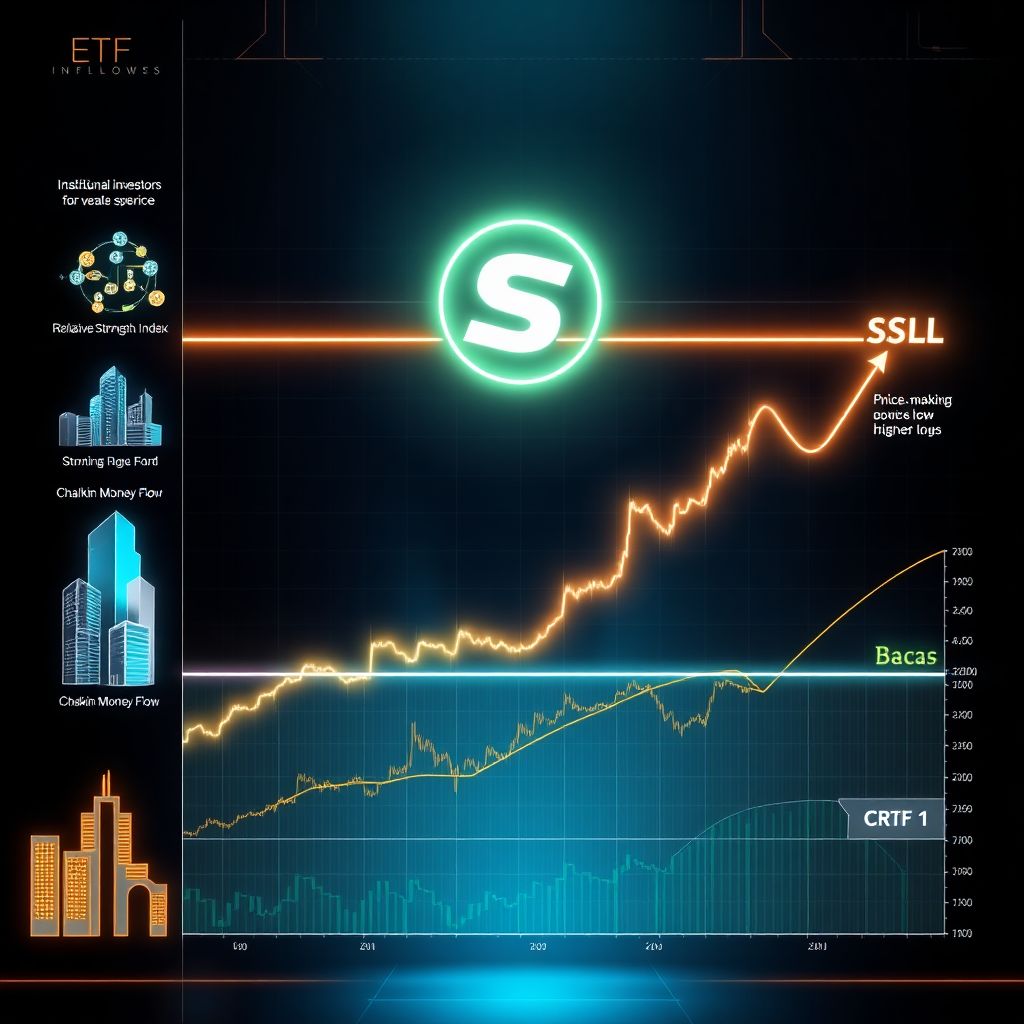
On the price chart, Solana (SOL) has printed a lower low between mid‑November and early December. Under normal circumstances, lower lows in price often confirm a bearish trend. However, Solana’s Relative Strength Index (RSI) told a different story: instead of following price downward, the RSI formed a higher low over the same period.
This pattern, known as bullish RSI divergence, suggests that selling momentum is weakening even as price makes new short‑term lows. The RSI, a widely used momentum oscillator, helps traders gauge whether an asset is oversold or overbought. In this case, the higher low on the RSI implies that bears are losing control and that buyers may be quietly stepping back in.
For many technical traders, such divergence at or near an established support zone is often viewed as an early sign of a possible trend shift. It doesn’t guarantee a rally on its own, but it shifts the risk‑reward profile in favor of those betting on a bounce rather than a continued breakdown.
Chaikin Money Flow hints at renewed accumulation
Reinforcing the positive momentum signal is the behavior of the Chaikin Money Flow (CMF) indicator. Recent readings show the CMF turning higher and moving toward a key descending trendline that has guided money flow over previous weeks.
The CMF incorporates both price and volume to estimate whether capital is flowing into or out of an asset. A rising CMF typically reflects accumulation, especially if it crosses above its trendline or into positive territory. According to the analysis, a clean break above that CMF trendline would highlight a meaningful shift toward net buying pressure, often associated with institutional or large‑ticket investors.
When a bullish RSI divergence appears at the same time as an improving CMF, traders often interpret this confluence as a stronger foundation for a potential reversal. Momentum, volume, and capital flow start to align in favor of the bulls — but the price still has to respond accordingly.
Long‑term weekly support remains intact — for now
One technical analyst pointed out that Solana is currently testing a major weekly support trendline that has been in play since 2023. Each time price has touched this rising support in the past, the market has generated notable rebounds, highlighting the level’s historical importance.
This long‑term trendline essentially marks the boundary between Solana’s broader uptrend and a deeper structural breakdown. As long as price holds above it on a weekly closing basis, the macro bullish structure can be argued to remain intact. A sustained bounce from this zone, especially with the current bullish divergences, would strengthen the case for a medium‑term recovery.
However, if SOL were to close decisively below this trendline, it would not only invalidate the current bullish RSI and CMF setup, but also raise concerns about a more prolonged downtrend and a potential re‑pricing toward lower historical demand areas.
ETF inflows signal resilient institutional interest
Beyond pure price action, Solana’s investment flows are showing surprising resilience. Spot exchange‑traded products tracking SOL have recorded net positive inflows for several consecutive weeks. The only notable pullback in demand appeared briefly in early December and was relatively minor compared to the broader inflow trend.
Cumulatively, these ETF inflows have grown to substantial levels, reflecting sustained interest from institutions and professional market participants. Even while Solana’s price has faced selling pressure, ETF products have continued to absorb supply, acting as a partial buffer against sharper declines.
Such behavior often suggests that larger players are using periods of weakness to build or maintain exposure, rather than abandoning the asset. For traders, this can be an important backdrop: when on‑chain or technical weakness contrasts with persistent institutional buying, market bottoms can form faster than sentiment might suggest.
How ETF demand can influence price dynamics
Spot ETFs, by design, require direct exposure to the underlying asset to back issued shares. When inflows outpace redemptions, ETF providers must acquire more SOL, effectively reducing the liquid supply available on exchanges.
In an environment where ETF demand remains robust while speculative derivatives activity cools, this supply absorption can mute downward volatility. It doesn’t guarantee immediate rallies, but it can slow sell‑offs and create a more favorable platform for upside once sentiment turns.
Conversely, if ETF inflows were to reverse into sustained outflows while price still sat near key support, that would undermine one of the main pillars currently underpinning Solana’s market structure. For now, though, the inflow trend continues to lean supportive.
On‑chain activity and narrative drivers
Fundamental and ecosystem developments are also contributing to Solana’s current narrative. Network usage has increased on the back of several high‑profile initiatives and a revival of speculative activity.
One notable example is the tokenization of prediction market products on Solana, which highlights the chain’s performance advantages and growing appeal for financial primitives. At the same time, newer meme‑style tokens such as Pippin have started gaining attention, historically a signal that retail traders are returning and risk appetite is rising.
While meme tokens are often dismissed as purely speculative, they tend to correlate with increased transaction volumes, active wallets, and trading activity across the broader ecosystem. For Solana, this type of engagement helps reinforce its status as a high‑throughput, low‑fee chain where both serious builders and speculative traders coexist.
Resistance remains the decisive line in the sand
Despite these constructive signals, technical analysts emphasize that Solana still has a clear hurdle to overcome. A key resistance level — which has repeatedly capped rallies since late November — continues to act as a ceiling for price.
The last meaningful close above this resistance occurred earlier in the month, but buyers failed to maintain momentum, allowing bears to regain control. Analysts now argue that for a genuine reversal to be confirmed, SOL must not only wick above this level intraday but close decisively above it on the daily and ideally weekly timeframes.
Such a breakout would complete the bullish setup implied by the RSI divergence and rising CMF, turning a tentative bottoming pattern into a confirmed trend reversal. It would also signal that buyers have absorbed the overhead supply that previously caused repeated rejections.
Potential upside and downside scenarios
If Solana successfully breaks and holds above the current resistance band, chart structures suggest that price could revisit higher zones that previously acted as rejection areas. These zones often become natural targets for swing traders, including former local highs and key Fibonacci retracement levels of the prior downtrend.
In a bullish scenario, sustained trade above resistance could invite momentum buyers, trigger short covering from over‑leveraged bears, and further amplify the impact of ETF inflows. Together, these forces would create a feedback loop in favor of higher prices.
On the other hand, a daily or weekly close below nearby support — and particularly below the long‑term weekly trendline — would significantly damage the bullish case. It would invalidate the current divergence setup, suggest that ETF demand was insufficient to counteract broader selling, and potentially open the door to a deeper retracement as sidelined buyers wait for clearer signs of stabilization.
How traders may interpret the current setup
For short‑term traders, the present conditions often translate into a tactical range‑trading environment: buy near support with tight invalidation, and take profits or reduce risk as price approaches the defined resistance band. Indicators such as RSI and CMF offering bullish cues can justify limited risk entries, but only if traders respect the possibility of a breakdown.
Swing and position traders, especially those aligned with institutional flows, may be more focused on confirmation rather than anticipation. They tend to seek a weekly close above resistance before upgrading their bias from “potential bottoming process” to “confirmed trend reversal.” Until then, the market can remain choppy and prone to false starts.
Long‑term holders, by contrast, might view the confluence of strong ETF inflows, durable weekly support, and growing network activity as validation that the core thesis around Solana’s ecosystem remains intact, even if short‑term volatility persists.
Broader market context and macro headwinds
Solana’s price behavior also needs to be viewed against a backdrop of wider crypto market uncertainty. While ETF inflows and on‑chain growth provide localized support, macroeconomic factors, regulatory developments, and liquidity conditions across digital assets can still exert pressure.
If risk assets as a whole face a downturn — for example, due to tighter monetary policy or a flight to safety — even strong individual projects like Solana may struggle to sustain rallies. In such phases, technical setups can fail more frequently, and support zones can break despite seemingly favorable indicators.
This is why many analysts underscore the need for confirmation through price rather than relying solely on indicators. A resilient breakout in a tough macro environment tends to be a stronger signal than optimistic divergences that never convert into higher highs.
What to watch next for Solana
Going forward, several key variables are likely to shape Solana’s near‑term trajectory:
1. Price reaction at weekly support: Whether the long‑standing trendline continues to hold or finally gives way will be central to the medium‑term outlook.
2. Behavior around resistance: Multiple rejections would suggest prolonged consolidation or downside risk, while a firm breakout would favor a recovery narrative.
3. RSI and CMF follow‑through: If these indicators continue to improve and confirm a shift in momentum and money flow, they will add weight to any bullish price action.
4. ETF flow patterns: Continued net inflows would reinforce institutional conviction; a sharp reversal to outflows would weaken one of the primary support pillars.
5. On‑chain and ecosystem activity: Sustained growth in active users, transactions, and new projects will help justify higher valuations over time rather than purely speculative spikes.
Conclusion: A constructive setup waiting for confirmation
Solana currently sits at a crossroads where technical indicators, institutional flows, and network activity are leaning bullish, while the broader market backdrop remains fragile. Bullish RSI divergence, an improving Chaikin Money Flow, and persistent ETF demand collectively hint that selling pressure may be exhausted near current levels.
Yet, the market has drawn a clear line: until Solana closes convincingly above the resistance band that has capped rallies since late November, the move from potential bottoming to confirmed reversal remains incomplete. The next decisive break — above resistance or below support — is likely to define Solana’s next major chapter, whether that is a renewed uptrend or an extended correction.