
After staging his own demise earlier this year, Jeffy Yu—the mind behind the once-popular AI musician Zerebro—has re-emerged with a new provocation: an AI-generated philosophical manifesto and an accompanying Solana-based meme coin.
The text, titled “Physical Limits of Intelligence” (PLOI), is presented as a kind of techno-futurist treatise written with the help of artificial intelligence. In parallel, a token with the same name launched on Solana and briefly ignited speculative fervor before cooling off.
From fake death to financial experiment
Yu’s earlier stunt—faking his own death and disappearing from public view—positioned him as one of the more controversial figures at the intersection of AI art and crypto culture. Now, his return is marked not by music, but by a blend of philosophy, performance art, and high-risk finance.
The PLOI token quickly gained traction, rocketing to a market capitalization of about 5.4 million dollars shortly after launch. That surge didn’t last: the valuation later slid to around 1.1 million dollars, illustrating just how violently such meme coins can swing in both directions.
One of the more notable early participants, a trader operating under the name PainCrypt0, reportedly turned a 2,634-dollar entry into more than 26,800 dollars in realized profit, according to on-chain analytics. That kind of outsized gain is emblematic of the speculative lottery that meme coins have become, especially on fast, low-fee chains like Solana.
The AI-written manifesto: a different kind of AI take
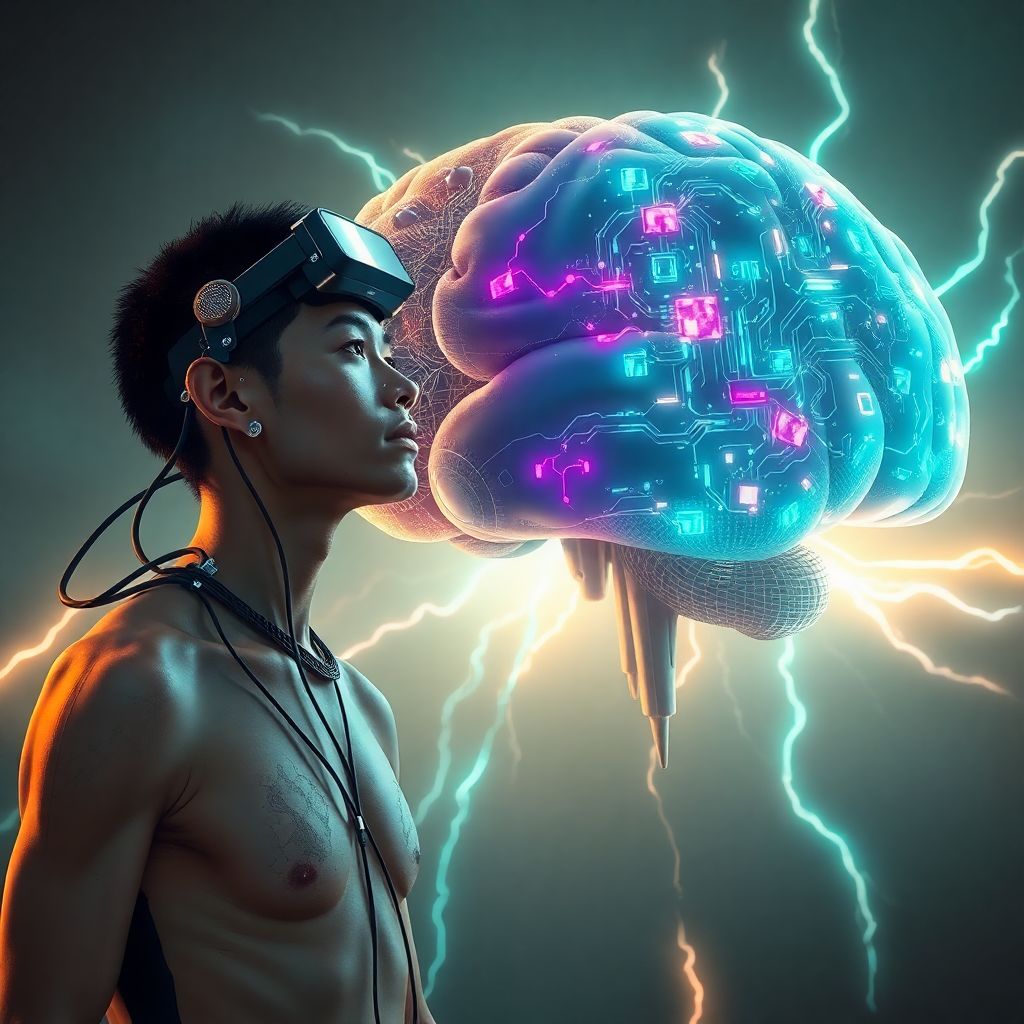
Unlike many techno-optimist tracts that forecast superhuman artificial general intelligence wiping the floor with humanity, the PLOI manifesto takes a more counterintuitive stance. It argues that AI, in isolation, will not surpass human-level intelligence in the way it is often portrayed. Instead, the document proposes that the real breakthrough will come from a gradual fusion of biological humans and artificial systems.
The core thesis is that intelligence is bounded by physical constraints: neurons, energy, hardware, time. Rather than expecting disembodied AI entities to simply vault past humans on purely digital substrates, the manifesto envisions a future in which humans and machines progressively interweave—biologically, chemically, and surgically.
In that imagined future, “intelligence” stops being something that belongs to either humans or machines alone. It becomes a shared, hybrid property, emerging from implants, neural interfaces, chemical enhancements, and advanced prosthetics working in tandem with software systems.
A new form of humanity, not replacement
Central to Yu’s AI-assisted text is the claim that humanity will not be cleanly replaced by AI, but gradually re-engineered by it. The manifesto sketches a trajectory in which:
– Biological brains are augmented with computational tools.
– Human perception is extended with sensors, wearables, and implants.
– Medical and neurochemical interventions reshape cognition.
– Surgical modifications blur the boundary between human tissue and synthetic components.
In this framing, the “end state” is not a world of cold machine overlords, nor one of purely organic humans resisting automation. Instead, it is a messy, layered continuum of hybrid beings—people whose memories, decision-making, and senses are deeply entangled with digital systems.
The document argues that this convergence, more than the rise of stand-alone superintelligent AI, is what will redefine what it means to be human.
Memecoins as performance art
The decision to pair this speculative philosophical project with a meme coin is deliberate—and deeply in tune with current crypto culture. On chains like Solana, meme coins have evolved from simple jokes into a form of social and artistic expression, where narrative often matters as much as economics.
In Yu’s case, the PLOI token functions as a kind of live, tradable performance piece:
– The manifesto provides the lore: a theory of post-human intelligence.
– The token becomes the speculative embodiment of that narrative.
– Traders, fans, and critics participate not just in a market, but in a story about the future.
The violent price swings and rapid profit-taking do not contradict the manifesto—they illustrate it. The same culture that speculates on dog-themed coins is now wagering on the value of a vision of human–AI convergence. The lines between ideology, marketing, and financial instrument blur.
“Stealth” plans and deliberate ambiguity
Yu has described the roadmap for the project as “stealth,” refusing to outline detailed public plans. That vagueness creates a tension at the heart of PLOI: is it primarily a philosophical experiment, a speculative trade, a piece of conceptual art, or the seed of a long-term technology project?
By refusing to make the token’s utility clear, the creator forces participants to project their own interpretation onto it. Some may see PLOI as nothing more than another fast-cycle meme coin destined to fade. Others may interpret the opacity as part of a broader commentary on how narratives themselves have become tradable assets.
The manifesto notably does not mention any token at all, underscoring that the coin is not the centerpiece of the text, but a satellite orbiting an idea. This separation allows Yu to claim that the philosophical content stands independent of market noise, even while benefiting from the visibility and virality that crypto speculation brings.
The ethics of spectacle: faked death and trust erosion
Yu’s decision to fake his death earlier in the year still casts a long shadow over every new move he makes. Trust is already fragile in the world of crypto and AI, and staging a death for dramatic impact raises significant ethical concerns.
On one hand, the stunt can be read as a critique of the attention economy—a dramatization of how creators feel compelled to escalate outrageous behavior to stay relevant. On the other hand, it can be interpreted as a straightforward breach of trust, trivializing death and manipulating an audience’s emotions for personal gain.
For a project that claims to be discussing the future of humanity and intelligence, that prior act complicates the message. If the ultimate trajectory is toward deeper entanglement between humans and AI, what does it mean that one of its loudest proponents is already willing to fabricate something as fundamental as their own mortality?
AI as co-author: real creativity or marketing trick?
The manifesto’s origin—being written “with” artificial intelligence—also invites scrutiny. As AI-generated content becomes easier to produce, claiming that a machine co-authored your philosophy risks becoming more of a branding signal than a substantive detail.
Still, there is something fitting about using AI as a collaborator on a text about the physical boundaries of intelligence. The manifesto itself becomes an artifact of the world it describes: a human–machine hybrid output, shaped both by Yu’s prompts and by the statistical logic of large language models.
This raises open questions:
– Is the document genuinely original, or a remix of existing transhumanist and post-humanist ideas filtered through an AI system?
– Does the use of AI diminish the manifesto’s authority, or does it make it a more honest representation of our current intellectual environment, where human thought is increasingly mediated by algorithms?
Regardless of the answers, the PLOI text signals a future in which philosophical discourse itself may be largely co-produced by machines.
Human–AI convergence: hype vs. plausible trajectory
Beyond the spectacle and meme coin volatility, the manifesto’s central claim touches on active debates in neuroscience, AI research, and bioethics. There is already a growing body of work around:
– Brain–computer interfaces and neural implants.
– Cybernetic prosthetics controlled by thought.
– Pharmacological and genetic interventions aimed at cognition.
– Wearable devices that continuously monitor and modulate bodily states.
The idea that intelligence will be shaped by a fusion of biology and technology is not pure science fiction—it is a continuation of trends already underway. The PLOI narrative amplifies these trajectories into a more dramatic worldview, suggesting that the real “race to superintelligence” is not between humans and AI, but within a new, combined category of beings.
What remains deeply uncertain is whether this convergence will be broadly accessible or restricted to those with money and power. A hybrid, enhanced future could just as easily sharpen social divides as erase them.
Speculation as a lens on belief
The PLOI coin also serves as a crude but revealing poll on how much faith people place in these kinds of narratives. Every buy and sell order is, in part, a bet on:
– The resonance of Yu’s story.
– The staying power of the PLOI brand.
– The broader appetite for speculative AI-themed tokens.
Crypto markets have repeatedly shown that people will speculate aggressively on memetic ideas long before any underlying utility exists. Whether or not one views that as irrational, it does highlight an important truth: in a world saturated with information, compelling stories—about AI, about the future, about the end of the purely human—carry real financial weight.
In that sense, the PLOI token is less a stable investment than a live barometer of how captivating Yu’s post-human vision currently is.
A glimpse of tomorrow’s culture
Taken together, Yu’s saga sketches a picture of the cultural environment we are drifting into:
– Public personas that can vanish and “die” as part of planned arcs.
– Manifestos co-written with AI, speculating on humanity’s redesign.
– Tokens spun up overnight to monetize or gamify philosophical ideas.
– Traders turning complex debates about intelligence and embodiment into quick-profit opportunities.
Whether one sees this as creative experimentation, dystopian theater, or both, it is likely a sign of things to come. As AI tools grow more powerful and crypto rails more frictionless, the distance between concept and financial instrument will continue to shrink.
For now, Physical Limits of Intelligence exists at the crossroads of these trends: half thought experiment, half speculative vehicle, all wrapped in a narrative of resurrection after a simulated death. Whatever its ultimate fate on the markets, it offers an early, unsettling glimpse of how future debates about what it means to be human may unfold—not just in books and lecture halls, but on-chain, tick by tick, in real time.