
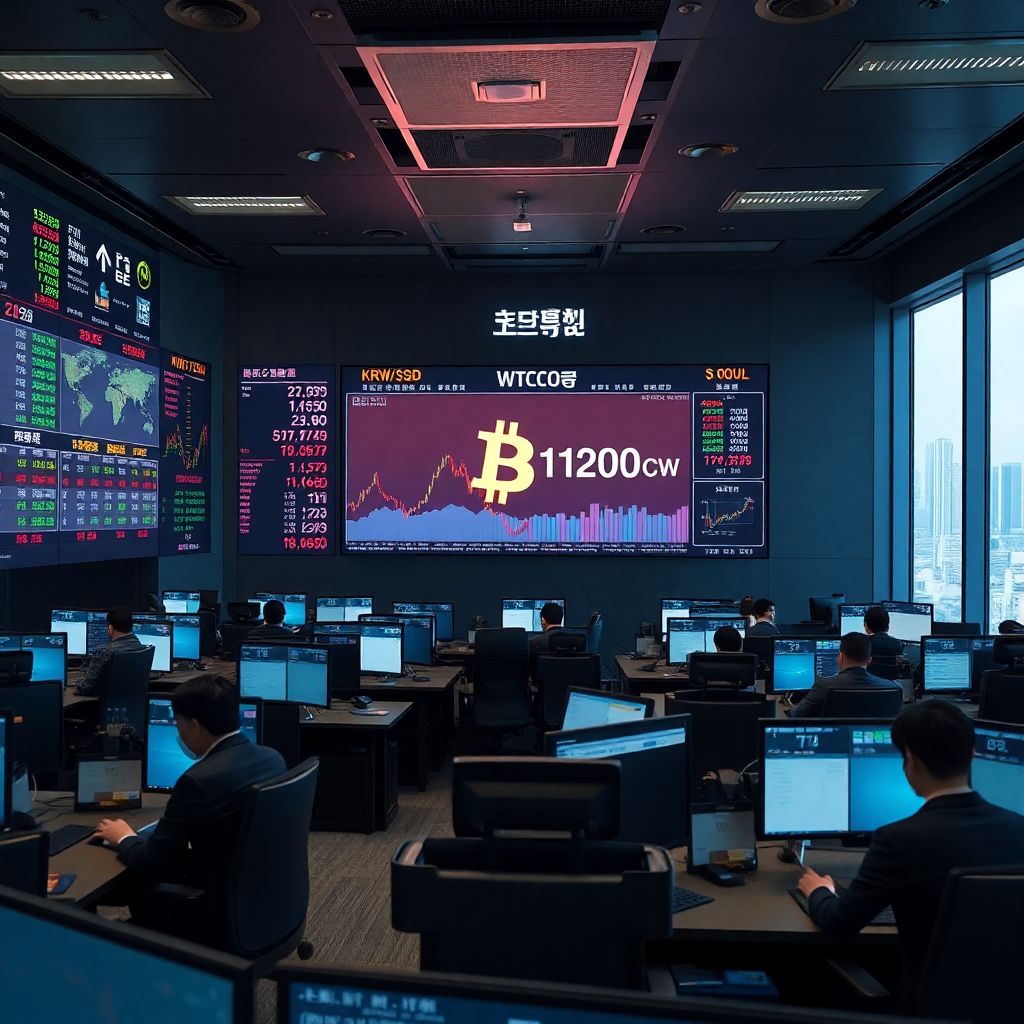
Woori Bank has started streaming live Bitcoin prices on the main dashboard of its flagship trading room in Seoul, placing the cryptocurrency on equal visual footing with foreign-exchange and stock market indicators. Bank officials say it is the first instance of a major South Korean commercial bank embedding a crypto price feed directly into its core dealing environment.
The new Bitcoin (BTC) ticker appears on the same screens that traders use to monitor key benchmarks such as the won–U.S. dollar exchange rate, bond yields and equity indices. This is the information hub where dealers manage foreign exchange, bonds and derivatives positions, making the inclusion of Bitcoin a symbolic step toward treating digital assets as part of the broader macro picture rather than as a fringe market.
A Woori Bank representative explained that the move is driven by the rising role of digital assets in shaping global risk sentiment. According to the official, Bitcoin has evolved into a barometer of broader market appetite for risk, often moving in tandem with technology stocks or serving as a leading indicator of shifts in investor confidence.
“As digital assets continue to gain weight in global financial markets, we concluded that they now function as a key signal for understanding overall market trends,” the official said. “To better assess market conditions and anticipate shifts in sentiment, it has become necessary to monitor Bitcoin alongside traditional indicators.”
The decision comes as South Korean financial institutions deepen their involvement in digital infrastructure and explore ways to integrate blockchain technology into existing services. Recently, Hana Financial Group entered into a partnership with Dunamu, the company behind the Upbit exchange, to embed blockchain tools into cross-border remittances and financial data systems. That tie-up underlines how large banks increasingly view distributed ledger technology as an operational upgrade rather than a purely speculative play.
Woori Bank, by contrast, has not yet announced any formal cooperation with a cryptocurrency exchange. Still, the institution has been signaling a broader strategic interest in digital assets. In October, Chief Executive Officer Jung Jin-wan highlighted that payments and digital asset ecosystems are becoming “increasingly interconnected,” implying that the emerging asset class could generate new business models and revenue streams for banks willing to adapt.
South Korea’s regulators are moving in parallel, working on clearer rules for digital assets and, in particular, for stablecoins linked to the Korean won. Policymakers in the government and the ruling Democratic Party are reviewing a framework that would limit the issuance of won-based stablecoins to consortia led by banks, with financial institutions holding a majority stake. If this proposal is implemented, major lenders such as Woori, Hana and others could become central infrastructure providers in a future stablecoin market, effectively anchoring digital won-tokens to the regulated banking system.
This potential bank-led approach to stablecoins reflects a broader philosophy in South Korea’s regulatory stance: allow innovation, but keep critical payment instruments within entities that already operate under strict licensing, capital and compliance requirements. For banks, that structure offers both an opportunity and a challenge. On one hand, they could capture a meaningful share of stablecoin issuance and related payment flows. On the other, they will bear primary responsibility for risk management, reserves, and adherence to anti-money-laundering standards in a rapidly evolving sector.
Investor behavior suggests that the local appetite for digital and tech-linked assets is far from marginal. During the Chuseok holiday, when domestic markets were closed, South Korean investors channeled substantial capital into U.S. technology names and crypto-related instruments. Trading volumes reportedly concentrated in leveraged exchange-traded funds and high-growth stocks, with traders attempting to ride momentum in U.S. markets rather than sitting idle during the local holiday lull.
At the same time, authorities are tightening oversight of how funds move in and out of the crypto ecosystem. South Korea has announced plans to expand so-called travel rule obligations for cryptocurrency transactions, lowering thresholds so that even smaller transfers will be subject to information-sharing and identity checks. Regulators say the change is meant to close a loophole where users could avoid scrutiny by fragmenting a large transfer into a series of smaller payments that each fell below the reporting limit.
In support of these efforts, the Financial Intelligence Unit is preparing to introduce pre-emptive account-freezing powers for high-risk cases. Under the upcoming framework, investigators will be able to lock accounts suspected of involvement in serious financial crime before assets can be moved or laundered. Officials indicated that the necessary legal amendments are expected to be submitted to the National Assembly in the first half of 2026, signaling a multi-year process of building out enforcement capabilities.
South Korea is also increasing cooperation with global supervisory bodies as it refines its rules for digital assets. Authorities are aligning more closely with standards promoted by international organizations such as the Financial Action Task Force, particularly in areas related to anti-money-laundering controls, cross-border information exchange and the classification of various crypto activities. This alignment is intended to reduce regulatory arbitrage and ensure that domestic rules are compatible with those applied in other major financial centers.
The inclusion of Bitcoin on Woori’s trading room screens can be viewed as a practical response to this changing landscape. For traders, having real-time BTC data displayed next to FX and equity metrics allows them to incorporate digital asset movements into their reading of global liquidity, risk-on/risk-off shifts and correlations with other asset classes. During periods of stress or exuberance, Bitcoin’s price often reacts rapidly, providing early signals that can influence how dealers manage currency exposure or hedge positions in other markets.
From a strategic standpoint, the move also helps Woori build internal expertise. Once traders and risk managers become accustomed to monitoring Bitcoin as part of their regular workflow, the bank is better positioned to assess future opportunities, whether in structured products referencing digital assets, custody services, or participation in tokenized markets. Even without a direct crypto trading desk, having institutional familiarity with crypto price behavior can reduce operational and reputational risk when the bank chooses to launch new offerings.
For South Korean banks more broadly, the convergence between traditional finance and crypto presents several possible business lines. These include regulated custody for digital assets, settlement and clearing services for tokenized securities, infrastructure for bank-backed stablecoins and white-labeled wallet or payment solutions for corporate clients. Each of these areas leverages core banking strengths—compliance, risk management, customer trust—while tapping into new forms of digital value transfer.
At the same time, the sector must navigate substantial risks. Volatility in crypto markets, uncertain long-term regulation and potential conflicts between existing banking rules and on-chain operations all raise complex questions. Compliance departments must ensure that any new product or integration meets strict standards around customer identification, source-of-funds verification and sanctions screening. Technology teams must assess how to securely connect bank systems to external blockchain networks or price feeds without creating new cyber vulnerabilities.
For customers and market participants, Woori’s step is a visible sign that digital assets are no longer being ignored by mainstream institutions. However, it does not mean that banks are endorsing any particular cryptocurrency as a safe investment. Instead, the bank is recognizing Bitcoin as a market variable that can move exchange rates, influence liquidity and shape investor psychology—factors that professional traders cannot afford to overlook.
The evolution of South Korea’s regulatory approach will likely determine how far and how fast banks expand their involvement. If the proposed bank-led stablecoin framework is adopted, lenders may become the primary issuers of digital won tokens used in payments, remittances and possibly even decentralized finance applications that operate under a compliant, permissioned structure. If the framework changes or is delayed, banks may focus more on infrastructure partnerships, custody services and indirect exposure through tokenized financial instruments.
In the near term, the most tangible consequence of Woori Bank’s decision is internal rather than public-facing: it integrates Bitcoin into the daily rhythm of a major trading floor. Yet symbolically, it underscores how digital assets have moved from the periphery of speculation toward the core of market analysis. As rules tighten, infrastructure matures and banks test new roles in the ecosystem, the line between “crypto markets” and “traditional markets” in South Korea is becoming increasingly blurred—starting with a single new line on a trading room screen.