
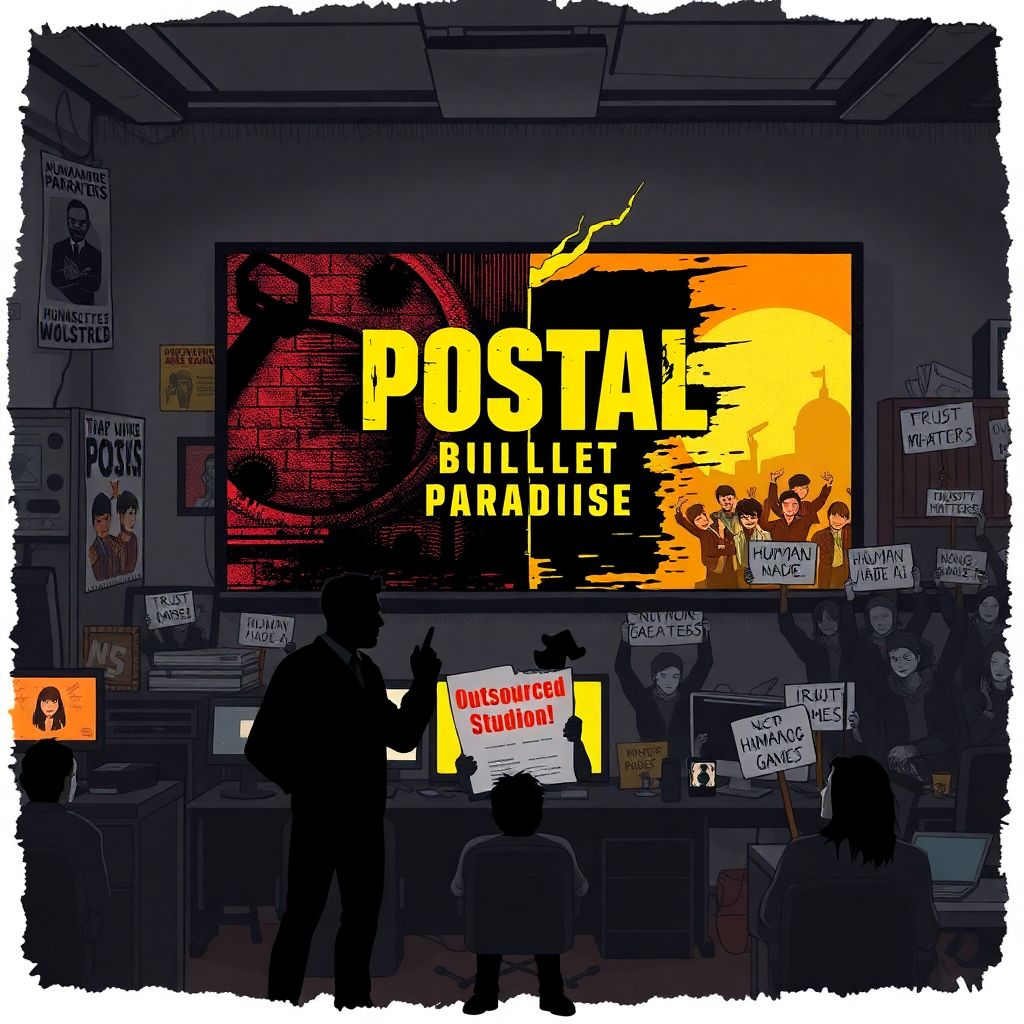
New ‘Postal’ Spinoff Axed Just a Day After Reveal Amid Generative AI Backlash
Running With Scissors, the studio behind the long-running and notoriously provocative Postal franchise, has abruptly pulled the plug on its newly announced game just 24 hours after unveiling it. The project, titled *Postal: Bullet Paradise*, has been canceled following a wave of criticism from players who claimed that the reveal trailer contained assets created with generative AI tools.
*Postal: Bullet Paradise* was billed as a fast-paced shooter spinoff set in the Postal universe, but it wasn’t being developed in-house. Instead, the work had been outsourced to an external team, Goonswarm Games. What was meant to be a fresh, chaotic twist on the series quickly turned into a PR disaster, as viewers dissected the announcement trailer and pointed to what they believed were telltale signs of AI-generated artwork and visual elements.
The controversy came at a particularly sensitive moment. Just days before the reveal, Running With Scissors had publicly condemned the use of generative AI in game development and other creative industries, positioning itself as an opponent of replacing human artistic labor with algorithmic tools. That firm stance sharply contrasted with what fans believed they saw in the new trailer, triggering accusations of hypocrisy and misrepresentation.
In response to the outcry, Running With Scissors announced that it would terminate the project altogether. According to the publisher, its decision was rooted in a breakdown of trust with Goonswarm Games. The studio suggested that it no longer had confidence in the external developer and emphasized that maintaining integrity and transparency with its audience was more important than pushing ahead with a tainted release.
The fallout didn’t stop at the game’s cancellation. Goonswarm Games is reportedly shutting down as a result of the dispute and the subsequent backlash. For a small studio, being publicly linked to alleged AI misuse and then dropped by a recognizable brand like Postal appears to have been a blow it could not withstand. The rapid unraveling of the partnership underscores how volatile and high-stakes the conversation around AI in creative work has become.
Running With Scissors, meanwhile, has tried to reassure players that the demise of *Postal: Bullet Paradise* does not signal the end of the franchise. The publisher says it still has multiple projects in the pipeline and wants to continue building the series while upholding the anti-AI position it recently articulated. In other words, it is attempting to turn the incident into a line in the sand: Postal games, it insists, should be made by people, not machines.
The incident highlights just how quickly generative AI can ignite controversy in the gaming world. In recent years, AI tools have become more accessible and more powerful, capable of producing concept art, textures, voice lines, music, and even code. Supporters argue that such tools can speed up workflows and empower small teams. But critics warn of job displacement, ethical gray zones over training data, and a general erosion of human authorship in art and entertainment.
In the case of *Postal: Bullet Paradise*, the alleged AI use stung even more because it appeared to contradict the publisher’s own public messaging. When a studio loudly denounces generative AI and then appears—fairly or not—to be associated with it in a major reveal, players are quick to call it out. Trust, especially in niche or cult franchises, is often built on a perception of authenticity. Postal has long leaned on its outlaw image and close rapport with its audience; anything that looks like a betrayal of that identity can trigger an outsized reaction.
This episode also illustrates how unforgiving first impressions have become in the digital age. A reveal trailer is often the single most important marketing beat for a new game. If the very first look at a project becomes mired in accusations of AI usage, plagiarism, or corner-cutting, it can be nearly impossible to recover. Rather than attempt a damage-control campaign, Running With Scissors chose the most drastic option—killing the game entirely and severing ties with the developer.
For external studios and contractors, the story serves as a warning. Publishers increasingly expect clear disclosure about pipelines, tools, and asset creation methods. Even if AI is used only in early ideation or as a minor component, failing to align with a publisher’s public values—or to secure explicit approval—can blow up both the project and the team’s reputation. The bar for transparency has risen, and the Postal incident suggests that some publishers are willing to enforce it harshly.
On the other side, players are becoming far more sophisticated at spotting and scrutinizing AI-assisted content. From oddly formed hands in concept art to generic-looking backgrounds and bizarre visual glitches, communities have begun to treat trailers and screenshots like evidence to be examined. Accusations can spread rapidly, and once momentum builds around the idea that a game is “AI-made,” it becomes a stigma that’s difficult to shed, regardless of the actual extent of AI use.
The broader industry is being forced to grapple with how to integrate—or reject—AI in a way that doesn’t alienate audiences. Some studios are adopting strict “no generative AI” policies for visual and narrative content, at least for now, to avoid even the appearance of impropriety. Others are experimenting quietly, hoping to reap the benefits without drawing too much attention. In both cases, clear communication is emerging as a crucial factor: players increasingly want to know how the games they love are made.
Ethically, the debate goes beyond simple tool usage. Generative AI systems are typically trained on massive datasets that include the work of countless artists and creators, often without their consent. For many players and developers, using outputs from such systems feels like benefiting from uncredited labor. When a studio that profits from a vocal, loyal fanbase appears to lean on such tools, it can feel like a betrayal of the creative ecosystem that made its success possible.
The *Postal: Bullet Paradise* saga may be short-lived, but it is likely to be cited as an early example of a “zero-tolerance” reaction to suspected AI involvement in game content. The fact that an established brand canceled a spinoff within a day of showing it, and that the external team is closing down afterward, sends a message: the reputational risk tied to generative AI can outweigh the potential production benefits, especially when public sentiment is already charged.
Looking ahead, studios working with established IP will probably tighten their contracts to explicitly cover AI use—what’s allowed, what isn’t, and what must be disclosed. Legal language around asset ownership, training data, and originality is poised to become standard in publishing agreements. For fans, that might translate into more open statements from developers about their pipelines, or at least clearer assurances when human-made art and writing are a core selling point.
For Running With Scissors, the immediate priority is to repair and maintain its bond with its audience. By sacrificing *Postal: Bullet Paradise* and publicly framing the decision as a matter of principle and broken trust, the publisher is attempting to demonstrate that its anti-AI stance is more than marketing rhetoric. Whether players view this as a genuine stand or damage control will depend on how consistently that stance is reflected in future titles.
Ultimately, the rapid rise and fall of *Postal: Bullet Paradise* encapsulates the tension facing today’s game industry: the temptation to use powerful new tools versus the growing insistence from players that games remain human-driven works of creativity. In this environment, a single trailer—only a few minutes of footage—was enough to decide the fate of an entire project, a development studio, and possibly the future tone of a controversial franchise.