
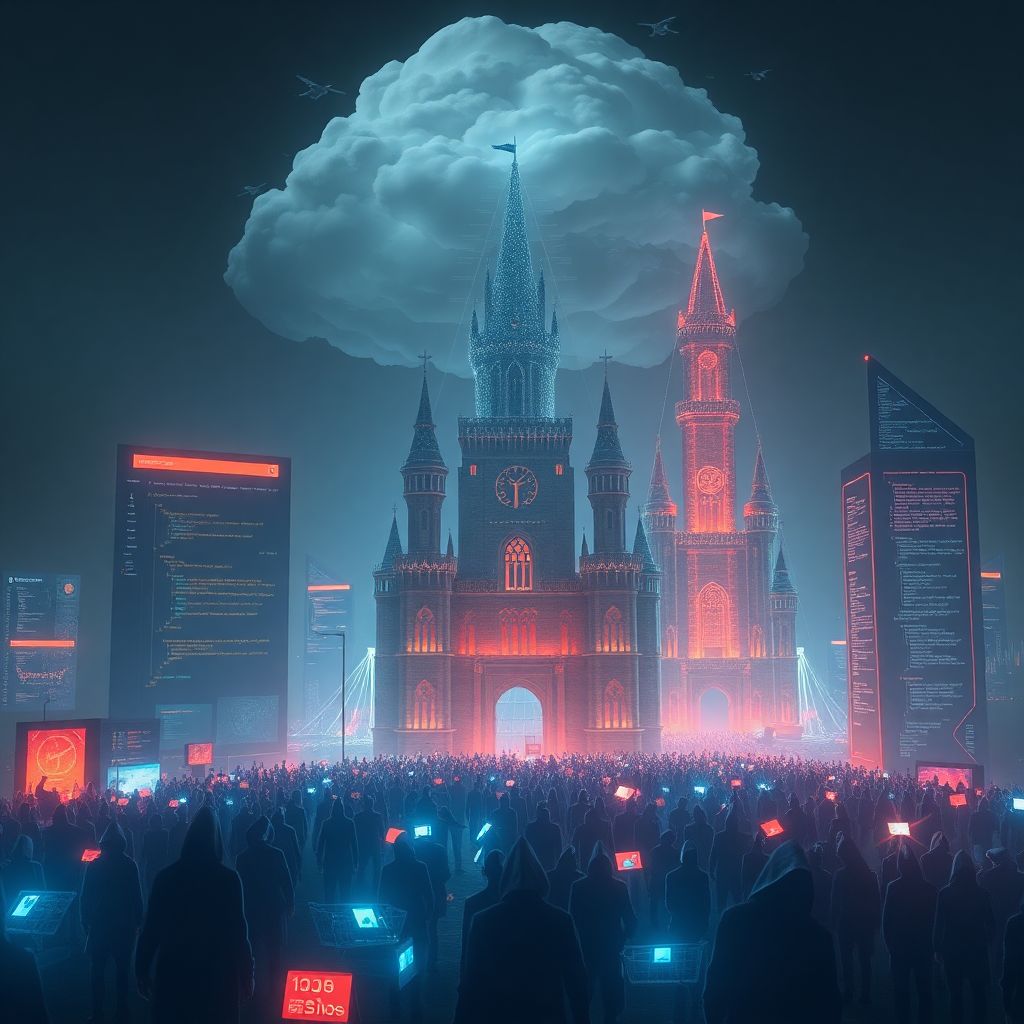
Feudalism 2.0: Why Big Tech Rules Like Digital Monarchs — And How Web3 Can Break Their Power
There is a particular kind of swagger with which today’s tech giants move through the world — the quiet certainty not of corporations, but of states.
Google arbitrates what is knowable.
Meta shapes how we connect and which voices reach us.
Amazon scripts how and where we consume.
These are no longer mere “platforms.” They function as empires. And like every empire in history, their business model is simple: extraction.
We have entered an era of techno-feudalism — Feudalism 2.0 — where the new nobility doesn’t wear crowns, it wears hoodies and sits in boardrooms. The “peasants” are not tied to farmland but to interfaces and ecosystems. Our labor is not plowing fields; it is generating data. Every tap, swipe, scroll, search, and location ping feeds a global extraction engine that never sleeps.
The New Digital Manor
In medieval Europe, a serf technically worked the land, but the harvest legally belonged to the lord. Feudalism was not just an economic system; it was a mindset that normalized dependence. The peasant existed inside a closed loop of obligation, reliance, and powerlessness.
Big Tech has replicated this logic with remarkable sophistication.
– We do not own our data; we simply create it.
– We do not control our digital identities; we lease access to them.
– We rarely give meaningful consent; we are steered by nudges, dark patterns, and default options designed to maximize extraction.
We are told we are “free” to leave any platform. In theory, a medieval serf could walk off the estate as well. In practice, there was nowhere else to survive.
Now try to live a modern life without search engines, messaging apps, cloud services, maps, email, or app stores. Good luck applying for a job, booking travel, using digital banking, accessing government services, or even getting basic navigation without touching an infrastructure controlled by a handful of firms.
This isn’t ordinary user retention. It is the deliberate construction of dependency. Once a tool becomes indispensable to functioning in society, it stops being just a product and starts behaving like a form of soft sovereignty.
Sovereign Power Without Elections
The geopolitical nature of this new order is what makes it so unsettling. Nation-states have borders, constitutions, elections, and at least some formal accountability. Big Tech has none of that — yet it governs decision after decision in our lives.
– Governments request meetings; platforms send terms of service updates.
– Regulators draft legislation; companies silently modify code.
– Parliaments debate content moderation; algorithms execute it in real time.
Digital infrastructure redraws borders in ways that traditional diplomacy can barely track. A mapping service can display one version of a disputed boundary to users in one country and a different version to users elsewhere. Social feeds decide which political narratives become visible and which vanish in the algorithmic background. E-commerce and logistics networks reach across continents with an efficiency many states can’t match.
No one cast a ballot for any of these platforms. Yet, day by day, line by line of code, they exercise power over what we see, how we speak, what we buy, and even how we understand reality. This is post-national power: global in reach, private in ownership, and optimized not for public good but for scale and profit.
In this system, our digital identities — our preferences, locations, habits, biometrics, purchase histories — become the equivalent of mineral deposits and fertile land. The platforms are the new landlords.
We Built the Cage
The harshest truth in all this is that the system rests on our own choices — or what looked like choices at the time.
We traded control for convenience.
We traded agency for instant gratification.
We traded autonomy for “free” services whose real cost was invisible.
We accepted opaque algorithms because they made things “personalized.” We clicked “I agree” on contracts we never read. We told ourselves that having everything in one ecosystem was efficient, not realizing we were tightening the lock around our own lives.
The result: we are back facing a question older than modern democracy itself — who rules? If, in practice, the answer is “platforms rule,” then any serious change will not be primarily political. It will be technological.
Web3 as an Industrial Revolution, Not a Casino
The original Industrial Revolution broke the back of feudal agriculture. New tools and new forms of organization gave workers leverage, raised productivity, and eventually forced political systems to adapt. The power structure of entire societies shifted because the underlying technology changed.
Web3 has the potential to do something similar to digital feudalism — if we stop treating it as a buzzword or a speculative playground and start seeing it as an infrastructure revolution.
The promise of Web3 is not “number go up.” It is:
– shifting control of identity away from centralized platforms
– enabling ownership over digital assets and data
– distributing governance instead of concentrating it
– building systems where users are participants, not just products
Decentralized technologies can rewire the incentives of the digital economy in roughly the same way machines rewired the labor economy: by giving individuals new tools, new rights, and new bargaining positions.
The goal is not to abolish technology. The goal is to reshape who it serves.
If the future is inevitably digital, then the crucial question becomes: digital for whom? For the tiny group of corporations that preside over Feudalism 2.0, or for the millions of people who actually generate the value?
The First Battle: Take Back Your Digital Identity
For everyday users, the revolution begins in a deceptively simple place: identity.
Right now, losing access to your primary email, cloud storage, or social media profile can be more disruptive than losing your keys or even your wallet. It can mean being locked out of banking, work tools, medical portals, contacts, authentication codes — your entire digital existence.
That single point of failure is a symptom of feudal design. Your “identity” lives on someone else’s servers, governed by someone else’s rules, and can vanish because of an algorithmic mistake or a misapplied policy.
Web3 introduces different building blocks:
– Identity wallets where you store cryptographic proofs about yourself.
– Verifiable credentials that let you prove things (age, education, membership, qualifications) without handing over full databases of personal information.
– Ownership-based logins where your access to services comes from keys you control, not accounts that can be revoked by a platform.
– User-controlled data vaults where your information resides under your control, and apps receive limited, revocable permissions.
Retail adoption of Web3 is not fundamentally about speculative tokens, meme coins, or flashy NFTs. It is about ordinary people recovering rights they never knew they’d signed away — the right to own their identity, to decide who can see their data, and to exit a service without losing their digital life.
Everyday Agency: What It Could Actually Look Like
In practical terms, a less feudal web could make daily life meaningfully different:
– You sign into services with an identity you control. If a platform bans you unjustly, it might cut off access to that service, but it can’t erase your entire digital personhood.
– When you share health information with an app, it accesses only what’s needed, for a specific purpose, and loses that access when you revoke it. Your medical history does not get permanently warehoused for ad targeting.
– Social graphs — your network of friends, followers, contacts — become portable. If you leave a platform, you don’t have to start from zero. You take your network with you.
– Content you create is provably yours and can move across platforms without being locked into proprietary formats and walled gardens.
This kind of structure shifts the balance of power. It doesn’t eliminate companies, profit, or platforms. It simply means “opting out” becomes realistic, not theoretical. Platforms must compete on value, not captivity.
Institutional Adoption: Breaking Structural Monopolies
The other front of this revolution lies with institutions: governments, enterprises, financial organizations, and public infrastructure.
For them, adopting Web3 principles is not about chasing hype; it is about reducing concentration risk and dependency on a handful of providers:
– Public records and registries can be anchored on transparent, tamper-resistant ledgers instead of opaque databases controlled by a single vendor.
– Supply chains can be tracked in a shared, verifiable way, reducing the ability of any one platform to become a chokepoint.
– Digital currencies and payment rails can be designed to interoperate, not to funnel all transactions through one or two private intermediaries.
– Identity systems can allow citizens to authenticate with the state or with banks without surrendering all their personal data to third-party ad networks.
Institutional adoption of decentralized infrastructure weakens the lock-in power of Big Tech. It creates alternatives. It allows public and private organizations to collaborate over shared data layers without ceding total control to a single corporate landlord.
Why Centralization Keeps Winning — For Now
Of course, there is a reason Feudalism 2.0 emerged so quickly: centralization is extraordinarily efficient in the short term.
One company, one codebase, one decision-making hierarchy — that structure moves fast. It onboards users easily, abstracts complexity, subsidizes costs with data extraction, and delivers a smooth interface.
Decentralized systems, by contrast, can feel clunky, fragmented, and hard to use. They require coordination, standards, and some level of technical literacy. The user experience of much of Web3 today is still miles behind the polished frictionlessness of Big Tech.
But so was early industrial technology: noisy, dirty, unreliable, and intimidating. Over time, it improved and reshaped everything from cities to labor rights. The same could happen with Web3 infrastructure, if we approach it as a multi-decade transformation rather than a get-rich-quick scheme.
The Hard Problems: Governance, Not Just Code
Breaking digital feudalism is not just a matter of deploying blockchains and tokens. Without careful design, decentralized systems can recreate old hierarchies in new forms — a few large holders controlling governance, insiders writing the rules, or new gatekeepers emerging around wallets and infrastructure.
That means the real work is partly political, even inside technological systems:
– Who gets to write and change the protocol rules?
– How are decisions made and challenged?
– How do we prevent “one token, one vote” systems from simply mirroring wealth inequality?
– What recourse exists when systems fail or are abused?
Successful Web3 systems will need credible governance, not just good code. They must offer not only exit — the ability to leave — but also voice: the ability to shape how the system evolves.
The Non-Negotiable: Decentralization or Nothing
If the goal is to escape techno-feudalism, then one principle is non-negotiable: decentralization cannot be a marketing term. It must be structurally real.
A “Web3” platform that:
– can unilaterally freeze user accounts
– decides content policies in closed rooms
– stores all keys on centralized servers
– or depends entirely on a single corporation for infrastructure
is not actually breaking from Feudalism 2.0. It is modernizing it.
The revolution either distributes control — over identity, data, infrastructure, and governance — or it doesn’t happen at all. There is no middle ground where a handful of companies remain kings but kindly promise to use their power more responsibly.
Choosing the Next Order
We are at an inflection point. The current system “works” in the sense that services are fast, intuitive, and deeply integrated into our lives. But it also quietly normalizes a level of dependency, surveillance, and corporate authority that would have seemed dystopian a generation ago.
The choice is not between technology and no technology. It is between:
– a digital world run as private estates, where we are tenants with revocable rights
– or a digital commons in which identity, data, and participation are governed by open rules and shared infrastructure
We already built the first version — Feudalism 2.0 — by accident, piece by piece, in the name of convenience. Building the alternative will take conscious effort, better design, and a long-term view.
But the logic is the same one that powered every successful revolution in history: when tools change, power can change with them.
If Web3 lives up to its potential, the kings of the current order will not disappear overnight. They will adapt, integrate, and fight to retain their advantages. Yet their monopoly on identity, attention, and data will no longer be inevitable.
And for the first time in decades, ordinary users will have a realistic answer to a question that has been quietly haunting the digital age: Who really rules here?