
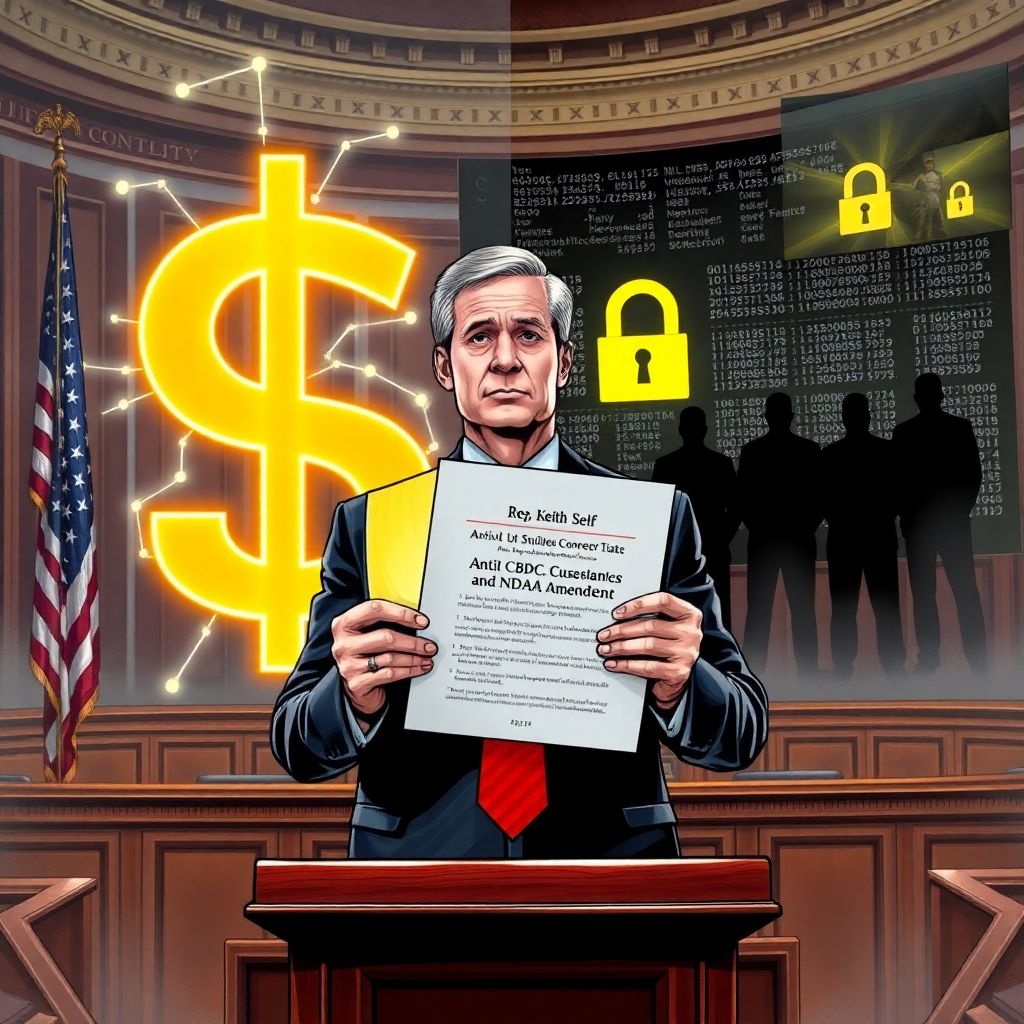
Rep. Keith Self Pushes Pre-Hearing Amendment to Bar a U.S. CBDC
Rep. Keith Self, a Republican from Texas, has introduced a fresh amendment to the National Defense Authorization Act (NDAA) aimed squarely at blocking the creation of a U.S. central bank digital currency (CBDC). The move comes just as the House Rules Committee prepares to decide whether the broader defense bill will move forward to a full House vote.
Self framed his proposal as a direct response to what he called unfulfilled commitments by Republican leadership to include explicit anti-CBDC language in the main text of the NDAA. In a public statement, he accused negotiators of abandoning those assurances, adding that his amendment is designed to “fix the bill” by restoring what he and other critics see as essential protections against financial surveillance.
According to reporting from Capitol Hill, House GOP leaders intend to push the NDAA through the chamber by late Wednesday afternoon. That timeline increases the stakes for Self’s amendment: if it is not made in order by the Rules Committee before the bill hits the floor, his attempt to insert a CBDC ban could be sidelined for this legislative cycle. Political insiders say the Rules Committee’s decisions on which amendments get a vote will effectively determine whether the CBDC issue gets meaningful debate.
The amendment carries the striking title “Anti-CBDC Surveillance State,” underscoring the core concern driving opposition to a central bank digital dollar: the fear that such a system could hand unprecedented monitoring and control powers to the federal government. Under the proposal, the Federal Reserve would be explicitly barred from testing, developing, or implementing a CBDC or “any” similar digital instrument that would function as a direct liability of the central bank and a widely used form of money.
At its most basic, a CBDC is a digital form of national currency issued, regulated, and backed by a country’s central bank. Conceptually, it serves as a government-backed alternative to physical cash, but in digital form, and is often portrayed as a modern complement or upgrade to existing fiat currency systems. Advocates argue it could make payments faster, cheaper, and more efficient, while improving financial inclusion for people who struggle to access traditional banking services.
Opponents like Self, however, see a very different set of risks. They warn that a U.S. CBDC could turn every transaction into a data point directly observable by federal authorities, effectively eroding the relative anonymity that cash still offers. For these critics, the potential for a “programmable” dollar—one that could theoretically be restricted, blocked, or tracked in real time—raises fundamental civil liberties questions. Self’s amendment is written to preempt that possibility by cutting off the Federal Reserve’s authority to even experiment with such a system.
The dispute over CBDCs has rapidly become a flashpoint inside the Republican Party, merging concerns about big government, financial privacy, and technological change. Some GOP lawmakers cast a CBDC as the digital equivalent of a surveillance tool, warning that future administrations could weaponize it to punish political opponents, restrict disfavored industries, or enforce social or environmental agendas through financial controls. The “surveillance state” language in Self’s amendment is calibrated to resonate with that base of voters and lawmakers who already distrust expansive federal authority.
Supporters of exploring a U.S. CBDC counter that many of these fears are speculative and can be addressed through strong legal safeguards and technical design choices, such as privacy-preserving architectures or strict statutory limits on government access to transaction data. They also point to the global race toward digital currencies: major economies—including China and members of the eurozone—are testing or rolling out their own central bank digital money. From that perspective, refusing to even test a CBDC could leave the U.S. financial system less competitive, particularly if cross-border payments migrate to infrastructures built and governed elsewhere.
Self’s amendment is unusually sweeping in that it does not merely slow the process or require further study—it seeks an outright prohibition on the Fed’s ability to design, pilot, or launch a CBDC. For the Federal Reserve, which has been conducting research and limited technical explorations into how a digital dollar might work, such a ban would freeze official experimentation in place. That would force any future Congress that changed its mind to first repeal or significantly revise the “Anti-CBDC Surveillance State” language before the Fed could move forward.
The broader context is the NDAA itself, a must-pass defense policy bill that historically serves as a vehicle for a wide range of policy riders, some only tangentially related to national security. CBDCs have been pulled into that orbit on the argument that control over money, payment rails, and financial infrastructure has become a core component of U.S. strategic power. Those backing a ban argue that a government-controlled digital dollar could become a tool of internal control reminiscent of the financial systems used by authoritarian regimes. Others argue that failing to modernize U.S. currency infrastructure could weaken the dollar’s role as the world’s dominant reserve currency over time.
From a legal perspective, a binding prohibition in the NDAA would place a clear congressional red line around digital currency experimentation by the central bank. It would also send a signal to regulators, financial institutions, and technology companies that Washington is not prepared, at least for now, to move toward a fully fledged digital dollar. That could shift private-sector innovation further toward decentralized cryptocurrencies and stablecoins issued by companies or protocols, which many already see as a de facto digital alternative to government money.
For investors and builders in the digital asset space, the outcome of Self’s amendment has implications beyond the narrow question of a CBDC. A successful prohibition would deepen the policy divide between permissionless, market-driven cryptocurrencies and state-issued digital money. Some crypto advocates welcome this separation, arguing that a government CBDC could crowd out private crypto adoption. Others worry that the same fears used to block a CBDC—particularly around anonymity and “illicit finance”—could later be redirected against existing digital assets.
Politically, Self’s maneuver highlights how digital currency policy has become a litmus test within portions of the Republican conference. Some lawmakers view opposition to a CBDC as part of a broader stance against what they describe as “weaponization” of government power, alongside concerns about censorship, banking de-risking, and regulatory overreach. As election cycles intensify, positions on CBDCs are increasingly being folded into campaign messaging about freedom, privacy, and the future of money.
Looking ahead, even if Self’s amendment fails to make it into the final NDAA, the debate it represents is unlikely to disappear. Any move by the Federal Reserve to advance beyond research and into real-world pilot programs for a digital dollar would almost certainly trigger a fresh wave of legislative proposals—either to authorize and structure a CBDC or to block and restrict it. In that sense, the “Anti-CBDC Surveillance State” amendment is as much an opening shot in a longer policy battle as it is an attempt to alter this year’s defense bill.
For now, the key procedural question is whether the House Rules Committee will allow a vote on Self’s language before the NDAA reaches the floor. That decision will determine whether members must go on record—either in favor of preventing the Fed from touching a CBDC, or in support of keeping that option open for future exploration. In a Congress where digital assets have moved from niche topic to mainstream issue, how lawmakers answer that question will help define the contours of U.S. monetary policy in the digital age.