

The new face of passive income in 2025

Staking has grown from a niche mechanic to a mainstream strategy for building long‑term crypto positions, and in 2025 it finally feels mature. Instead of running noisy mining rigs, you delegate tokens to validators, secure the network and earn yield in the same asset. For many beginners, staking is the first real answer to the question “how to stake crypto for passive income” without jumping into complex trading. The trick is understanding three pillars: how APY is formed, what validators actually do with your tokens, and where lock‑up risks can quietly eat your flexibility. Nail these, and staking becomes less like a lottery ticket and more like a systematic cash‑flow strategy.
APY, inflation and what your yield is really made of
In staking, APY isn’t magic; it’s math plus incentives. Networks like Ethereum, Solana or newer PoS chains pay rewards from protocol‑level issuance and a share of transaction fees. On dashboards and even on the best crypto staking platforms you’ll see “estimated APY”, but under the hood it’s a moving target driven by total staked supply, validator performance and slashing penalties. A tempting banner promising the highest apy crypto staking often ignores token inflation: 15% APY means little if circulating supply inflates 20% annually. Smart stakers compare *real* yield by subtracting inflation and weighing token fundamentals instead of chasing the loudest number on the screen.
How validators actually earn your rewards
Validators are the backbone of any Proof‑of‑Stake network: they propose and attest blocks, keep nodes online 24/7 and follow consensus rules. When you delegate, you’re not sending coins away; you’re cryptographically assigning voting power to a validator while keeping on‑chain ownership. A solid validator has low downtime, robust monitoring, geographic distribution and battle‑tested key management. Poor operators risk getting “slashed” for double‑signing or being offline, which directly hits your rewards. That’s why experienced users rarely stake with anonymous nodes promising absurd yields. Instead, they choose providers with transparent uptime metrics, security audits and a clear explanation of how they manage infrastructure at scale.
Lock‑up, liquidity and the risk of being stuck
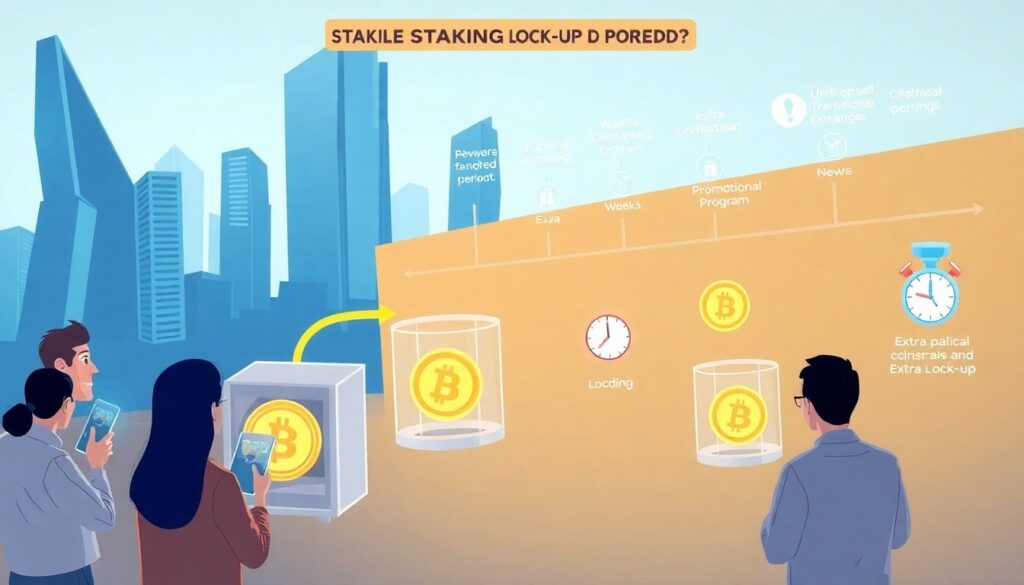
Lock‑up is where many newcomers get surprised. Some networks enforce unbonding periods from a few days to several weeks; during this time you can’t move or sell your staked coins. On top of that, centralized exchanges may add their own lock‑ups for promotional programs, effectively extending your illiquidity window. This is why staking must be aligned with your cash‑flow horizon: funds you might need next month are poor candidates for long bonding periods. Liquid staking tokens partially solve this, letting you trade a derivative while the original remains staked, but they introduce smart‑contract and depeg risk. Diversifying between flexible and locked options helps balance yield and agility.
Inspiring examples: from small deposits to serious yield

One of the most motivating aspects of staking in 2025 is how modest portfolios can scale over time. Consider a student who consistently stakes a few hundred dollars’ worth of a major PoS asset every month. By automating restaking of rewards and ignoring short‑term price swings, they compound over multiple cycles. After a few years, they’re no longer “just holding”; they’re running a personal micro‑treasury that continuously emits tokens. Another example is community validator cooperatives: groups of users pooling funds to spin up their own node instead of outsourcing everything to exchanges, turning passive owners into active network participants and capturing both financial and governance upside.
Successful project cases and platform evolution
Some of the most interesting success stories come from networks that treated staking as a core UX feature, not an afterthought. Chains that integrated native, one‑click delegation in their wallets saw validator sets grow more decentralized and resilient, while early stakers captured strong upside. At the same time, the best crypto staking platforms learned to compete on transparency instead of hype: clear breakdowns of fees, real‑time validator performance, automatic reward compounding and on‑chain proof of reserves. A few platforms even let users seamlessly move between validators, minimizing downtime and smoothing yields, which helped them attract institutional clients that once ignored staking entirely.
Step‑by‑step: building a responsible staking strategy
1. Define your time horizon and risk tolerance before locking anything.
2. Choose networks with clear economics, robust ecosystems and audited code.
3. Compare validators or providers by uptime, commission and security record.
4. Use a staking rewards calculator to test realistic scenarios instead of trusting banners.
5. Decide how much to keep liquid versus bonded or in liquid staking derivatives.
Along the way, ask yourself: crypto staking vs lending which is better for your situation? In 2025, staking is typically safer at the protocol level, while lending can offer higher but more counterparty‑dependent yields. The right mix often includes both, sized according to your need for liquidity and your belief in underlying assets.
Resources for learning and what’s ahead after 2025
Leveling up in staking is mostly about structured learning. Start with official docs of your target chains, then move to validator blogs, security reports and community forums focused on risk analysis. Developer conferences and online workshops now dedicate full tracks to staking economics and validator operations, giving you direct access to experts. Looking forward from 2025, expect more regulated staking products, deeper integration of staking into wallets and neobanks, and smarter auto‑compounding vaults that adapt to on‑chain conditions. Over the next five years, staking is likely to blur into traditional finance, turning what began as a crypto niche into a standard yield layer for global digital assets.