
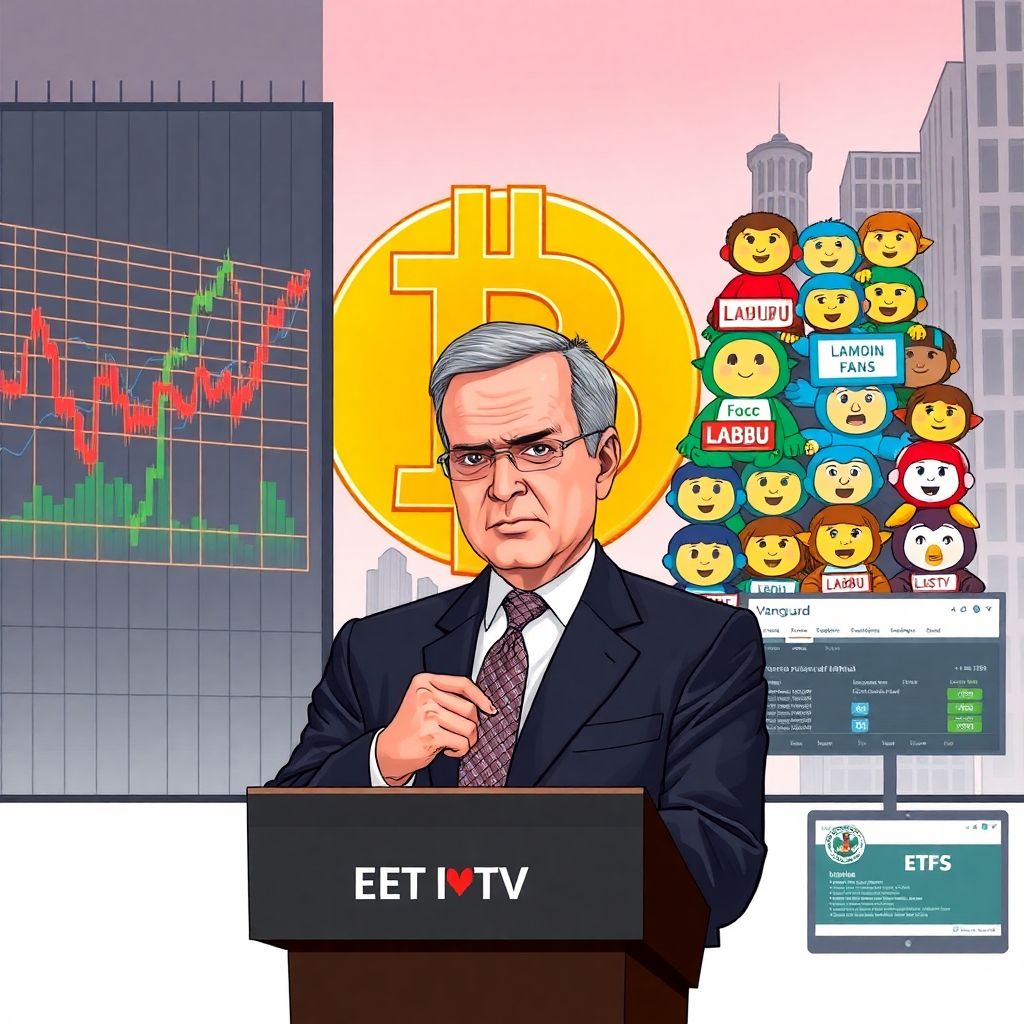
Vanguard Exec Dismisses Bitcoin as a “Digital Labubu” Even as Firm Opens Door to Crypto ETFs
A top Vanguard executive has compared Bitcoin to a passing collectible craze, even while the asset management giant quietly expands access to crypto-related exchange-traded funds (ETFs) for its clients. The contrast highlights an ongoing tension across traditional finance: institutions see clear demand for digital assets, yet many of their leaders remain unconvinced that cryptocurrencies belong in serious, long-term portfolios.
“Digital Labubu”: Bitcoin as a Speculative Toy
Speaking at the ETFs in Depth conference in New York, John Ameriks, Vanguard’s global head of quantitative equity, drew a sharp line between Bitcoin and the kinds of assets Vanguard typically champions.
Ameriks argued that Bitcoin fails to meet the fundamental criteria the firm looks for in long-term investments—specifically, the ability to generate cash flows and compound value over time. Shares in a company can produce earnings and dividends; bonds pay interest; real estate can generate rental income. By contrast, Bitcoin, in his view, functions more like a tradeable object whose price depends largely on what the next buyer is willing to pay.
To drive the point home, Ameriks labeled Bitcoin a “digital Labubu,” invoking the craze around Labubu plush toys—mass-produced collectibles that went viral, surged in secondary-market prices, and quickly became symbols of speculative mania. The analogy framed Bitcoin not as a breakthrough monetary technology, but as a high-volatility fad driven by sentiment and scarcity rather than underlying economic output.
Vanguard’s Long-Standing Caution on Crypto
Ameriks’ comments are consistent with Vanguard’s broader philosophy. The firm has for years taken a conservative stance on cryptocurrencies, emphasizing low-cost, broadly diversified exposure to traditional asset classes like global equities and bonds.
Vanguard has repeatedly declined to launch its own spot Bitcoin or crypto-focused funds, stating that digital assets do not align with its core mission of long-term investing based on fundamentals. From the company’s perspective, assets without predictable cash flows, robust regulatory frameworks, or clear intrinsic value sit outside the toolkit it recommends for retirement and wealth-building strategies.
Yet Clients Can Now Trade Crypto ETFs
Despite this skepticism, Vanguard has not been able to ignore the reality of market demand and regulatory change. Recent shifts in national policy and the regulatory landscape—most notably the approval of multiple Bitcoin and crypto-related ETFs in major markets—have forced large asset managers to confront crypto more directly.
In response, Vanguard has taken a pragmatic step: it now allows eligible clients to trade certain crypto-linked ETFs on its brokerage platform, even though it does not sponsor or actively promote such products. This is a significant move for a firm that until recently was seen as almost entirely crypto-averse.
The message is nuanced: while Vanguard still does not view Bitcoin as a core holding suitable for most long-term investors, it recognizes that clients want the option to gain exposure. Providing access to third-party ETFs is a way to accommodate that demand without reversing its own investment philosophy.
The Tension Between Policy Shifts and Institutional Beliefs
Ameriks’ remarks underscore a broader tension playing out across the financial sector. On one side, regulators and policymakers are slowly integrating digital assets into the traditional market structure, allowing for regulated funds, custodians, and trading venues. That has made it easier for large institutions to offer crypto exposure in a compliant manner.
On the other side, many portfolio managers and CIOs still evaluate Bitcoin through the lens of traditional asset analysis—and find it wanting. Without identifiable cash flows, conventional valuation models struggle to assign a “fair value” to Bitcoin, leading many institutional investors to classify it as speculation rather than investment.
Why the “Toy” Label Matters
Labeling Bitcoin a “digital Labubu” is more than an offhand insult. It signals how a major institution frames risk for its clients. If an asset is likened to a collectible toy, it implicitly sits in the realm of discretionary bets—something you might buy for fun or out of curiosity, but not something a retirement plan should rely on to meet future obligations.
This perspective can influence allocation recommendations, risk models, suitability assessments, and even how advisors talk to clients about crypto. For long-term, goal-focused investors, Vanguard’s messaging is clear: Bitcoin, in their view, is not on the same footing as stocks, bonds, or other income-producing assets.
The Counterargument: Bitcoin as Digital Gold
Supporters of Bitcoin would counter that such comparisons miss the point. They argue that Bitcoin more closely resembles digital gold than a plush toy—an asset with limited supply, independent of any single government, and potentially useful as a store of value in times of monetary instability.
From this angle, the lack of cash flow is not a bug but a feature: Bitcoin is meant to be a neutral, non-sovereign asset, not a business. Its value proposition lies in censorship resistance, predictable issuance, and global portability, rather than dividends or coupons.
This clash of perspectives—Bitcoin as speculative collectible versus Bitcoin as monetary innovation—explains much of the divide between long-time crypto advocates and traditional asset managers like Vanguard.
Why Vanguard Still Won’t Launch Its Own Crypto Funds
Even as it enables trading in crypto ETFs from other providers, Vanguard continues to refrain from launching proprietary Bitcoin or crypto products. There are several reasons for this:
– Brand positioning: Vanguard has built its reputation on simplicity, low fees, and long-term discipline. Embracing a volatile, debate-heavy asset class could dilute that message.
– Regulatory and operational complexity: Directly managing crypto exposure involves custody, security, compliance, and technological challenges that are still evolving.
– Client outcomes: The firm likely worries that late-cycle retail enthusiasm for crypto could lead to poor timing and losses, which would ultimately reflect badly on any in-house products.
Allowing clients to buy third-party crypto ETFs through its platform offers a compromise: access without endorsement.
What This Means for Individual Investors
For investors using Vanguard or similar platforms, Ameriks’ comments and the firm’s cautious stance send a clear signal: if you choose to allocate to Bitcoin or other digital assets, you are stepping outside the boundaries of what the firm considers a core, evidence-based portfolio.
That doesn’t necessarily mean you should never own crypto. It does mean you should treat it as a high-risk satellite position rather than a foundational holding—something sized modestly relative to your overall assets, with the expectation of sharp drawdowns and long periods of underperformance.
Investors who remain interested in crypto despite institutional skepticism should consider:
– Position sizing: Keeping allocations small enough that a total loss would not derail long-term goals.
– Time horizon: Being prepared to hold through multi-year cycles of boom and bust.
– Diversification: Avoiding concentration in a single token or narrative, and ensuring the bulk of the portfolio remains in diversified traditional assets.
The Significance of Access, Even Without Enthusiasm
Vanguard’s decision to open trading in crypto ETFs, even while publicly questioning Bitcoin’s merits, illustrates an important evolution in the market. Digital assets are moving from the fringes into the standard investment toolkit—not necessarily as recommended holdings, but as instruments that major platforms are expected to support.
In practice, that means:
– Crypto exposure can now be accessed within existing brokerage and retirement accounts.
– Investors can trade regulated, exchange-listed products rather than relying on offshore platforms or direct wallets.
– Traditional risk controls, reporting, and oversight can be applied to crypto allocations.
Even institutions that see Bitcoin as a “digital Labubu” are acknowledging that it is not going away—and that their clients expect at least the option to participate.
A Divided Future for Digital Assets in Traditional Portfolios
Ameriks’ remarks capture a moment of transition. Bitcoin and other digital assets have won a degree of regulatory acceptance and institutional access, but they have not yet won the intellectual or philosophical acceptance of many large asset managers.
In the coming years, that divide may narrow if:
– Crypto markets mature and volatility declines.
– More data accumulates on how Bitcoin behaves across different macro regimes.
– Tokenization, blockchain-based settlement, and digital infrastructure become embedded in mainstream finance.
Alternatively, the skepticism could persist, with Bitcoin remaining a niche, high-risk bet on the edges of otherwise conventional portfolios.
For now, Vanguard’s position is emblematic: open the door to crypto ETFs, but keep them firmly separated from the firm’s core long-term investing doctrine—and do not hesitate to call Bitcoin what its leadership believes it is: a speculative “digital Labubu,” rather than a pillar of future wealth-building.