

You send tokens into a cross‑chain bridge, they disappear from one chain and magically appear on another. Feels like teleportation. Under the hood, though, there’s a lot of plumbing, risk, and design trade‑offs.
Before we dive in: nothing here is investment advice. Bridges are still experimental, and the numbers below are based on public datasets (DeFiLlama, Chainalysis, L2Beat and project reports) as of late 2024 / early 2025.
—
Why Cross-Chain Bridges Exist in the First Place
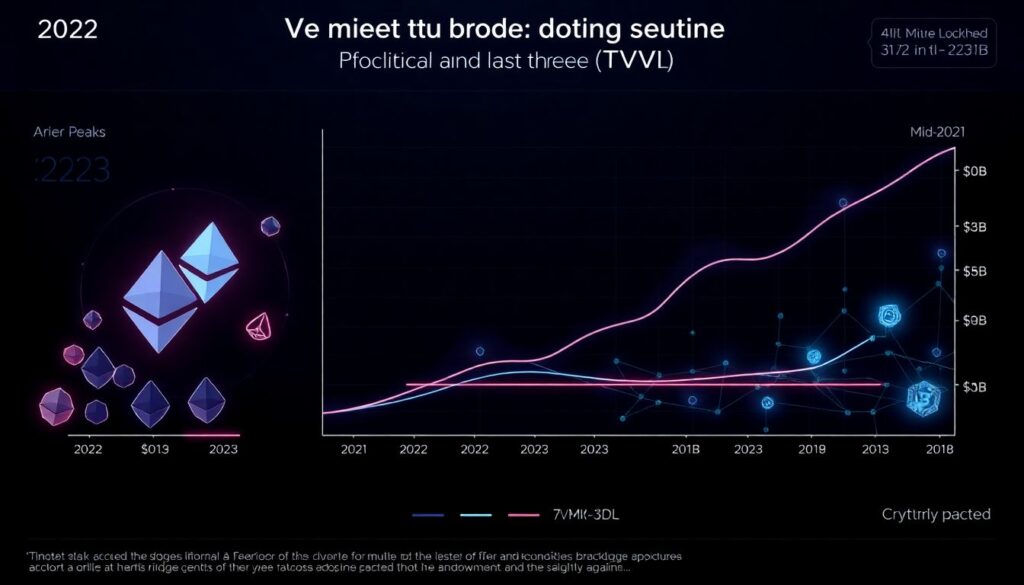
Over the last three years, crypto stopped being “just Ethereum + a couple of L1s.” In 2022, the total value locked (TVL) in bridge protocols peaked around the $25–30B range. After the 2022 bear market and big hacks, bridge TVL dropped below $10B by mid‑2023, then slowly recovered to roughly $15–18B by Q4 2024 as L2s and modular stacks took off.
At the same time:
– Ethereum L2s (Arbitrum, Optimism, Base, zkSync, etc.) went from under $3B TVL in early 2022 to over $25B combined by late 2024.
– Non‑EVM ecosystems like Solana, Cosmos, and Bitcoin L2s saw renewed user activity, forcing people to think hard about how to transfer crypto between blockchains without going through a centralized exchange every time.
So bridges emerged as the connective tissue. But “bridge” is an umbrella term; there are several fundamentally different designs.
—
The Core Idea: Lock Here, Mint There (or Route Liquidity)
Almost every cross‑chain bridge you touch falls into one of two mental models:
1. Lock-and-mint (canonical or external bridges)
– Your tokens are locked or escrowed on chain A.
– A representation (“wrapped” token) is minted on chain B.
– Later, you burn the representation on B to unlock the original on A.
2. Liquidity networks / routers
– Liquidity providers keep pools of assets on multiple chains.
– You deposit asset X on chain A, and a router sends you asset X from its pool on chain B.
– Under the hood, the LPs settle balances, but you experience it as instant bridging.
From a user perspective, both look identical: tokens vanish on one side and appear on the other. Underneath, however, the trust and failure modes are very different—and that’s what matters when you’re looking for the best cross chain bridge for crypto in your specific use case.
—
Different Bridge Architectures, Visualized in Plain Language
Let’s walk through the main families and how your funds “travel.”
1. Multisig + Oracle Bridges (External Lock-and-Mint)
– Example mental model: a group of signers (often 5–20) collectively controls a big vault on chain A.
– When you deposit, off‑chain relayers or on‑chain oracles observe your transaction.
– Once a threshold of signers confirms it, the bridge contract on chain B mints wrapped tokens to your address.
Imagine a shared bank vault controlled by a committee. They watch the security cameras (blockchain A), then instruct a second bank on blockchain B to credit you.
2. Light Client / Native Bridges
– Chain B runs a simplified “light client” of chain A inside a smart contract, verifying block headers and Merkle proofs.
– Your deposit on A is proven directly to this light client on B, with no human committee needed.
This is like B running a mini‑version of A’s node software, so it doesn’t have to “trust” a middleman to tell it what happened. These are considered some of the most trust‑minimized designs, though they’re complex and gas‑heavy.
3. Optimistic Bridges
– By default, the bridge assumes that messages from A to B are valid.
– Anyone can submit a fraud proof within a challenge period if something looks wrong.
– If a proof succeeds, the invalid message is rolled back.
This is similar to Optimistic Rollups: “we assume honesty unless challenged.” It gives better performance than full light clients but relies on at least one honest watcher.
4. ZK (Zero-Knowledge) Bridges
– A prover builds a cryptographic proof that “this state transition on chain A really happened.”
– Chain B verifies the proof using a succinct zkSNARK or zkSTARK.
– No committee, no assumptions about watchers—just math.
In theory, this is close to a gold standard for a secure cross chain bridge for DeFi, but the proofs can be expensive to generate, and the tooling is still maturing.
5. Liquidity / Router Bridges
– You send tokens to a contract on A.
– The protocol (or a market maker) immediately sends you equivalent tokens already sitting on B.
– Later, they rebalance or hedge this exposure in bulk.
Your funds don’t literally “move” chain‑to‑chain; you’re being matched against cross‑chain liquidity. This can feel like the classic “cheap cross chain bridge with low fees,” because it’s fast, with slippage priced into the route.
—
Step by Step: What Actually Happens When You Bridge
Let’s follow a generic lock‑and‑mint transaction so you can visualize your crypto’s journey.
1. You approve and deposit
– On chain A, you sign two transactions:
– An `approve()` so the bridge can move your token.
– A `deposit()` call that actually transfers it in.
2. Event gets observed
– The deposit emits an event: “User X locked 1 ETH for chain B.”
– Relayers/oracles watch chain A, pick up this event, bundle it into a message.
3. Message gets delivered to chain B
– Depending on design, they either:
– Send a Merkle proof to a light client / zk verifier on B, or
– Gather signatures from a multisig committee and submit them to B.
4. Mint / release on chain B
– The bridge contract on B verifies the proof or signatures.
– If valid, it mints wrapped tokens (or releases existing liquidity) to your address.
5. Reverse path for withdrawals
– When you send back wrapped tokens and call `redeem()`, the process runs in reverse to unlock the original funds on chain A.
That’s essentially how most protocols tackle the seemingly simple request to bridge bitcoin to ethereum step by step, although in Bitcoin’s case, you’re dealing with UTXOs, different scripting, and often a more centralized custody model on the BTC side.
—
Comparing the Main Approaches: Trust, Speed, and Cost
Let’s distill the trade‑offs across these designs.
Multisig / Oracle Bridges
– Pros:
– Straightforward to implement.
– Fast confirmations; cheap on‑chain logic.
– Easy UX; widely deployed.
– Cons:
– High custody risk; if the multisig is compromised, the entire vault is at risk.
– Hard to scale to many chains without ballooning complexity.
Light Client / Native Bridges
– Pros:
– Very strong security assumptions; effectively “trust the source chain’s consensus.”
– No single trusted committee.
– Cons:
– Complex contracts and expensive verification, especially for non‑EVM consensus.
– Not every chain exposes the data needed to do this cleanly.
Optimistic Bridges
– Pros:
– More efficient than full light clients.
– Security improves as more independent watchers monitor.
– Cons:
– Withdrawal delays due to challenge windows.
– UX friction: funds might feel “stuck” during dispute periods.
ZK Bridges
– Pros:
– Strong, mathematically enforced correctness.
– Fast finality on destination chain once proof is verified.
– Cons:
– Heavy proving requirements; may rely on specialized hardware or proving markets.
– Tooling and audits still relatively young as of 2025.
Liquidity / Router Bridges
– Pros:
– Very fast, near‑instant UX.
– Flexible routing, often best for retail users who prioritize speed.
– Cons:
– You trust the solvency and risk management of liquidity providers.
– Potential for temporary depegs or failed routes under stress.
—
Security Reality Check: Stats from 2022–2024
The last three years were brutal but educational for bridge security.
– 2022
– Chainalysis reported that cross‑chain bridges were the single largest DeFi hack vector, with over $2B stolen (Ronin, Wormhole, Horizon, Nomad, etc.).
– Bridges accounted for roughly two‑thirds of all DeFi value hacked that year.
– 2023
– Total value stolen from bridges dropped significantly, to somewhere under $800M, depending on how you classify certain incidents.
– Part of that decline was due to lower TVL (easier targets had already been hit), but also to better audits, circuit‑breaker mechanisms, and on‑chain monitoring.
– 2024
– Preliminary public datasets suggest bridge‑related losses fell again, to the $300–500M range, even as TVL slowly crept back up.
– More projects migrated away from centralized multisig bridges toward native, optimistic, or zk‑based designs, and insurance‑like coverage products started to appear.
The lesson: bridges are getting safer in aggregate, but the risk isn’t gone. Attackers simply moved from naive multisigs to more subtle contract and validator‑set exploits.
—
How Fees Actually Work (and Why “Cheap” Is Relative)
When people look for a cheap cross chain bridge with low fees, they mostly see the front‑end fee and miss the other components:
– Gas on the source chain (approve + deposit)
– Gas on the destination chain (claim / receive)
– Protocol fee (flat fee or % of volume)
– Implicit cost: slippage or unfavorable routing, especially for large size
In 2022, bridging $1,000 from Ethereum mainnet to a busy L2 could easily cost $30–50 in total gas + protocol fees. By late 2024, thanks to L2 scaling and EIP‑4844–style data‑availability savings, many common L1→L2 or L2→L2 moves cost under $5 for typical retail‑size transfers during normal conditions.
Liquidity routers often look cheapest for small amounts because:
– They batch risk and settlement across many users.
– They can subsidize fees with token incentives or MEV capture.
But if you’re moving eight figures and prioritizing safety, the “cheapest” option in pure dollars might not be the best cross chain bridge for crypto in your situation.
—
How to Transfer Crypto Between Blockchains Without Losing Your Mind
Let’s simplify the user journey. For a typical ERC‑20 from Ethereum to an L2:
1. Pick your path
– Native L2 bridge (usually safest for that L2).
– Reputable third‑party bridge (for speed / flexibility).
2. Connect your wallet on the source chain
– Double‑check the bridge URL; phishing is rampant.
– Check that you’re on the correct network (e.g., Ethereum mainnet).
3. Select token and amount
– Watch for warnings: some tokens don’t exist on the destination chain or have different contract addresses.
4. Confirm fees and destination network
– Many scams rely on users accidentally sending to the wrong chain or via a fake token.
5. Sign transactions
– You’ll usually sign an `approve` then a `bridge / deposit`.
– On the destination chain, you may need to “claim” or just wait for automatic credit.
6. Verify receipt
– Add the token contract on the destination chain if it doesn’t show by default.
– Check a block explorer, not just your wallet UI.
Under the hood, all the architectures we described are doing the heavy lifting. From your point of view, if you stick to well‑audited, widely used routes, this process becomes a fairly routine answer to how to transfer crypto between blockchains.
—
Pros and Cons from a User’s Perspective
Here’s a more practical lens. Think in terms of what you actually care about when using a bridge.
You care about:
– Not getting rugged.
– Not overpaying.
– Not waiting hours for funds to show up.
– Having tokens that are actually usable in the apps you want.
Trade‑offs you’re making:
– Security vs speed
– Native / light client / zk bridges: heavier security, sometimes slower or more expensive.
– Liquidity routers: ultra‑fast, but you’re exposed to the solvency and risk‑management of LPs.
– Native vs wrapped assets
– Native assets via canonical bridges tend to be more widely accepted in that ecosystem.
– Third‑party bridged versions can fragment liquidity and cause confusion (“Which USDC is the real one?”).
– Complexity vs flexibility
– Aggregator UIs simplify routing but add one more dependency you must trust.
– Direct use of protocol‑owned bridges may be safer, but less convenient.
—
How to Choose a Bridge in 2025: A Short Checklist
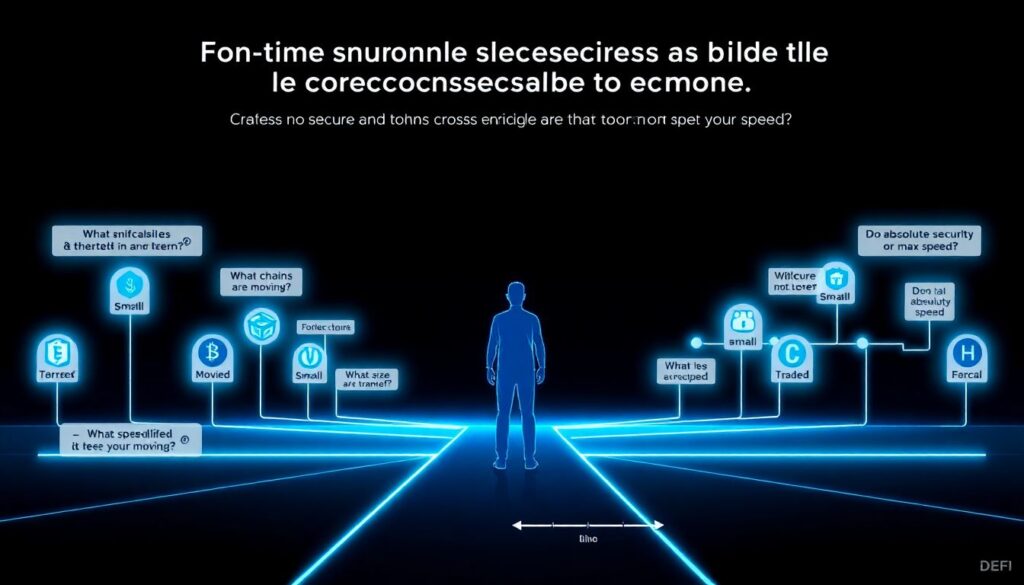
There is no single, universal secure cross chain bridge for DeFi that’s best for everyone. Instead, consider:
– What chains and tokens are you moving?
– What size are your transfers?
– Do you prefer absolute security or max speed?
Here’s a quick mental model you can apply:
– When in doubt, use native bridges
– For ETH or canonical stablecoins from Ethereum to a major L2, the official bridge is usually the safest default.
– For small, frequent moves, consider routers
– Sub‑$1,000 transfers where time matters more than theoretical risk often fit liquidity networks well.
– For serious size (5–6 figures and up)
– Look for:
– Audits by reputable firms.
– Public bug bounties.
– Transparent documentation of validator sets, governance, and risk assumptions.
– For long‑term DeFi positions
– Prefer assets and bridges that are natively integrated with the major apps on the destination chain, so you’re not stuck in a fringe wrapper.
—
What “Best Cross-Chain Bridge for Crypto” Actually Means
People often ask for a single winner: “just tell me the best bridge.” That question hides several choices:
– Best for security: often native / canonical or light‑client / zk‑style bridges, especially when your target is a specific L2 or appchain.
– Best for UX: routers and aggregators that auto‑select paths, show clear final fees, and handle network switching.
– Best for DeFi composability: whichever bridge issues the asset version that dominant DeFi protocols on the destination chain treat as canonical (e.g., “real USDC”).
If you’re designing your own app or strategy, think of bridges as infrastructure with different SLAs: some are “bank‑grade safe but slow,” some are “Venmo‑fast but more trust‑heavy.”
—
Trends to Watch in 2025
The bridge landscape is not static. Several trends are reshaping what “cross‑chain” even means:
– Modular stacks and shared security
– Rollup‑as‑a‑service and shared sequencer networks blur the line between “bridging” and “intra‑ecosystem messaging.”
– In some modular ecosystems, sending messages across appchains is closer to an internal transfer than a classic bridge.
– Inter‑L2 and intra‑ecosystem native messaging
– Ethereum L2s are moving toward common standards for cross‑rollup messaging.
– This could reduce reliance on third‑party bridges for L2↔L2 moves over the next 2–3 years.
– ZK proving markets and hardware accelerators
– As ZK proving gets cheaper and faster, ZK bridges become more realistic for everyday users, not just for high‑value routes.
– Insurance and risk tokenization
– We’re starting to see coverage protocols that explicitly underwrite bridge risk.
– For some users, paying a small premium for insurance could be more attractive than constantly hunting for the “safest” design.
– Regulated and institutional bridges
– Institutional players increasingly demand audited, regulated infrastructure, especially when tokenizing real‑world assets across chains.
– Expect more KYC’d, permissioned bridges that coexist with fully permissionless ones.
Taken together, 2025 is shaping up less as “one bridge to rule them all” and more as a mesh of specialized, interoperable systems where bridging becomes a background detail of UX rather than a big, scary step.
—
If you treat bridges as critical infrastructure instead of black boxes, you’re already ahead of most users. Understand which trust assumptions you’re buying, match the bridge to your transfer size and purpose, and keep an eye on the evolving security track records. Your crypto’s journey across chains will never be literally risk‑free—but it can be deliberate, informed, and increasingly smooth.