
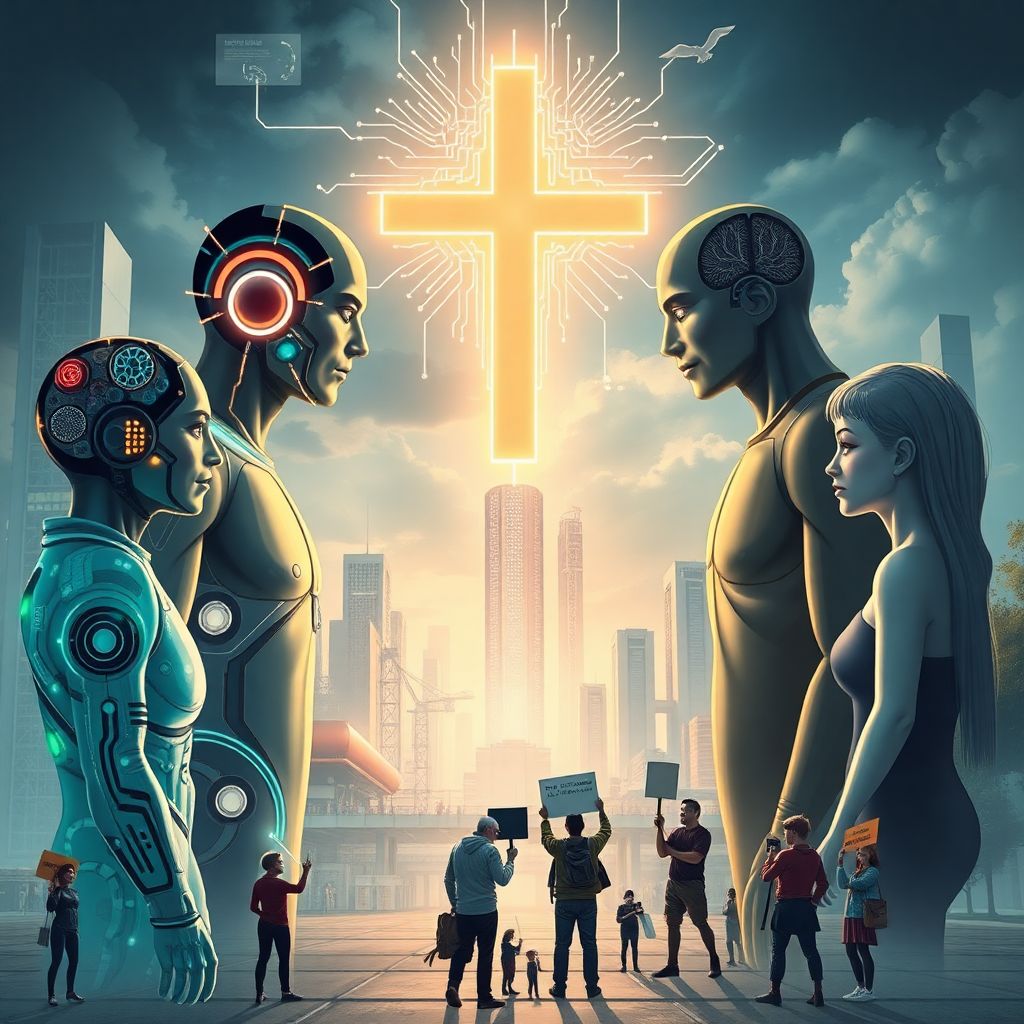
Transhumanism, the philosophical and technological movement that aspires to conquer aging and ultimately abolish death, has been thrust into the spotlight after being denounced as a “death cult” during a high-profile public debate.
At the Institute of Art and Ideas’ “World’s Most Dangerous Idea” event, held on December 4 in the UK, neuroscientist and philosopher Àlex Gómez-Marín launched a fierce critique of transhumanism. He argued that, beneath its glossy futurist branding and scientific rhetoric, the movement operates more like a quasi-religious faith – one that might end up erasing the very thing it claims to protect: our humanity.
“I think transhumanism is a death cult,” Gómez-Marín said, calling it “a pseudo-religion dressed in techno-scientific language” whose ambitions target “the extinction of the human condition.”
According to his argument, promises of immortality, digital consciousness, and radically enhanced bodies don’t merely challenge traditional beliefs about life and death – they risk redefining what counts as a person, what counts as a life, and whether ordinary humans, with their vulnerabilities and limits, are still seen as valuable at all.
Transhumanism: Salvation Through Technology or End of the Human Story?
Transhumanism, in broad terms, is the belief that humans can and should use advanced technologies – from genetic engineering and brain-computer interfaces to artificial intelligence and nanotechnology – to transcend biological limitations. Its supporters envision a future where aging is optional, disease is essentially eradicated, and cognitive abilities can be vastly amplified.
For advocates, this is not a fringe fantasy but a moral imperative: if we can prevent suffering and premature death, they argue, we have a duty to do so. The idea of passively accepting aging and mortality becomes, in their eyes, ethically suspect.
Gómez-Marín and other critics counter that this vision misdiagnoses what is wrong with the human condition and misunderstands what it means to live well. By treating finitude and vulnerability as mere “bugs” to be patched with technology, they fear transhumanism might turn into a ruthless form of perfectionism – a world where anything less than enhancement is seen as failure or obsolescence.
A “Pseudo-Religion” in Technological Clothing
The sharpest point of contention in the debate centered on whether transhumanism is genuinely a scientific, rational project – or whether it reproduces the structures and promises of religion while denying that it does so.
Gómez-Marín described the movement as a new kind of faith: it has a promised paradise (immortality, superintelligence, post-biological existence), a story of salvation (uploading minds, upgrading bodies, merging with machines), and a powerful sense of cosmic purpose (guiding evolution to a “higher” form). What is missing, in his view, is honest recognition that these are metaphysical commitments, not merely engineering challenges.
From this perspective, the “death cult” label is not only about an obsession with death, but also about how the movement appears to make peace with sacrificing the old human form – and perhaps entire ways of life – in pursuit of a new, superior species or substrate of consciousness. Humanity as we know it becomes a temporary scaffolding to be discarded once something “better” has been built.
Transhumanists Push Back: “We’re Trying to Save Lives, Not Worship Death”
Transhumanist thinkers and supporters at the event rejected the accusation as unfair and deeply misleading. For them, the movement is precisely the opposite of a death cult: it is a revolt against the inevitability of death and an insistence that science and technology can meaningfully extend healthy life.
They argue that labeling transhumanism a cult obscures the genuine ethical motivations behind it. If aging leads to immense suffering, cognitive decline, and the loss of loved ones, then research aimed at extending healthy lifespan is, in their view, an extension of the same moral logic that underpins vaccines, antibiotics, and modern medicine. No one calls hospitals “death cults” for trying to keep people alive longer.
Supporters also point out that transhumanism is not a monolith. Some focus purely on medical longevity and age-related disease, others on human enhancement, and still others on far-future possibilities like digital minds. To bundle all of these under a single “cult” label is, they say, a form of rhetorical attack that short-circuits serious debate.
The Human Condition: Something to Fix or Something to Protect?
The clash at the event highlighted a deeper philosophical divide: is the human condition primarily a problem to be solved, or is it something to be cherished and preserved, despite – or even because of – its limits?
Critics argue that mortality, fragility, and emotional dependence on others are not only sources of suffering but also foundations of meaning. Love, courage, sacrifice, and even creativity often arise in response to finitude. The knowledge that life is short and precarious shapes how we value relationships, achievements, and time itself. Remove that horizon, they ask, and what happens to our sense of urgency, commitment, and responsibility?
Transhumanists reply that meaning is not inherently tied to early death or biological constraints. People already find purpose in long-term projects, learning, art, and relationships that evolve over decades. If more healthy time were available, they argue, humans (or post-humans) would likely discover new forms of meaning rather than fall into boredom or nihilism. They also stress that the goal is not necessarily eternal life in a simplistic sense, but radically extending health and capacity, allowing individuals to decide for themselves how long they wish to live.
Who Gets to Be “Upgraded”? The Ethics of Inequality
Another central concern raised during and around the debate is the risk that transhumanist technologies will deepen existing social inequalities.
If advanced life-extension, cognitive enhancement, or neural implants are costly and controlled by powerful actors, they might become exclusive privileges of the wealthy, politically connected, or technologically advanced regions of the world. In such a scenario, “enhanced” elites could gain such a significant advantage in health, intelligence, and lifespan that social mobility collapses and democratic norms erode.
Critics fear a future where a small class of quasi-immortal, hyper-capable beings wield disproportionate influence over resources, politics, and culture, while the majority remain unenhanced – potentially treated as a permanent underclass. The rhetoric of “improvement” could be used to justify new forms of discrimination, echoing past abuses tied to eugenics and “scientific” hierarchies of worth.
Transhumanist advocates tend to acknowledge these risks but insist they are not intrinsic to the idea of enhancement. They argue that equitable access, public regulation, and robust ethical frameworks can prevent dystopian outcomes. In their optimistic scenarios, life-extending and augmenting technologies become as widespread and normalized as smartphones or vaccines, benefiting almost everyone rather than a select few.
Are We Creating Tools – or a New Species?
Beneath the surface of the debate lies an existential question: at what point does “enhancing humans” become “replacing humans”?
Some critics suspect that the logical endpoint of transhumanism is the emergence of entities so radically altered – or entirely digital – that calling them “human” would be more metaphor than reality. If consciousness can be transferred to machines, or if AI entities merge with or surpass human minds, the biological organism that evolved over hundreds of thousands of years might become a transitional phase rather than the main character of the story.
For those uneasy with this prospect, the fear is not just of losing individual lives, but of losing a shared narrative – of being the kind of creatures who are born, grow old, and die. They worry that a universe populated by disembodied consciousness or machine-based superintelligences would be, in some profound sense, a universe in which we no longer exist.
Transhumanists often push back by emphasizing continuity rather than rupture. To them, glasses, vaccines, prosthetics, and smartphones are already ways in which technology has altered what humans are and can do. Future enhancements may be more dramatic, but still part of a historical trajectory of self-modification. From this angle, transhumanism is less a revolution than an acceleration of tendencies already embedded in human culture.
The Psychological Cost of Chasing Immortality
Another dimension, less technical but equally significant, concerns the psychological and cultural impact of turning death into a solvable engineering problem.
If society internalizes the belief that death is optional, those who die – or who can’t access life-extending technologies – may come to be seen as victims of injustice, negligence, or poor planning. Grief might be overshadowed by guilt, litigation, or resentment. The simple act of aging could become pathologized, intensifying anxiety and perfectionism.
Critics worry that instead of teaching people to live well within limits, a transhumanist culture might trap them in an endless quest for optimization: a permanent war against any sign of decline. This could exacerbate existing pressures around productivity, appearance, and performance, converting even the final chapter of life into a personal failure if not technologically averted.
Transhumanist thinkers acknowledge the need for new psychological and philosophical tools to handle longer, healthier lives. They argue that humanity has repeatedly adapted to radical changes in lifespan, medical capability, and social structure, and can do so again – but concede that emotional and cultural shifts will be as important as technical breakthroughs.
The Role of AI and Digital Consciousness
Artificial intelligence looms over the transhumanist conversation, both as a potential tool and as a possible successor.
Some transhumanists imagine AI as a means to better understand the brain, design safer genetic modifications, or manage complex biological systems. Others contemplate far more radical ideas, such as “mind uploading” – transferring or reproducing human consciousness in a digital substrate.
Critics raise two main problems here. First, there is no scientific consensus that consciousness can be faithfully copied or moved into machines in any meaningful sense, making these promises highly speculative. Second, even if such a feat were possible, it is unclear whether a digital replica would be “you” in any continuous, subjective sense, or simply a convincing imitation that leaves the original person behind.
For those wary of transhumanism, talk of digital immortality sounds less like medical progress and more like metaphysical gamble – one that risks redefining identity and personhood without fully understanding what is being changed.
Transhumanism as a Mirror for Our Fears and Desires
One reason the debate becomes so heated is that transhumanism concentrates some of the deepest anxieties and hopes of contemporary society.
On one side lies an almost instinctive horror at suffering, decline, and death, amplified by a culture accustomed to technological fixes. On the other side is a growing sense that unrestrained technological power can outpace wisdom, creating problems far more catastrophic than the ones it solves.
To call transhumanism a “death cult” is, in part, to accuse it of misunderstanding what makes life precious. To defend it is to assert that clinging to traditional limits, simply because they are familiar, may itself be a betrayal of human potential.
Where the Debate Goes Next
The clash at the “World’s Most Dangerous Idea” event did not resolve the tension between these visions, but it did make one thing clear: questions around transhumanism are no longer hypothetical side notes to science fiction. They are moving toward the center of real policy, research, and cultural discussion.
As advances in longevity science, neurotechnology, AI, and genetic engineering accelerate, societies will be pushed to decide what kinds of enhancement – if any – should be encouraged, regulated, or banned. They will have to confront who gets access, how “normal” human life is defined, and whether there are lines we refuse to cross even if crossing them becomes technically possible.
In that sense, the dispute over whether transhumanism is a utopian project, a moral necessity, or a dangerous quasi-religion is not just an abstract argument among philosophers. It is an early skirmish over the narrative that will guide humanity – or whatever follows it – through one of the most consequential technological transitions in its history.