
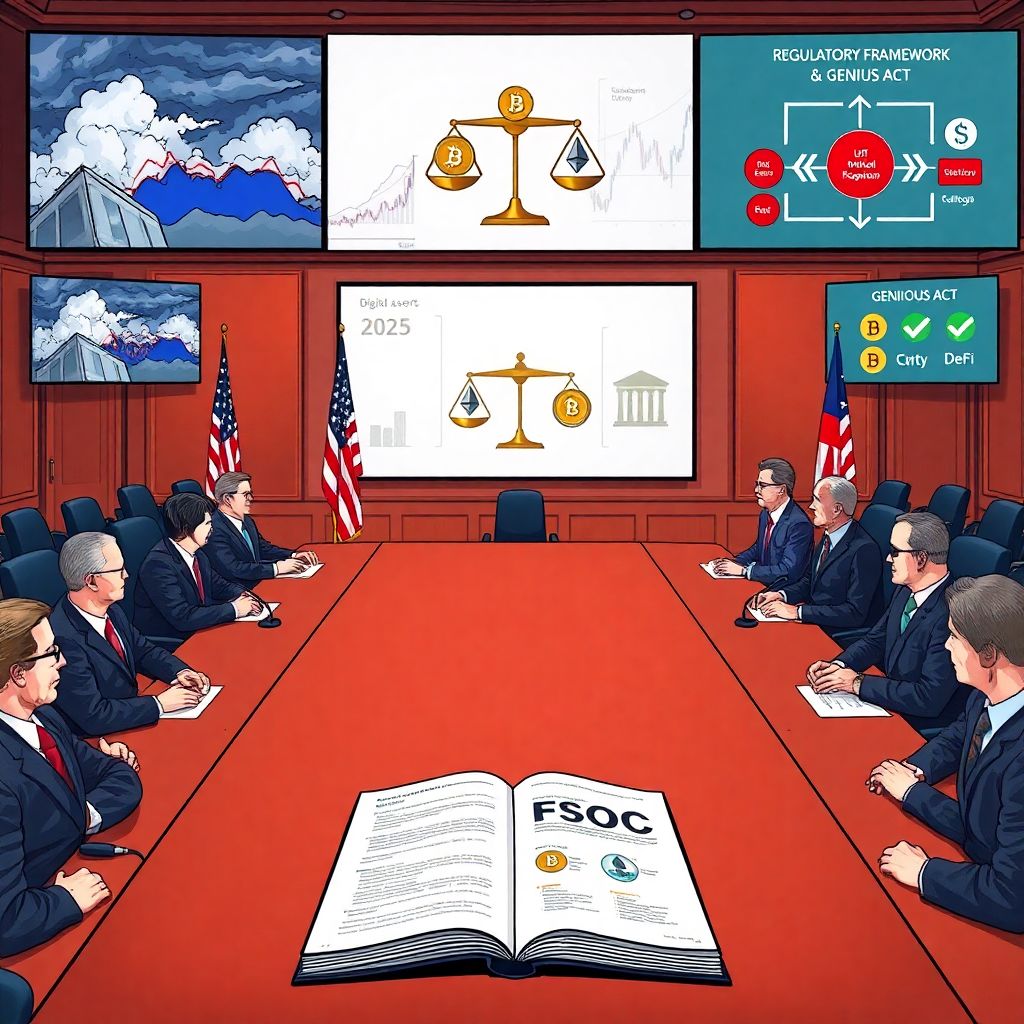
Financial Stability Oversight Council Softens Crypto Stance in 2025 Report
The Financial Stability Oversight Council’s (FSOC) 2025 annual report, released last week, marks a clear departure from the alarmist tone that defined its previous assessments of digital assets. After years of framing cryptocurrencies as a looming threat to U.S. financial stability, the council now acknowledges that recent legislation and regulatory advances have reduced many of the risks it once highlighted.
At the center of this shift is the GENIUS Act, a comprehensive federal law enacted earlier this year that establishes a clearer framework for the oversight of crypto assets, stablecoins, and digital-asset service providers. In the report, the FSOC argues that the Act has brought “meaningful regulatory clarity” to an industry that previously operated in a legal gray zone, and has helped move significant parts of the market under direct federal supervision.
Previous FSOC reports placed particular emphasis on the danger of spillovers from the crypto sector into traditional finance. They warned that unregulated stablecoins could trigger “run dynamics” reminiscent of money-market fund crises, that major crypto intermediaries suffered from poor governance and lax risk controls, and that digital assets were increasingly used to facilitate illicit finance. While the 2025 report does not walk back those concerns, it presents them in a more nuanced way and balances them with a recognition of concrete progress.
The council notes that several of the vulnerabilities it previously identified are now being addressed through licensing regimes, capital and liquidity standards, enhanced disclosures, and clearer roles for existing regulators. Stablecoin issuers that meet the GENIUS Act’s requirements, for example, are now subject to reserve rules and supervision aligned with other short-term dollar instruments. Large trading platforms and custodians, once largely unregulated, are beginning to operate under federal charters or equivalent oversight.
“The Council recommends continued implementation of the GENIUS Act and the prompt finalization of related rulemakings to ensure that emerging risks in digital-asset markets are addressed within a consistent regulatory framework,” the report states. At the same time, it stresses that “regulation should remain technology-neutral and focused on economic function rather than labels,” signaling an effort to integrate crypto into the broader financial system rather than treat it as a separate, inherently dangerous category.
A significant contextual factor in the council’s softer stance is the broader political environment. The report explicitly notes “a shift in policy priorities relating to digital assets,” an unmistakable reference to President Trump’s public embrace of the crypto industry and his administration’s push to position the United States as a leader in digital-asset innovation. Whereas prior administrations often framed crypto mostly as a risk to consumer protection and financial stability, current policymakers are increasingly weighing competitiveness, capital formation, and technological leadership alongside those concerns.
This change does not mean the FSOC has become a cheerleader for digital assets. The document still devotes substantial space to familiar warning signs: the opacity of some DeFi protocols, the concentration of trading activity on a small number of platforms, the potential for leveraged speculation, and the ongoing use of certain privacy tools and cross-chain bridges by bad actors. However, instead of portraying these issues as existential threats to the financial system, the report tends to cast them as “manageable risks” that can be mitigated through targeted regulation, supervision, and international cooperation.
One of the most notable shifts lies in the treatment of stablecoins. Earlier reports described them as a potential flashpoint for runs that could propagate into short-term funding markets. The 2025 edition draws a distinction between fully backed, regulated stablecoins and those that fall outside the new framework. The council acknowledges that compliant issuers now operate with “more robust reserve practices, enhanced transparency, and clearer redemption arrangements,” which in its view reduces the likelihood of panic-induced redemptions spilling over into traditional markets.
At the same time, the report cautions that unregulated or offshore stablecoins still pose risks, particularly if they become widely used for payments or trading by U.S. residents without adequate oversight. The FSOC urges regulators to monitor linkages between these tokens and the banking system, and to be prepared to act if liquidity stresses or operational failures emerge.
The council also offers a more granular assessment of crypto intermediaries than in the past. Rather than characterizing the sector as uniformly fragile or poorly run, the 2025 report differentiates between firms that have adopted “institutional-grade governance, risk management, and compliance programs” and those that have not. It notes that several major players now maintain board-level risk committees, independent audits, segregation of customer assets, and robust cybersecurity practices comparable to those in traditional finance.
However, the report warns that smaller or rapidly growing firms may still lack the controls necessary to weather market shocks or operational disruptions. It encourages primary regulators to tailor their supervisory approaches to the risk profiles of individual entities, rather than applying a one-size-fits-all model.
On the question of illicit finance, the FSOC’s tone has also evolved. Previous reports highlighted the use of crypto for money laundering, ransomware payments, and sanctions evasion, often implying that these activities were intrinsic to the technology. The 2025 report acknowledges that while digital assets continue to be used for illicit purposes, recent advances in blockchain analytics, combined with more comprehensive know-your-customer and anti-money-laundering requirements, have improved authorities’ ability to detect and respond to suspicious activity.
The council underscores that crypto should be subject to the same AML/CFT standards as other financial instruments, but it also recognizes the potential benefits of transparent, traceable ledgers when appropriate oversight tools are in place. This balanced framing contrasts sharply with earlier language that often portrayed the space primarily through the lens of criminal abuse.
Importantly, the report spends more time than in prior years discussing the potential benefits of responsible digital-asset innovation. It mentions opportunities to modernize payment systems, enhance cross-border settlement, expand access to capital markets, and develop new forms of tokenized assets. While careful to avoid endorsing specific business models or technologies, the FSOC makes clear that its mandate is not to “protect incumbents from competition,” but to ensure that innovation does not come at the expense of financial stability.
The GENIUS Act is presented as a key tool for achieving that balance. By clarifying which agencies oversee which segments of the market—and under what standards—the law aims to reduce regulatory fragmentation and the uncertainty that has long plagued both companies and investors. The council credits this clarity with encouraging more firms to seek compliant paths into the U.S. market rather than operating from less regulated jurisdictions.
Still, the report emphasizes that implementation is in its early stages. Many rules required by the Act remain in proposal form, and agencies must coordinate to avoid both gaps and duplication. The FSOC calls for “strong interagency cooperation” to align definitions, reporting requirements, and enforcement approaches, and signals that it will continue to serve as a forum for resolving cross-cutting issues.
Another theme is the growing interconnectedness between the crypto ecosystem and traditional finance. The report notes that banks, broker-dealers, and asset managers are increasingly offering digital-asset services or exposure through custody, structured products, and tokenized instruments. While this integration can support better risk management and investor protections, it also raises the possibility that shocks in crypto markets could have a more direct impact on regulated institutions.
In response, the FSOC proposes that supervisors closely monitor institutions’ digital-asset activities, with particular attention to leverage, liquidity mismatches, and operational dependencies on third-party service providers such as custodians and technology vendors. The council urges firms to include severe crypto-market stress scenarios in their internal stress tests and to assess how disruptions in blockchain infrastructure or smart contracts could affect their broader operations.
The report also touches on global dynamics. It notes that other major jurisdictions have moved forward with their own comprehensive frameworks for digital assets, and that the United States risks ceding influence over international standards if it lags behind. The council argues that a clear domestic framework, rooted in the GENIUS Act and existing financial laws, positions the U.S. to play a shaping role in cross-border regulatory coordination, especially on issues like stablecoin interoperability, cross-jurisdictional supervision, and shared approaches to enforcement.
For market participants, the 2025 FSOC report sends two signals at once. On one hand, it indicates that the era of treating all crypto activity as inherently destabilizing is over. The council now recognizes a spectrum of risk and is willing to distinguish between speculative, loosely regulated products and those that operate under robust regulatory guardrails. On the other hand, it makes clear that regulatory scrutiny is not going away—if anything, it is becoming more structured, data-driven, and integrated into the broader architecture of U.S. financial oversight.
Looking ahead, the report suggests several areas that will likely dominate the policy agenda in the coming years: the treatment of decentralized finance protocols, the prudential regulation of systemically important stablecoin issuers, the integration of tokenized real-world assets into capital and money markets, and the development of standards for digital-asset custody and market infrastructure. Each of these, the council notes, will require careful calibration to preserve financial stability while allowing productive experimentation.
Ultimately, the FSOC’s 2025 report reflects an evolution from viewing crypto primarily as a threat to seeing it as a durable, if still volatile, component of the financial landscape—one that must be governed by clear rules, consistent oversight, and an understanding that technology will continue to advance faster than regulation. The softened tone is not a sign of complacency, but an acknowledgment that the conversation has moved beyond “for or against crypto” toward a more practical question: how to manage its risks while harnessing its potential within the existing financial system.