
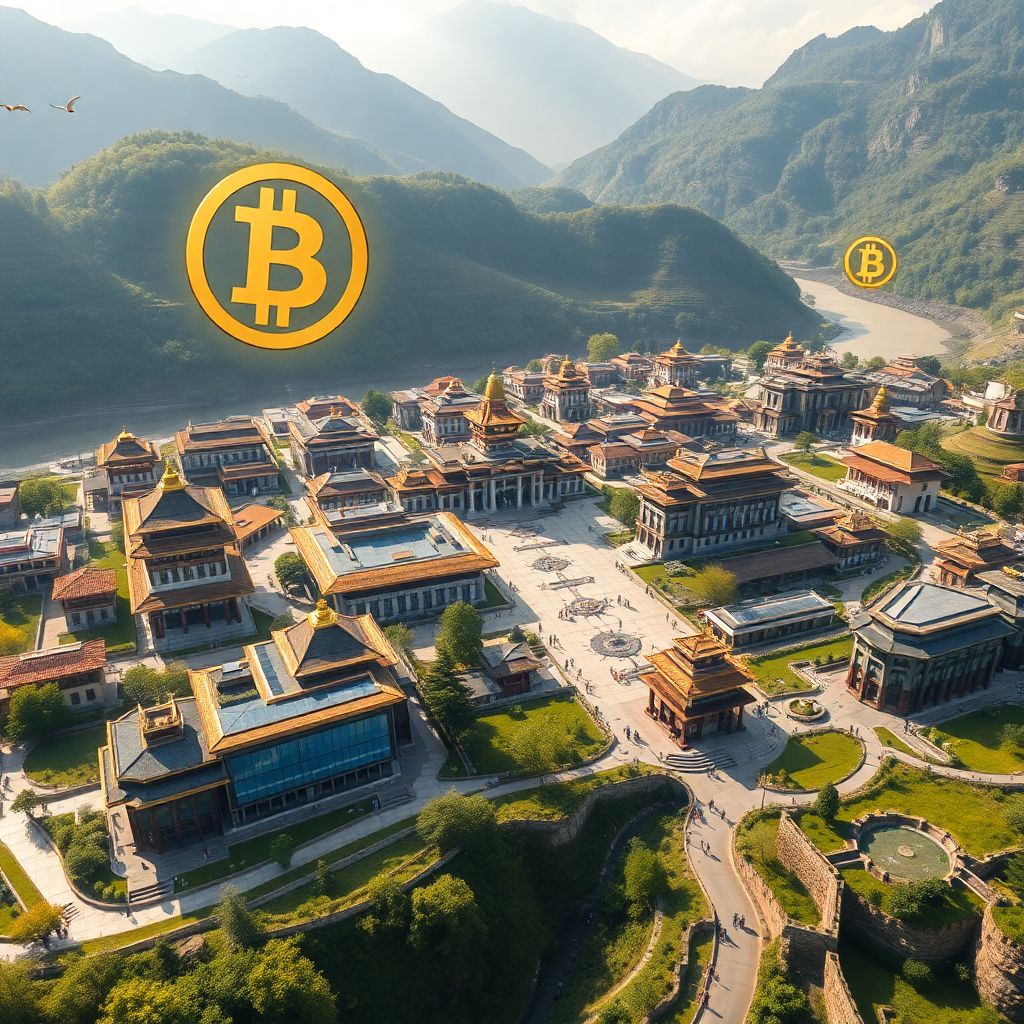
Bhutan Commits 10,000 Bitcoin to Build $1 Billion “Mindfulness City”
Bhutan has formally committed up to 10,000 Bitcoin—around $1 billion at current prices—from its sovereign digital asset reserves to finance the development of Gelephu Mindfulness City (GMC), a planned economic and cultural hub in the south of the country. The commitment, announced on Wednesday, positions Bhutan among the first nations to deploy such a large pool of state-held cryptocurrency directly into long‑term national infrastructure and development.
According to the plan, the 10,000 BTC will not be sold. Instead, the holdings are intended to be maintained as a long-term strategic reserve while generating yield to support the growth and operations of Gelephu Mindfulness City. In other words, the Bitcoin itself remains on Bhutan’s balance sheet as a sovereign asset, while the income it produces is directed toward building and expanding the city.
A Royal Vision for Shared Prosperity
The project is being framed not just as an economic initiative, but as a national mission. In his National Day Address, His Majesty King Jigme Khesar Namgyel Wangchuck underscored that the benefits of the Mindfulness City must extend to every citizen.
“As your King, I must ensure that every Bhutanese is a custodian, stakeholder, and beneficiary of GMC,” he declared. “This commitment is for our people, our youth, and our nation.”
The language reflects a broader philosophy behind the project: Gelephu Mindfulness City is meant to embody Bhutan’s long-standing emphasis on well‑being, culture, and environmental stewardship, while simultaneously opening the door to new forms of economic opportunity, jobs, and innovation. The Bitcoin Development Pledge is being presented as a core financial pillar supporting that ambition.
One of the Largest Sovereign Crypto Commitments
City officials described the Bitcoin Development Pledge as one of the largest known sovereign commitments of digital assets to infrastructure and development anywhere in the world. While some governments have disclosed digital asset holdings or experimented with crypto-related policies, Bhutan’s move stands out for its scale and its clear link to a specific, long-horizon national project.
By anchoring a major economic development plan in a reserve of Bitcoin, Bhutan is effectively using crypto not only as a store of value but as a financial engine for public investment. Yields generated from these reserves are expected to support everything from physical infrastructure and utilities to innovation programs and social initiatives within the Mindfulness City.
What Is Gelephu Mindfulness City?
Gelephu Mindfulness City is envisioned as more than a conventional economic zone. Planned for southern Bhutan near major regional trade routes, the city aims to blend modern infrastructure with Bhutan’s core values—mindfulness, environmental harmony, and social cohesion.
The project is expected to host a mix of sectors:
– Technology and digital services that can tap into global demand for remote and high‑value knowledge work.
– Health, wellness, and education centers aligned with Bhutan’s reputation for spiritual and mental well‑being.
– Sustainable tourism and culture-based industries that showcase Bhutanese heritage, arts, and traditional practices.
– Green and resilient infrastructure, designed to minimize environmental impact and prepare for climate-related challenges.
The Bitcoin-backed funding model is meant to give planners a long-term source of capital, allowing them to design the city with decades of growth and adaptation in mind rather than chasing short-term returns.
A New Model for Digital Reserves
Bhutan’s approach highlights a significant shift in how digital assets can be integrated into sovereign finance. Instead of treating Bitcoin as purely speculative or as an emergency reserve, Bhutan intends to use its holdings as a productive asset while maintaining long-term exposure.
While detailed mechanics have not been fully disclosed, the stated goal is to use yield from the 10,000 BTC to underwrite Gelephu’s development. In practice, that may involve a mix of:
– Allocating a portion of reserves to yield-generating strategies within carefully managed risk parameters.
– Using Bitcoin as collateral to unlock additional financing for infrastructure and enterprise development.
– Maintaining a strategic core reserve that is not touched, preserving long-term national wealth.
Crucially, Bhutan has ruled out outright selling the Bitcoin reserves as part of this initiative, underscoring that the assets are being treated as a long-term national store of value rather than a short-lived funding source.
Jobs, Innovation, and National Resilience
The initiative is framed around three major goals: job creation, economic development, and national resilience.
Job creation:
Gelephu Mindfulness City is expected to become a magnet for new employment opportunities, particularly for younger Bhutanese entering the workforce. The city plans to emphasize sectors that can offer skilled jobs—technology, services, creative industries, wellness, and research—rather than only low-wage or transitional work.
Economic development:
By anchoring a significant new hub in the south of the country, Bhutan aims to diversify its economy beyond traditional pillars such as hydropower and agriculture. Gelephu could become a gateway for trade, investment, and collaboration with regional and international partners, while still preserving Bhutan’s carefully managed approach to modernization.
National resilience:
Using Bitcoin reserves to fund a long-term strategic project is also a hedge against global uncertainty. Diversifying state assets and building new economic engines may help Bhutan better withstand external shocks—whether financial, environmental, or geopolitical—by reducing overreliance on a narrow range of revenue sources.
Ensuring All Bhutanese Share the Benefits
A key feature of the King’s message is inclusivity. The plan is structured so that citizens across all regions, not only residents of Gelephu, can participate in and benefit from the Mindfulness City.
This may take the form of:
– Nationwide skills and training programs preparing Bhutanese for jobs and entrepreneurship opportunities connected to GMC.
– Business linkages that allow farmers, artisans, and small enterprises in rural areas to sell goods and services into the city’s economy.
– Public infrastructure and digital connectivity upgrades that tie remote regions more closely to national and international markets through Gelephu.
By positioning every Bhutanese as a “custodian, stakeholder, and beneficiary,” the project aspires to avoid the common trap where large developments create localized prosperity while leaving the rest of the country behind.
Balancing Tradition and High-Tech Finance
Bhutan’s decision to rely on Bitcoin to fund a city centered on “mindfulness” may sound paradoxical at first glance, but it fits within a broader national narrative: embracing selective modern tools while protecting cultural identity and spiritual values.
The Mindfulness City is meant to demonstrate that advanced finance and technology—crypto reserves, digital services, high‑tech infrastructure—can be deployed in a way that supports, rather than erodes, a society’s deeper priorities. Urban design, environmental regulations, and cultural planning for Gelephu are all expected to reflect Bhutan’s philosophy of holistic well‑being.
In that sense, the project is an experiment: can a nation use cutting-edge digital assets to strengthen an economy built around happiness, balance, and long-term thinking instead of short-term profit alone?
Potential Risks and Long-Term Considerations
Committing such a large amount of Bitcoin to a single strategic vision is not without risk. Bitcoin prices are historically volatile, and global regulation of digital assets remains in flux. Bhutan’s strategy, therefore, requires careful risk management, conservative assumptions, and contingency planning in case of severe market downturns.
However, by explicitly rejecting the idea of liquidating its reserves and instead focusing on long-term holding and measured yield generation, Bhutan appears to be approaching Bitcoin as a multi-decade asset, not a short-cycle trade. This perspective is more aligned with how central banks treat gold or strategic reserves than with speculative crypto trading.
Over the long run, the success of the Bitcoin Development Pledge will likely be judged less by short-term price movements and more by tangible outcomes: how many sustainable jobs are created, how resilient and inclusive Gelephu becomes, and whether the city truly enhances national well‑being.
What This Means for the Future of Sovereign Crypto Strategy
Bhutan’s pledge may serve as a reference point for other countries watching the intersection of digital assets and public finance. While not every nation holds significant crypto reserves, the idea of using blockchain-based assets as productive, yield-generating instruments for public projects is now more than theoretical.
If the Gelephu Mindfulness City succeeds—delivering growth, innovation, and social benefits while preserving culture and environment—it could encourage other states to explore similar models. Conversely, any missteps or unmanaged risks will be closely studied as cautionary lessons.
For Bhutan itself, the decision to put 10,000 Bitcoin behind a single, clearly articulated national vision signals confidence: confidence in its digital-asset strategy, confidence in its developmental model, and confidence that a mindfulness-centered city, powered in part by crypto, can contribute to a more prosperous and resilient future for all Bhutanese.