
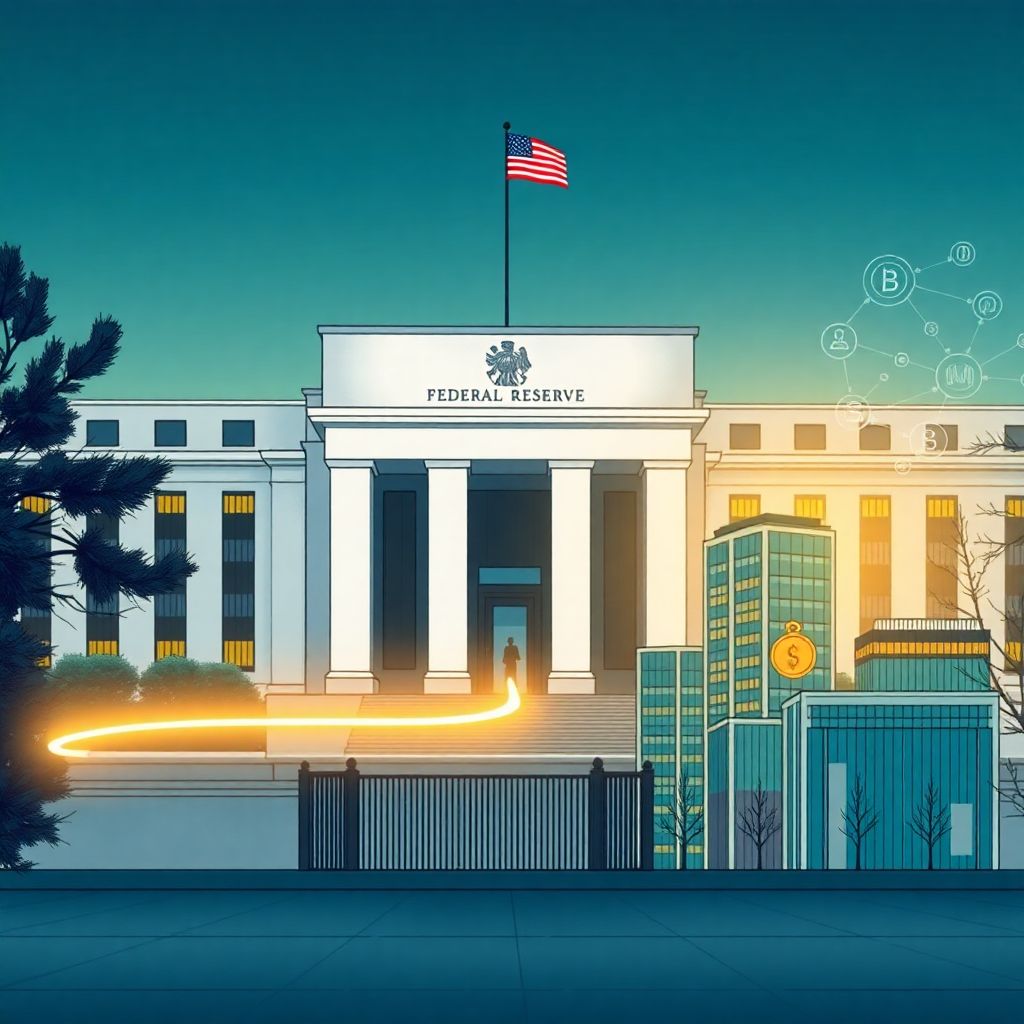
Fed officials are pressing ahead with a scaled‑down version of their most sought‑after banking credential, opening a potential path—albeit a narrow one—for crypto‑focused institutions to plug directly into the U.S. payment system.
The central bank has formally requested public comment on a proposal to create a fast‑track approval framework for so‑called “innovation‑focused” banks. At the heart of the plan is a stripped‑back, or “skinny,” master account: a limited‑purpose account at the Federal Reserve that would give qualifying firms access to core payment infrastructure without granting them the full range of privileges enjoyed by traditional banks.
What a “skinny” master account actually is
A master account at the Fed is effectively a bank’s passport to operate on a national scale. It allows an institution to settle payments directly through the Federal Reserve’s systems, including real‑time gross settlement and other key rails that underpin the U.S. financial system. For decades, these accounts have been the domain of regulated banks and certain specialized entities subject to stringent oversight.
The proposed “skinny” version would be more constrained. Instead of opening the door to all the functions of a standard master account, the Fed is exploring a tightly circumscribed access model with heightened conditions, aimed specifically at newer, technology‑driven financial firms—including crypto banks—that otherwise sit outside the conventional banking perimeter.
Why this matters for crypto banks
Crypto‑native banks and custodians have long argued that direct access to the Fed’s payment system is essential if they are to compete on equal footing with traditional financial institutions. Today, most must rely on correspondent banking relationships or intermediaries to move dollars, adding cost, complexity, and counterparty risk.
A master account would, in theory, allow a crypto bank to:
– Hold balances directly at the Fed rather than exclusively at commercial banks.
– Clear and settle payments in central bank money instead of depending on private intermediaries.
– Offer faster, potentially cheaper services to clients moving funds between fiat and digital assets.
However, full master account access has been repeatedly denied to several high‑profile crypto banks, with the Fed and regional Reserve Banks pointing to concerns about financial stability, compliance gaps, and the risks of tying volatile digital asset activities into the heart of the payments system.
The “skinny” account concept is the Fed’s attempt to square that circle: provide limited access that fosters innovation and competition, but under constraints designed to insulate the broader banking system from crypto‑related shocks.
From idea to proposal: Waller’s October blueprint
Fed Governor Christopher J. Waller first publicly floated the idea of a restricted‑scope master account in October. At the time, he framed it as a way to accommodate firms that are experimenting with new financial technologies—such as tokenized deposits, stablecoin‑adjacent products, or blockchain‑based payment solutions—without granting them the same privileges as well‑capitalized, diversified banks.
Under that early vision, a “skinny” master account could come with:
– Narrowly defined use cases for payments and settlement.
– Stronger liquidity and capitalization requirements relative to risk.
– Tight limits on activities considered high‑risk, such as proprietary trading in volatile digital assets.
– Enhanced reporting and supervisory expectations tailored to novel business models.
The new request for comment indicates that the Fed is now turning that conceptual sketch into a more concrete policy framework.
The Fed’s long‑running skepticism toward crypto banks
Behind the proposal lies a history of friction between crypto‑oriented firms and the central bank. Several digital asset banks and trust companies have pursued master accounts or membership in the Federal Reserve System over the past few years, often with public disputes when those efforts stalled or were denied.
Regulators have consistently argued that granting unfettered access to entities whose balance sheets are closely tied to crypto markets could transmit volatility, liquidity stress, or operational failures into the core of the U.S. financial system. They have also raised questions about:
– The adequacy of compliance controls for anti‑money laundering and sanctions.
– The resilience of technology infrastructure underpinning tokenized or blockchain‑based services.
– The legal clarity around certain digital asset activities and customer protections.
This backdrop helps explain why the Fed is not proposing open‑door access, but a narrower, more controlled structure.
How the fast‑track process would work
The plan under discussion introduces a “fast‑track” approval lane for institutions that meet the Fed’s definition of “innovation‑focused” and can satisfy a pre‑set list of risk and compliance benchmarks. While details are still being fleshed out, the framework is likely to include:
– Standardized application criteria specific to non‑traditional banks and fintech‑style entities.
– A more predictable timeline for review, in contrast to the opaque and often lengthy processes many applicants have faced.
– Pre‑defined risk categories, with corresponding safeguards, depending on the nature of the firm’s activities and its regulatory home.
Importantly, the fast‑track does not guarantee approval. Instead, it is designed to make the process more transparent and to distinguish between applications that are broadly suitable for narrow access and those that remain too risky for any form of Fed account.
Public comment and the battle of narratives
By putting the proposal out for public comment, the Federal Reserve is inviting banks, fintechs, crypto firms, academics, and consumer advocates to shape the final rules. The debate is likely to fall along familiar lines.
Supporters will argue that:
– Direct, though limited, access to Fed rails can reduce concentration risk in payments and make the system more competitive.
– Clear guidelines are better than the ad hoc, case‑by‑case rejections that have characterized recent years.
– Innovation in areas like tokenized deposits, programmable money, and real‑time settlement depends on reliable access to central bank infrastructure.
Critics, particularly from within the traditional banking sector, are expected to counter that:
– Any weakening of the traditional gatekeeping around master accounts could undermine the safety and soundness of the system.
– Oversight of non‑traditional banks remains uneven across state and federal regimes.
– Crypto‑exposed balance sheets and business models are still too unstable to be connected—even indirectly—to central bank money.
The Fed will have to synthesize these competing views into a final policy that can withstand both political and market scrutiny.
What “skinny” access might look like in practice
While the precise contours are still in flux, a practical implementation of the “skinny” master account could involve:
– Functional limits: Accounts usable only for specific payment and settlement activities, not for broad lending or investment operations.
– Balance caps: Limits on the size of balances or transaction volumes that can pass through the account.
– Ring‑fencing requirements: Clear separation between activities that tap Fed infrastructure and higher‑risk crypto or trading operations elsewhere in the group.
– Enhanced disclosures: Detailed reporting to supervisors on flows related to digital asset transactions, customer concentrations, and liquidity positions.
Such constraints would aim to ensure that if a crypto‑oriented firm encounters market turmoil, the damage is contained and does not propagate through Fed payment channels.
Implications for stablecoins and tokenized dollars
The proposal is also highly relevant for issuers of stablecoins and tokenized cash‑like instruments. Many such issuers insist their tokens are fully backed by high‑quality dollar assets, including Treasury bills and bank deposits. Direct access to a Fed account—even in skinny form—could strengthen that claim by allowing some reserves to sit directly at the central bank.
That, in turn, raises strategic questions:
– Will some stablecoin providers seek banking charters or special‑purpose licenses to qualify for skinny accounts?
– Could limited Fed access become a differentiator between “safer” and “riskier” dollar‑pegged tokens in the eyes of regulators and institutions?
– How will traditional banks respond if non‑bank issuers of tokenized dollars gain even partial access to central bank money?
The answers will shape the competitive landscape for digital dollars in the coming years.
A cautious opening, not a green light
For the crypto industry, the Fed’s move is not a blanket endorsement of digital assets. It is better understood as a cautious opening: a recognition that completely excluding new financial models from central bank infrastructure may be unsustainable, but that integrating them must be done on the Fed’s terms, with risk controls front and center.
In practical terms, many crypto banks will still face substantial hurdles. They will need:
– Robust governance and risk management frameworks that resemble, in key respects, those of traditional banks.
– Clear regulatory status, whether via state banking charters, federal oversight, or both.
– The ability to demonstrate resilience through stress scenarios that include severe crypto market downturns.
Only a subset of firms—those with the most conservative structures and the deepest compliance investments—are likely to meet the bar for even a “skinny” account.
What happens next
Over the coming months, the Fed will collect and analyze feedback on the proposal, adjust the contours of its plan, and eventually publish a finalized framework. Once that is in place, innovation‑focused banks, including crypto‑sector players, will have the first formalized path to apply for a limited‑scope master account under transparent criteria.
Whether this marks the beginning of a broader integration of digital asset institutions into the core of the U.S. financial system—or remains a carefully contained experiment—will depend on how both regulators and the industry navigate the balance between innovation and systemic safety.
For now, the message from the central bank is clear: outright exclusion is giving way to tightly managed access. The era of the “skinny” master account is moving from concept to reality, and crypto banks will have to decide how—and whether—to adapt their business models to fit within its narrow but significant opening.