
Marshall Islands turn to crypto to deliver basic income as cash and banks fall behind
Access to money in the Republic of the Marshall Islands (RMI) is undergoing a quiet but radical experiment. Faced with crumbling cash infrastructure and limited access to traditional banking, the Pacific island nation has begun using a blockchain-based system to distribute universal basic income (UBI) to its citizens.
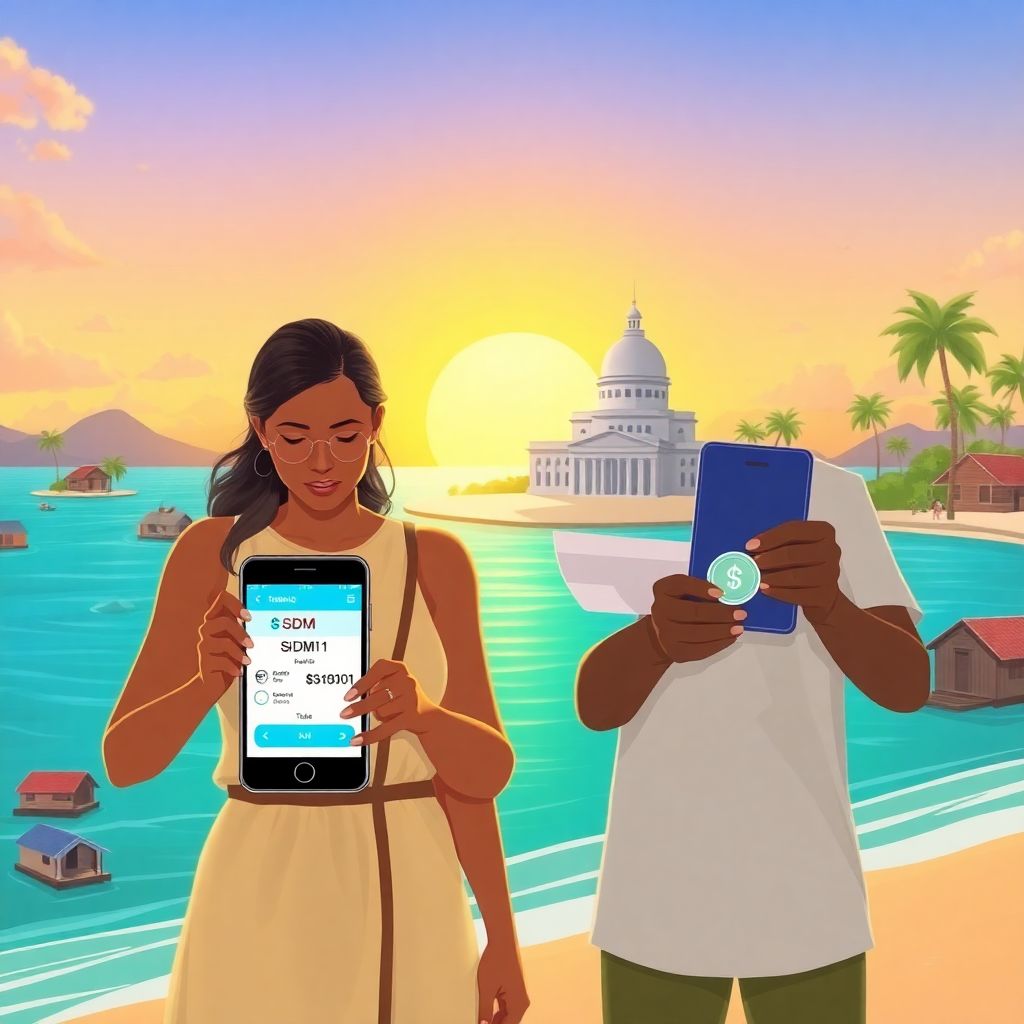
At the end of last month, residents enrolled in ENRA, the Marshall Islands’ UBI program, received their regular benefits in two very different ways. Some collected old‑fashioned paper checks. Others opened a mobile app called Lomalo and found a new digital asset—USDM1—credited to their “digital citizen wallet.”
Lomalo runs on Stellar, a blockchain network designed for fast, low-cost payments. The wallet and its integration were developed by Crossmint, a company that specializes in enterprise blockchain tools. For the roughly 40,000 people living across the RMI’s scattered atolls and islands, this marks the first real-world test of whether crypto infrastructure can stand in for the banking services they largely lack.
Why the Marshall Islands need an alternative
The RMI has long struggled with financial inclusion. Large commercial banks have little incentive to maintain expensive physical branches across sparsely populated islands. International “de-risking” pressures have also led some foreign banks to scale back correspondent relationships with small jurisdictions, making cross-border payments slower, costlier, and less reliable.
For many Marshallese, that has translated into a patchwork system of cash, checks, and limited banking options that do not always reach remote communities. Government programs like ENRA, which aims to provide a consistent income floor to citizens, are particularly vulnerable to these constraints: distributing checks requires physical presence, transportation, and time—things that are often in short supply.
Against this backdrop, digital assets are not just a buzzword but a potential lifeline. A mobile wallet that works over basic internet or cellular connections can reach citizens on distant atolls far more efficiently than a bank branch or a mailboat full of envelopes.
What is USDM1 and how is it different from a typical stablecoin?
The token used in the pilot, USDM1, is not a conventional crypto stablecoin issued by a private company against reserves held in commercial banks. Instead, it is structured as a fully collateralized sovereign bond instrument.
According to Paul Wong, director of special projects at the Stellar Development Fund (SDF), each USDM1 token represents a claim on a government-backed bond. The collateral generates yield, and the token itself is meant to function as both an investment-grade asset and a day-to-day medium of exchange within the Marshallese economy.
The crucial distinction from many stablecoins is where the returns go. In many commercial stablecoin models, the issuer invests reserves in interest-bearing assets and captures the yield while users simply hold tokens pegged to a currency. In the Marshall Islands’ design, the economic benefit from the underlying bond is meant to accrue to the public—either directly to token holders or indirectly via government programs—rather than to a private intermediary.
In other words, the state is experimenting with a structure where the same asset that backs people’s digital money can also help fund public goods or strengthen fiscal stability.
Lomalo: a “digital citizen wallet” instead of a bank account
The Lomalo wallet is more than a generic crypto app; it’s designed as a “digital citizen wallet” tailored for government payments. Residents can receive their ENRA disbursements in USDM1, check balances, and eventually use those balances to pay for goods and services, send funds to other users, or convert them into other forms of money.
Because it runs on Stellar, transfers of USDM1 can be confirmed in seconds and cost a fraction of a cent in network fees. This is a significant improvement over the current reality, where sending or receiving funds often involves long waits, paperwork, and transportation between islands or even different countries.
For citizens who have never had a formal bank account, Lomalo effectively becomes their entry point into a functional digital economy: a place where they can store value securely, track their income, and participate in electronic payments without needing a traditional bank.
How the pilot UBI distribution works in practice
During the recent ENRA distribution, the government split recipients into two tracks. One group continued to receive paper checks as before. The other received their benefits entirely in USDM1 via Lomalo. This setup allows the authorities and technology partners to compare real-world outcomes between the two methods:
– How quickly do people actually access their funds?
– How often do payments get lost, delayed, or misdirected?
– Do digital recipients face usability barriers such as low connectivity or lack of digital literacy?
– Are merchants willing and able to accept USDM1 in exchange for goods and services?
These questions are critical for determining whether a blockchain-based system can genuinely serve as a substitute—or even an upgrade—for legacy banking in a geographically fragmented country.
Why a sovereign bond-backed token matters
Choosing a sovereign bond structure for USDM1 is a strategic move with several implications:
1. Credit quality and trust
Because the token is backed by government bonds, its safety is tied to the creditworthiness of the issuing state and its partners rather than the business risk of a private stablecoin issuer. For citizens, this can make the digital asset feel more like a state-guaranteed instrument than a speculative crypto token.
2. Alignment with public policy
The yield generated by the underlying bonds can be directed toward national priorities—UBI, infrastructure, health, or climate resilience—creating a feedback loop where the digital money system reinforces social programs instead of merely riding on top of them.
3. Reduced reliance on foreign banks
By anchoring its digital currency to its own sovereign instruments, the RMI can potentially reduce dependence on external banking systems that have previously been reluctant to serve small island jurisdictions.
Potential benefits for citizens and the state
If the pilot proves successful and scales, the Marshall Islands could see several tangible advantages:
– Faster and cheaper government payments
UBI, pensions, and other social transfers can move instantly over the Stellar network, reaching citizens without delays, lost envelopes, or costly intermediaries.
– Broader financial inclusion
Anyone with a basic smartphone and intermittent internet access can participate. Even offline or low-connectivity solutions, such as QR codes or agent-based cash-out points, can be layered on top.
– Transparent and auditable flows
Blockchain’s inherent traceability allows auditors and policymakers to verify that funds reach the correct recipients, reducing fraud and improving policy evaluation.
– Monetary and fiscal experimentation
With a programmable digital asset, the government could experiment with targeted stimulus, conditional transfers (for example, disaster relief tied to specific events), or time-limited vouchers that encourage spending in certain sectors.
Challenges and open questions
Despite its promise, the initiative is far from risk-free or frictionless.
– Digital literacy and trust
Many Marshallese citizens may not be familiar with private keys, seed phrases, or crypto concepts. The success of Lomalo depends on whether it can abstract away complexity and earn trust. Losing access to a wallet should not mean losing access to vital income.
– Connectivity gaps
Some atolls have spotty or unreliable internet. Any serious rollout must include offline-friendly features or local agents who can help users access balances and cash out when necessary.
– Merchant acceptance
For USDM1 to function as real money, stores, service providers, and employers must be willing to use it. That involves building a local payment ecosystem—POS tools, simple QR-pay apps, and familiar pricing in local currency equivalents.
– Regulation and oversight
Blending a sovereign bond with a digital token raises regulatory questions. Authorities must clarify how USDM1 is classified, what protections users have, and how the system fits into domestic and international financial rules.
How the experiment fits into global digital currency trends
The Marshall Islands’ approach sits at the crossroads of several global trends:
– Central bank digital currency (CBDC) research, where governments explore digital versions of national currencies;
– Yield-bearing digital assets, where on-chain instruments represent rights to real-world income streams;
– Public-sector use of blockchain, not just for pilots and proofs-of-concept but for delivering real social benefits.
Unlike many CBDC projects, however, the RMI is starting with a very specific use case—universal basic income—and a concrete problem: the inadequacy of its existing cash-and-banks system. That focus could make it easier to measure results and justify continued investment.
Could this model be replicated elsewhere?
Small island states and remote territories around the world face similar challenges: thin banking infrastructure, high remittance costs, and dependence on foreign financial institutions. If the RMI’s experiment with USDM1 and Lomalo proves effective, other governments may study the model for:
– Distributing social benefits in hard-to-reach regions;
– Reducing transaction costs for remittances and cross-border payments;
– Issuing small, retail-facing slices of sovereign bonds in user-friendly digital form;
– Creating domestic digital payment rails that reduce reliance on cash.
However, replication is not trivial. Each country has its own legal framework, monetary policy, and technological capacity. What works in a nation of 40,000 spread across the Pacific may need significant adaptation to function in larger, more complex economies.
The bigger question: can crypto really replace basic banking?
The Marshall Islands’ trial does not attempt to replace the entire banking system overnight. Instead, it targets the core services many citizens need most: receiving money from the state, holding it securely, and spending or sending it as needed.
If a blockchain wallet can reliably fulfill those functions—especially in a place where conventional banking has repeatedly fallen short—it strengthens the argument that digital assets can act as a practical backbone for financial inclusion, not just as speculative investments.
The coming months and years will reveal whether USDM1 and Lomalo become a permanent fixture of Marshallese life or remain a limited experiment. Either way, the RMI has positioned itself at the forefront of a critical question for the 21st century: when traditional financial infrastructure fails to reach everyone, can carefully designed crypto systems step in and make universal access to basic income and payments a reality?