
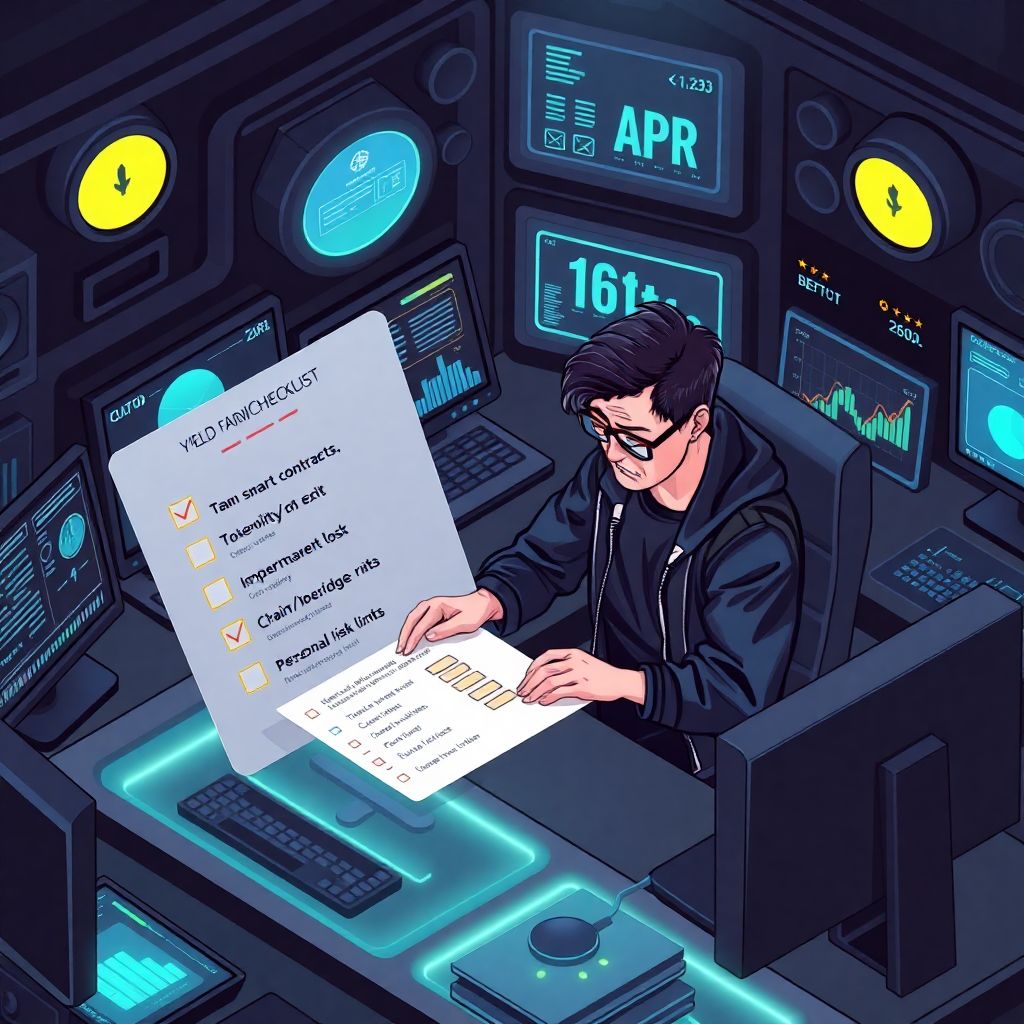
Why You Need a Yield Farming Checklist Before Clicking “Deposit”
Most people discover yield farming through screenshots of insane APRs and stories about “money working while you sleep”. What they don’t see: smart contracts frozen, liquidity pools drained, or governance tokens collapsing by 80% in a week. Yield farming looks like a magic money printer only until you realize it’s really a set of stacked risks that you either control or you don’t. A clear checklist forces you to slow down, frame yield as payment for risk, and treat every new farm as a small due‑diligence project, not a lottery ticket.
—
Historical Context: How We Got to Today’s Farms
Yield farming didn’t emerge from nowhere. It started with simple liquidity mining: protocols like Compound and Aave paying users in governance tokens to bootstrap liquidity. Uniswap and other AMMs turned LP positions into tradable shares, and the “DeFi summer” of 2020 layered leverage, auto‑compounding, and complex vaults on top. From there, experimentation went wild: food coins, anonymous devs, unaudited contracts chasing the highest apy defi yield farming numbers on tracking sites. Understanding this history matters, because it shows a pattern: incentives first, safety later. Your checklist is the tool that flips that order for you personally.
—
Basic Principles: How Yield Farming Actually Pays You
Before any checklist, you need a mental model. Yield farming is not free money; it’s compensation for providing scarce resources: liquidity, collateral, or risk absorption. Protocols pay you in one or more tokens because you take three main risks: smart contract failure, market volatility, and economic exploits. best yield farming platforms usually optimize three levers: capital efficiency, security, and incentive design. When you evaluate a farm, you’re really judging how those levers are tuned and whether the extra APR justifies the extra risk. Lock this logic in before you look at any flashy UI.
—
10-Point Yield Farming Checklist (with Some Unusual Moves)
1. Who’s Actually Running This Thing?
Start with people, not numbers. Check the team: are they public, pseudonymous with a long on‑chain track record, or completely anonymous and new? Look for GitHub activity, prior projects, and community presence. A doxxed team isn’t a guarantee of safety, but it raises the cost of running away. Now the non‑standard move: search the dev wallets on-chain using explorers and see how they interact with the protocol. Are they farming alongside users or only dumping incentives? A team not “eating its own dog food” is a red flag, no matter the APR.
—
2. Smart Contract Reality Check (Beyond “Audited = Safe”)

Most users stop at “we’re audited” in the docs. Go deeper. Check: who did the audit, how many issues were found, and whether there were follow‑up audits after major upgrades. Search for bug bounties and active security programs. Then use an unusual but powerful trick: look at how often the core contracts change. Constant redeployments suggest unstable architecture; no upgrades ever may mean the team patched nothing after launch. For very high TVL protocols, see if multiple formal verification reports exist. Low risk doesn’t mean no risk, but you should feel you’re paid appropriately for the code you’re trusting.
—
3. Tokenomics: Where Does Yield Really Come From?
If you don’t understand the reward token, you don’t understand the yield. Map the tokenomics: emission schedule, vesting, and who gets how much. If your reward is a governance token with infinite inflation and no revenue share, you’re often just front‑running future sellers. A practical test: imagine everyone auto‑compounds rewards for six months. Does the circulating supply explode while demand stays flat? If yes, you’re betting on momentum, not fundamentals. In serious protocols, part of the yield is funded by real fees from users, not just printed tokens. Those are the places that can survive market cycles.
—
4. Liquidity and Exit Plan (Assume You’ll Need to Run)
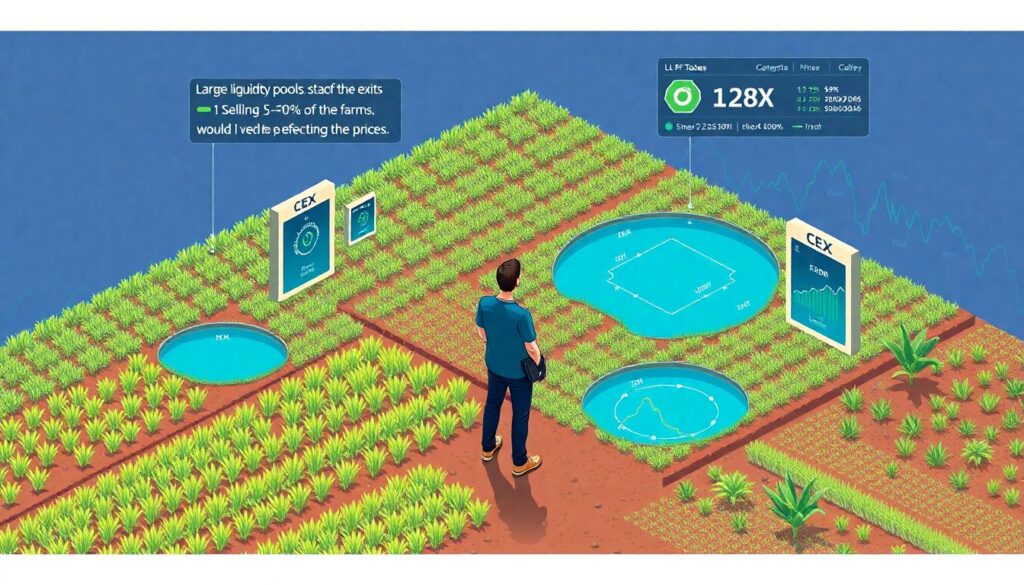
A farm is only as good as your ability to exit. Before depositing, decide how you would unwind under stress. Check the depth of liquidity for the LP token or reward token on major DEXes and CEXes. If selling 5–10% of the farm’s TVL would crash the price, you’re effectively locked. Here’s a non‑standard tactic: simulate an exit in a portfolio tracker or DEX aggregator with a mid‑range amount (say $5k–$20k) and see slippage. Do this for both your LP token and the reward token. If the exit looks ugly in calm markets, it will be worse in a panic.
—
5. Impermanent Loss and Correlation, Not Just APR
For pairs, yield is frequently just compensation for impermanent loss (IL). Calculate IL assuming a 30–50% move in each asset; plenty of online calculators help. What many farmers miss is correlation: pairing a new governance token with ETH is very different from pairing two stablecoins. If you’re using yield farming strategies for beginners, a counterintuitive but smart move is to prioritize highly correlated pairs (e.g., staked ETH derivatives with ETH) where IL is limited. You might earn less headline APR but keep more of your value when markets move sharply in either direction.
—
6. Chain and Bridge Risk: Don’t Ignore the Base Layer
Most checklists stop at the protocol, but yield depends on the entire stack. Ask: How decentralized is the L1/L2? How many validators or sequencers exist? What’s the history of outages or reorgs? If a farm involves bridged assets, you inherit bridge risk, which historically has been one of the largest sources of loss in DeFi. Non‑standard move: treat bridged tokens with an internal haircut (e.g., value them at 80–90% of face value in your personal risk model) unless the bridge has battle‑tested history and strong security assumptions. Your effective APR often shrinks after you mentally price that risk.
—
7. Incentive Design: Sustainability vs. Ponzinomics
You want rewards that become more valuable as the protocol grows, not rewards that require constant new entrants. Look for fees flowing to tokenholders, real demand for the protocol’s core product, and emissions that decrease over time. If most TVL leaves the protocol when rewards are tapered, it was pure mercenary capital. A neat trick: ignore all farms younger than 3–6 months and see which pools kept TVL after initial hype died. Protocols that retain sticky liquidity without constant bribes are usually safer foundations for how to earn passive income with crypto yield farming over the long run.
—
8. Governance and Upgradability: Who Can Flip the Switch?
Check admin keys and timelocks. Can a multisig instantly change withdrawal logic, fee parameters, or pause the protocol? Who sits on that multisig, and are they publicly known? A yield farm with an “emergency admin” that can reroute funds is, in practice, custodied capital. For a more advanced, non‑standard safeguard, read the upgradeability pattern: is it a proxy contract that can be pointed at entirely new logic? If yes, your checklist should include whether upgrades require on‑chain governance plus a delay, or just a small group of signers. Control equals risk; you should know exactly who holds it.
—
9. Operational Hygiene: Front-End, Oracles, and UX Traps
Many losses come not from core logic but from peripheral components. Check which oracles the protocol uses (Chainlink, custom TWAPs, or proprietary solutions) and how often they’ve been manipulated historically. A farm dependent on thinly traded oracle feeds invites economic exploits. Also, don’t underestimate front-end risk: fake UIs, DNS hijacks, or scripts injecting malicious contract calls. Non‑standard habit: always verify the contract address from multiple independent sources (docs, explorers, reputable aggregators) and pin it in your wallet. Treat every new dApp like a browser extension: assume it might try to over‑request permissions unless proven otherwise.
—
10. Your Personal Constraints: Caps, Checkpoints, and Kill Switches
The final checklist item isn’t on-chain; it’s in your behavior. Define hard rules: maximum percentage of your net worth in any single protocol, chain, or smart contract stack; minimum time between deposit and top‑up (no FOMO deposits); and a “kill switch” condition (e.g., protocol loses 30% TVL or token dumps 40% on volume). A surprisingly effective, unusual tactic: create a simple written memo for each farm—why you entered, what you’re assuming, and when you exit. When conditions change, you compare reality to the memo instead of reacting emotionally to price swings or Twitter threads.
—
Case Studies: How to Apply the Checklist in Practice
Consider a new farm offering 250% APR on a volatile governance token–ETH pair. Using the checklist, you note: anonymous team with no prior track record, a single audit by a small firm, emissions front‑loaded in the first month, and LP liquidity shallow relative to TVL. Impermanent loss at realistic price swings wipes out much of the advertised return, and a central admin key can pause withdrawals. Your decision: skip or size it at a tiny, strictly speculative amount. Now compare that to a mature money market on a major chain, where yield is mostly fee‑driven and token rewards are modest. Your checklist would likely green‑light a larger, more stable allocation.
—
Common Misconceptions and How to Avoid Them
One big myth is that more decentralization automatically equals more safety. A protocol with scattered governance but no clear security process can still be fragile. Another misconception: stablecoin pools are “risk‑free”; in reality, they layer smart contract, peg, and oracle risk. Many newcomers treat APY as a fixed promise, not a moving target that trends down as TVL rises. When you analyze yield farming risks and how to avoid scams, you’ll find most scams exploit social assumptions, not code—fake partnerships, forked UIs, or spoofed tokens. Your defense isn’t paranoia; it’s a disciplined workflow that treats every farm as untrusted until proven otherwise.
—
Non-Standard Strategies to Level Up Your Yield Farming
Instead of endlessly chasing new farms, consider building a “core and explore” framework: 80–90% of capital in battle‑tested protocols and 10–20% reserved for experimental plays with strict stop‑loss rules. Use best yield farming platforms mainly as infrastructure for automation (auto‑compounding, rebalancing) rather than a source of speculative picks. Diversify not by number of farms but by risk types: one stablecoin farm, one correlated pair, one reputable lending market, and maybe a small options‑based strategy. Over time, you’ll realize that the real edge isn’t secret alpha; it’s systematic risk management executed consistently, guided by a checklist you actually follow.
—
Wrapping Up: Turn the Checklist into a Habit
A checklist only works if it becomes automatic. Before every deposit, quickly run through those ten points: team, contracts, tokenomics, liquidity, IL, chain, incentives, governance, operations, and your own constraints. You don’t need perfection—just enough friction to kill the worst decisions. Save notes, track your farms, and review outcomes every few months. Over a cycle, disciplined, boring decisions tend to outperform impulsive hunts for the next 1,000% APR. Yield farming can be a powerful way to grow capital, but only if you treat it less like a casino and more like an engineering problem you’re solving step by step.