
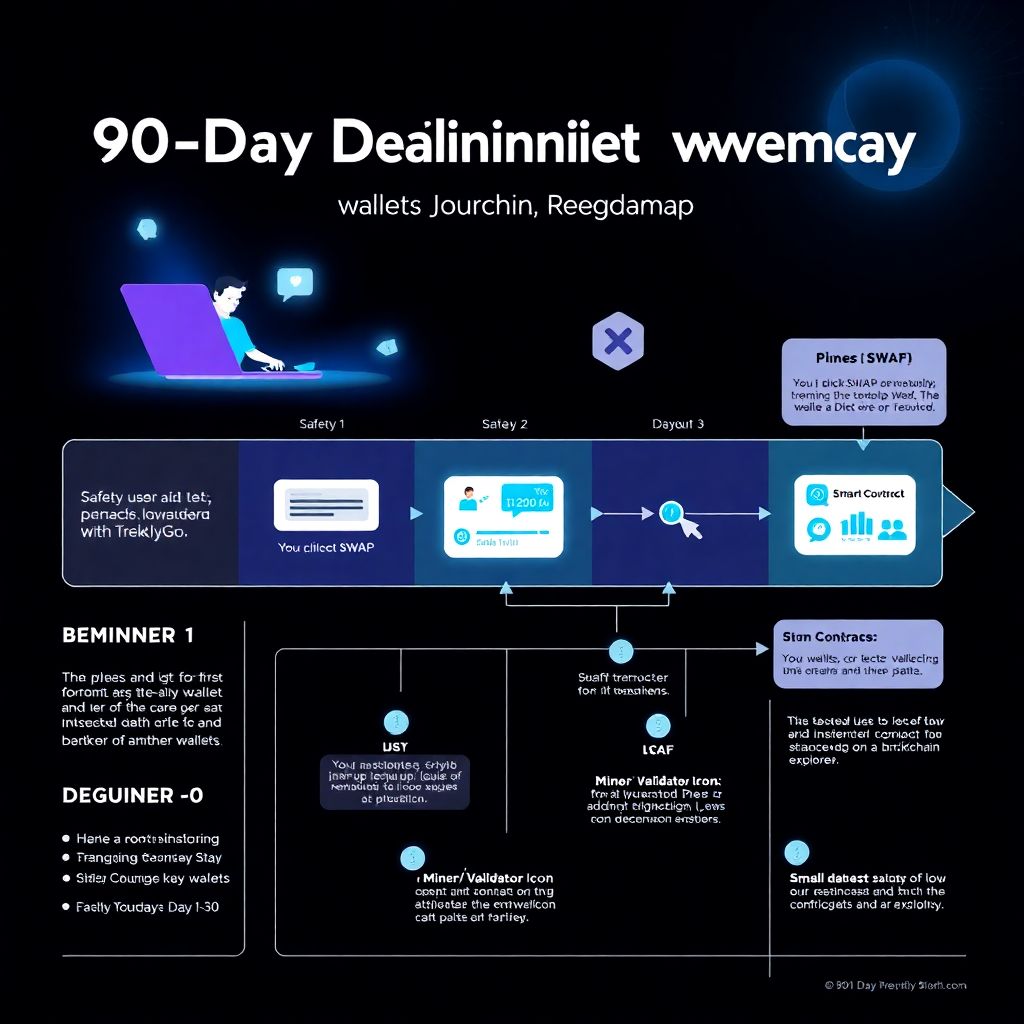
Most people open a DeFi app, see fifty buttons, and immediately feel lost. That’s normal. DeFi looks like finance plus programming plus a foreign language. This 90‑day TreklyGo roadmap is built to make that mess feel more like a gym training plan: three months, clear milestones, small but consistent repetitions. We’ll walk through what to learn first, what to ignore at the start, how to avoid painful beginner errors, and how TreklyGo can act as your guided layer on top of a very chaotic ecosystem so you actually learn DeFi step by step instead of rage‑quitting on day three.
—
Core DeFi Ideas You Must Lock In
What DeFi Actually Is (And What It’s Not)
Decentralized finance is just a stack of smart contracts that copy old financial primitives — swaps, loans, savings, derivatives — but run on blockchains instead of banks. When you click “swap” in a DeFi app, you’re sending a transaction to code that sits on a network like Ethereum; there’s no bank clerk, no manager, and, crucially, no “support hotline” to reverse a mistake. In practice, that means control and responsibility move from institutions to you. TreklyGo builds around that reality: its interface doesn’t replace smart contracts, but orchestrates how you interact with them, logs what you did, and helps you understand why a transaction behaved the way it did, instead of hiding the raw mechanics behind pretty buttons.
Text diagram – classic bank vs DeFi:
Bank user → Website → Bank database → Bank ledger
DeFi user → Wallet → Smart contract → Public blockchain ledger
The user’s path is visually similar, but notice the middle: closed, private logic versus open, verifiable code. That difference explains both the appeal of DeFi and the risk profile that catches beginners off guard.
Key Terms You’ll Actually Use
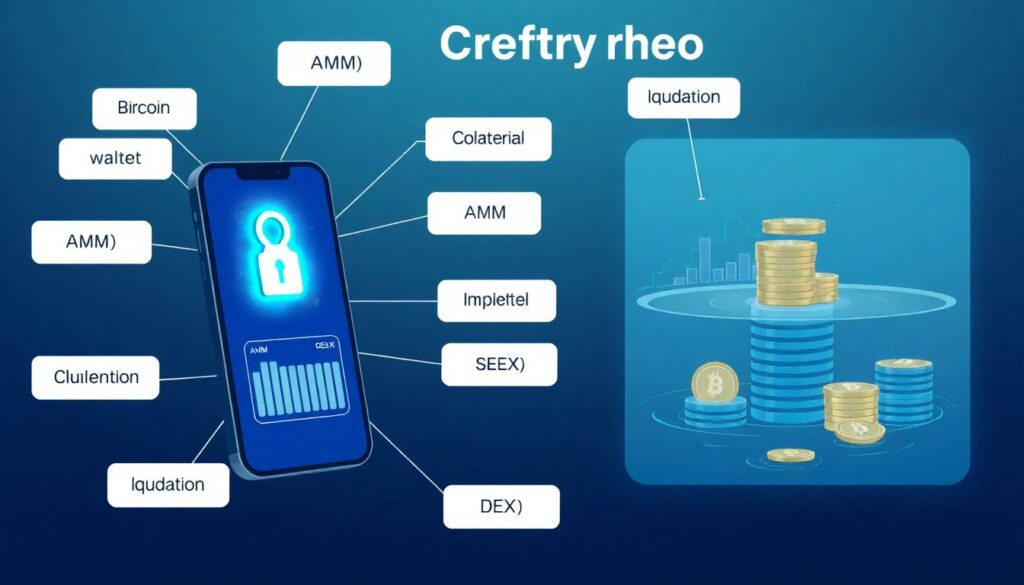
You don’t need a dictionary of three hundred buzzwords, but you do need a tight core: wallet, private key, gas fee, AMM, liquidity pool, DEX, slippage, collateral, liquidation. A wallet is just an app that holds your keys; the keys are what control your funds, not the app. A DEX (decentralized exchange) is code that lets you swap tokens; under the hood, an AMM (automated market maker) uses liquidity pools to set prices. Liquidity pools are shared baskets of two (sometimes more) assets; you deposit both sides, traders swap against that pool, you earn fees, and you take on the risk of price changes between those assets. TreklyGo’s interface surfaces those connections in context: hover on a “pool” and it shows you token pair, fee tier, and historical volatility, effectively turning each click into a mini lesson instead of a blind guess.
—
How TreklyGo Structures a 90‑Day DeFi Journey
Phase 1 (Days 1–30): Safety, Wallets, and On‑Chain Awareness
The first month in our 90 day defi learning roadmap is about learning to survive, not to chase yield. In TreklyGo, this phase is intentionally low‑risk: you operate with tiny amounts, explore testnets when possible, and map out the mental model of how your wallet interacts with smart contracts. You practice funding a wallet, sending tokens, and confirming what really happened on a block explorer instead of just trusting the UI. Conceptually, it’s like a driving simulator: you’ll “crash” a few transactions, but with amounts you can afford to lose, and the platform annotates each failure — wrong network, insufficient gas, incorrect token address — so the error becomes a data point instead of an expensive mystery.
Text diagram – your first DeFi transaction:
You click “Swap” → Wallet pops up → You approve → Transaction enters mempool → Miner/validator includes it in a block → Smart contract updates balances → Explorer shows final state.
Newcomers often compress all that into “I pressed a button and nothing happened” or “why is my transaction stuck.” In this phase TreklyGo keeps you mostly in blue‑chip assets and stablecoins, so price noise doesn’t distract from the fundamental lesson: every DeFi operation is just a state change on a shared ledger, and once it’s written there, you can’t negotiate it away.
Phase 2 (Days 31–60): Swaps, Pools, and Basic Yield
The second month focuses on interaction patterns: swaps, providing liquidity, and simple lending markets. Here TreklyGo functions almost like a defi trading course for beginners, but instead of videos alone, you learn through guided on‑chain exercises. You start with simulated swap paths: the platform will show you how routing works (e.g., Token A → stablecoin → Token B) and visualize slippage as you adjust trade size. Then you move to liquidity pools, where common misconceptions surface quickly: “more APY is always better,” “impermanent loss is only temporary,” or “my deposit is guaranteed.”
Text diagram – liquidity provider flow:
Deposit token X + token Y → Receive LP tokens → Earn trading fees → Price ratio changes → You withdraw → You get new amounts of X and Y → Compare to just holding both.
TreklyGo walks you through that last comparison explicitly, graphing how your position would look if you had never entered the pool. That’s where beginners usually realize that high APR banners hide very real risk. Alongside AMMs, you experiment with lending: depositing collateral into a lending market, borrowing against it, then watching health factors and liquidation thresholds in real time. The idea is to internalize that collateralization is not a vague notion but a very specific numeric ratio that the protocol will enforce ruthlessly.
Phase 3 (Days 61–90): Strategy, Automation, and Risk Management
The final month shifts from mechanics to judgment. You already know how to press the buttons; now you learn when not to press them. TreklyGo introduces you to basic strategy templates — delta‑neutral farming, simple hedging with stablecoins, rotating between pools as incentives change — and maps each pattern to its underlying assumptions. Instead of treating DeFi like a casino, the platform nudges you into thinking in scenarios: “If ETH drops 20%, what happens to this leveraged position?” or “If trading volume dries up, does this yield still justify the smart‑contract risk?”
Text diagram – risk layer stack per strategy:
Smart contract risk → Oracle/price feed risk → Liquidity risk → Volatility risk → Leverage/liquidation risk.
Each strategy in TreklyGo is explained as a specific combination of those layers. That framing lets you compare new protocols without hype: you can mentally overlay their risks with those you already know. By the end of 90 days, the goal is not to turn you into a quant, but to build an internal checklist you automatically run through before deploying capital anywhere in the ecosystem, whether inside or outside TreklyGo.
—
TreklyGo vs Other Learning Paths in DeFi
Why Not Just YouTube and Random Medium Articles?
Most newcomers start with search engines and influencer videos. Those resources can be useful, but they are unstructured and heavily incentive‑driven: tutorials are often thinly veiled promotions, and nobody tracks whether you actually learned or just watched. In contrast, TreklyGo bakes your progress into the product: each module ties to actual on‑chain actions, each action is logged with context, and you’re prompted to reflect on outcomes — “Did slippage match what you predicted?” “How did APR change after 24 hours?” — before moving on. It’s less about passive consumption, more about building muscle memory around core DeFi patterns.
If you only follow ad‑driven content, your experience will skew toward trending narratives: memecoins, over‑leveraged yield strategies, speculative NFTs. TreklyGo deliberately slows that impulse; its default flow starts with infrastructure‑style protocols and battle‑tested primitives. It borrows the structure of a traditional curriculum without losing the permissionless experimentation that makes DeFi interesting. Think of it as switching from random gym machines to a structured 12‑week training block: the movements are similar, but the outcomes are entirely different because the work is sequenced instead of improvised.
How TreklyGo Compares to Centralized “Crypto Academies”
Some centralized exchanges offer their own academies and “structured” paths. They’re convenient, but they keep you within their walled garden; you mostly learn how to use that particular exchange, not the broader ecosystem. TreklyGo aims for the opposite: it positions itself as a meta‑layer, explaining core patterns so you can later navigate any protocol. When people search for the best defi platform for beginners, they often unconsciously mean “a place where I can click without thinking.” TreklyGo flips that assumption by surfacing what’s happening behind each click. You still get guardrails and safer defaults, but the intent is education first, transaction volume second. In a space where misaligned incentives are the norm, that inversion matters.
—
Starting to Invest: From Play Money to Real Capital
Moving From Simulation to Skin in the Game
At some point, you’ll want to move beyond testnets and $5 experiments. The question is how to start investing in defi without turning your first deposit into tuition fees for an expensive mistake. TreklyGo’s answer is phased allocation: as you complete modules and demonstrate understanding (e.g., consistently predicting fee impact and basic risk scenarios), the platform gradually unlocks higher suggested caps for your deposit sizes. It’s not a hard restriction — you can always override — but it gives you a sanity check before you scale up.
In practical terms, your path might look like this: for the first month, you keep real capital on centralized ramps or custodial wallets and only send small amounts into on‑chain experiments. In month two, you move a fixed percentage of your portfolio (say, 5–10%) into live DeFi strategies that you already tested in simulation. By month three, assuming you’re consistently documenting outcomes and adjusting, you can responsibly scale that allocation if you wish. Each step includes explicit prompts from TreklyGo about opportunity cost, diversification, and worst‑case scenarios, so your migration from beginner to active participant is intentional, not emotionally driven.
—
Frequent Beginner Mistakes TreklyGo Tries to Prevent
Mistake 1: Treating DeFi Like a Lottery Ticket
A pervasive error is thinking of DeFi purely in terms of “moonshots.” Newcomers chase whatever just pumped on social media, confuse volatility with opportunity, and never ask the boring question: “What is the mechanism that creates this yield?” TreklyGo counters that by forcing a short analysis before you deploy: it will highlight where returns are coming from — trading fees, emissions, leverage, or outright ponzinomics — in plain language. That doesn’t guarantee you avoid bad bets, but it makes willful ignorance harder. Seeing “this APY depends on constant new capital entering” right before confirming a transaction is a powerful psychological nudge to reconsider, or at least to size the position appropriately.
Mistake 2: Ignoring Gas Fees, Slippage, and Execution Details
Many first‑timers focus only on nominal returns and forget that execution costs eat profit. On high‑fee networks, doing dozens of tiny transactions can wipe out gains, while on cheaper chains, people tend to neglect slippage settings and end up overpaying on each swap. TreklyGo incorporates pre‑trade estimates that overlay fees, slippage, and price impact in one view, and asks you to predict your final received amount before you click confirm. Over time, that habit tunes your intuition: you stop treating each transaction as a black box and start checking whether the trade still makes sense after all friction is included. It’s mundane, but it’s precisely the kind of operational discipline that separates sustainable users from those who burn out quickly.
Mistake 3: Over‑Leverage and Underestimating Liquidations
Leverage is the hidden trap of DeFi. Platforms make it feel simple: deposit one asset, borrow another, repeat, and suddenly your exposure is several times your initial capital. The problem is that liquidation engines don’t sleep or negotiate; if your collateral value drops below a threshold, you’re out. TreklyGo visualizes liquidation as a moving boundary instead of a static number. When you adjust leverage, you see a dynamic band: price ranges where your position is safe and ranges where a relatively modest move will trigger forced selling. Combine that with historical volatility plots, and it becomes much harder to pretend “this asset will never drop that far.” The point is not to scare you off leverage entirely, but to make each leveraged move an explicit, quantified choice rather than blind optimism.
Mistake 4: Security Apathy and Blind Trust in UIs
Another classic mistake is assuming that if something looks polished, it must be safe. People sign infinite token approvals, ignore contract addresses, and click through warnings because they’re in a rush. When something goes wrong, they’re shocked to discover there is no global “undo.” TreklyGo bakes security friction into the user journey: before your first significant approval, it teaches what an approval actually does, how a malicious contract can drain funds, and how to revoke permissions later. It flags unaudited or recently deployed contracts, surfaces protocol age and audit status, and encourages you to cross‑check addresses on explorers. These small frictions are intentional; they slow you down at the exact points where most newcomers move too fast.
—
TreklyGo as a Step‑By‑Step DeFi Coach
The Value of Embedded Diagrams and Explanations
One underrated element of learning is having the right mental pictures. Throughout its modules, TreklyGo embeds inline, text‑style diagrams rather than burying explanations in separate docs. When you’re about to join a pool, you might see something like: “You deposit USDC + ETH → Smart contract mints LP tokens → Traders swap against your liquidity → You earn fees → When you withdraw, you might receive more USDC and less ETH than you put in.” This is more than decoration; it trains you to think in flows and state changes. Over weeks, you start mentally drawing similar diagrams for new protocols you encounter elsewhere, which makes unknown territory far less intimidating.
Because the platform encourages you to reflect after each session — what went as expected, what didn’t, which assumptions failed — it quietly turns your history into a personalized knowledge base. That’s the opposite of binge‑watching tutorials and remembering almost nothing the next day. Whether you arrived searching for a quick way to learn defi step by step or stumbled in via a friend’s recommendation, the structure is the same: hands‑on practice, annotated outcomes, and a gradual increase in complexity instead of throwing you into the deepest yield farm on day one.
—
From Curious Beginner to Confident DeFi User
What “Pro” Really Means After 90 Days
Becoming a “pro” in DeFi isn’t about predicting every market move; it’s about not being surprised by how the system behaves. After 90 days with TreklyGo, “professional” means you understand what happens when you press a button, where your returns come from, and which risks you’re actually taking. You can look at a new protocol, sketch a mental diagram of its flows, and decide — with reasons — whether it deserves your capital. You recognize your own psychological traps: FOMO, greed, revenge trading after a loss. Maybe you started the journey looking for a quick defi trading course for beginners, but you end up with something more durable: a set of habits and frameworks that make you resilient in a volatile environment.
From there, continuing is mostly about scale and specialization: perhaps you focus on one ecosystem, dive deeper into on‑chain data analysis, or start automating parts of your strategy. Whatever direction you choose, the foundation you built over those first three months — security hygiene, execution awareness, realistic risk assessment — will keep paying dividends. DeFi will still be complex and occasionally chaotic, but it will no longer feel like an opaque casino. With TreklyGo as your initial guide, you’ve turned a confusing landscape into a navigable map, and you can keep updating that map as the space evolves.