
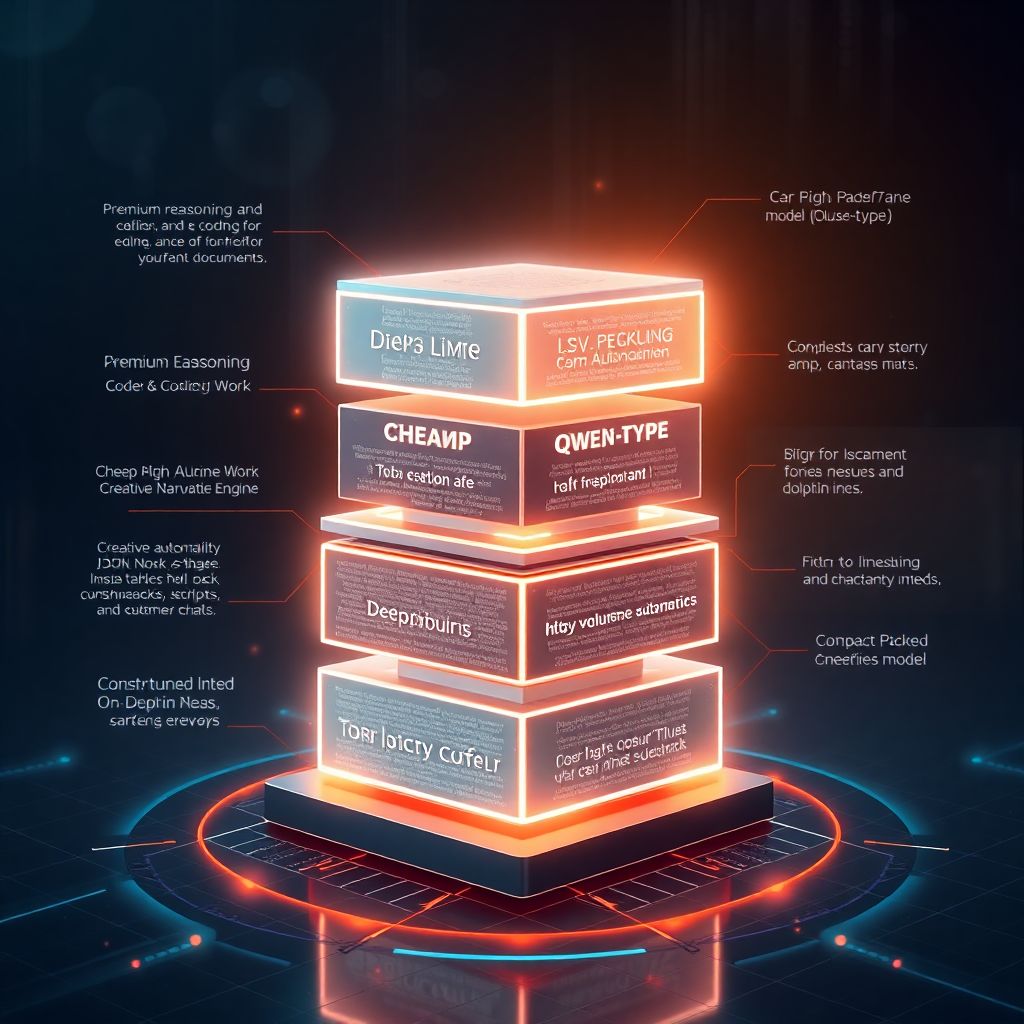
The Best AI Large Language Models of 2025: Why the “Stack” Beat the “Single Best”
In 2025, the smartest move in AI wasn’t arguing about which large language model was objectively “the best.” It was learning how to combine several of them into a coherent stack: one model for deep reasoning and premium coding, another for high‑volume batch work, a third for fiction or scripts, and a constrained model for situations where safety, cost, or infrastructure limits mattered more than raw fluency.
Models stopped competing on personality and started competing on utility. The winners were the users who treated them as tools, not as chatty artificial friends.
Below is a breakdown of the models that consistently earned a place in real‑world workflows—and how they fit into a modern AI stack.
—
2025: The Year LLMs Grew Up
The defining theme of 2025 was maturity:
– Smarter – better reasoning, fewer hallucinations, stronger grasp of codebases, documents, and images.
– Cheaper – tokens and API calls dropped in price, enabling constant background automation instead of sporadic one‑off prompts.
– Specialized – instead of one generalist model for everything, niche models emerged for coding, storytelling, research, compliance writing, and more.
The result: chasing *one* “best” LLM became a waste of time. The real advantage went to those who assembled the right combination of Claude + DeepSeek/Qwen + Muse + Dolphin (and often others) and routed tasks intelligently between them.
—
Claude: Premium Brain for Coding and Editing
In most serious stacks, Claude sat at the top as the “brains” of the operation.
Where it excelled:
– Advanced coding assistance
– Understanding large codebases across multiple languages
– Explaining complex legacy logic in plain English
– Generating reliable refactors and migration plans
– High‑quality editing and rewriting
– Turning rough drafts into publication‑ready content
– Preserving a brand voice while tightening structure
– Handling long, multi‑document contexts without losing the thread
– Policy‑aware and safety‑aware reasoning
– Keeping answers aligned with internal guidelines
– Offering careful, non‑sensationalist explanations on sensitive topics
Why it mattered in 2025:
As more teams plugged AI directly into their development pipelines and documentation flows, they needed a model that was not just clever, but *trustworthy*. Claude became the “expensive expert” in many stacks: not the first stop for every trivial prompt, but the authority used for tasks where correctness and clarity were non‑negotiable.
Common pattern:
– Use a cheaper model to draft something quickly.
– Send the draft to Claude to rewrite, sanitize, and verify.
—
DeepSeek and Qwen: Workhorses for Cheap Volume
If Claude was the senior engineer on your team, DeepSeek and Qwen were the tireless junior staffers you threw bulk work at.
Typical use cases:
– High‑volume customer support and FAQ generation
– Turning one master answer into dozens of channel‑specific variants
– Localizing responses for different regions and tone expectations
– Bulk data transformation
– Cleaning CSVs and JSONs with natural‑language instructions
– Reformatting text into templates, summaries, call notes, and bullet lists
– Exploratory brainstorming
– Generating large lists of ideas, titles, variations, or concepts
– Producing fast first drafts that a stronger model or human later refines
Why they became stack essentials:
– Cost efficiency – You could process millions of tokens without blowing the budget.
– Good‑enough quality – For non‑critical content and internal tooling, they were more than adequate.
– Flexibility – Especially when fine‑tuned or used with custom system prompts, they handled niche formats surprisingly well.
Many teams adopted a simple rule:
> “If it must be *right*, send it to Claude. If it just needs to be *done*, send it to DeepSeek or Qwen.”
This division of labor allowed businesses to scale AI usage aggressively without losing control over costs.
—
Muse: Fiction, Worldbuilding, and Creative Voice
While generalist LLMs can write stories, Muse‑style models emerged as specialists in creative writing. Their value wasn’t just coherence—it was *voice*.
What made Muse‑type models stand out:
– Narrative control
– Maintaining consistent character arcs and world rules over long texts
– Handling complex plot structures, flashbacks, and ensemble casts
– Style imitation and transformation
– Emulating a particular genre, era, or literary tradition
– Rewriting outlines into vivid scenes with sensory detail and natural dialogue
– Collaborative ideation
– Co‑creating lore, maps, magic systems, or sci‑fi technologies
– Offering alternatives when a storyline got stuck
In 2025, serious creators stopped using generic chatbots for long‑form fiction and moved to models tailored for narrative work. Muse became the “writer’s room in a box,” especially when paired with a more analytical model for continuity checks and fact‑checking.
A common workflow:
1. Draft outline and scenes with Muse.
2. Pass the draft to Claude (or another strong reasoning model) to:
– Flag inconsistencies
– Smooth pacing
– Check internal logic
3. Iterate with Muse again for style and emotional punch.
—
Dolphin: When Constraints Matter More Than Polish
Not every environment can afford a massive model—or wants one.
Dolphin‑style models gained traction precisely because they were designed to operate within tight constraints:
– Lower resource requirements
– Optimized for smaller GPUs or even edge devices
– Suitable for environments with limited network connectivity
– Strict behavior and safety controls
– Tuned to obey narrow, predictable behavioral limits
– Easier to certify for regulated industries or internal enterprise tools
– Deterministic or near‑deterministic settings
– Prioritizing repeatability over creative variation
– Useful for workflows where the same input must always yield the same output
These models rarely produced the most stylish or inventive answers, but that was the point. They were chosen for predictability, footprint, and compliance, not charm.
Typical scenarios:
– On‑device assistants in corporate laptops or kiosks
– Internal tools that must never deviate from pre‑approved policies
– Automated transformations in build pipelines, where surprises are costly
In many stacks, Dolphin‑type models were the “safe default” for conservative organizations, while more capable cloud models were reserved for advanced tasks under stricter monitoring.
—
From Chatty Characters to Professional Tools
One of the quiet cultural shifts in 2025 was the way people related to models.
– Early LLMs were often marketed like virtual friends or assistants with quirky personas.
– By 2025, serious users stopped caring whether the model had “personality.” They cared whether it:
– Respected context windows
– Followed instructions consistently
– Integrated with tools, APIs, and existing workflows
– Delivered stable, auditable results
The most sophisticated deployments treated LLMs as components:
– A reasoning engine
– A text transformer
– A controller for tools and agents
The question was no longer “Which model do I like chatting with?” but “Which model is better at orchestrating my CI pipeline, summarizing 500‑page PDFs, or generating safe contract drafts?”
—
How to Build an Effective LLM Stack in 2025
If you’re assembling your own stack, think in terms of roles, not brands.
1. High‑Precision Reasoning & Premium Output
– Use a top‑tier model (like Claude) for:
– Final code reviews
– Sensitive documents (legal, policy, compliance)
– Complex multi‑step reasoning and planning
– This is your “expert reviewer” and “final editor.”
2. High‑Volume Drafting and Automation
– Use economical models (DeepSeek, Qwen, or equivalents) for:
– Massive content generation and transformation
– Routine customer communications
– Data tagging, classification, and templating
– They are the “bulk workers” feeding material into your pipeline.
3. Specialized Creativity
– Use a creative specialist (Muse‑style) for:
– Fiction, scripts, lore, marketing narratives
– Naming, branding, and story‑driven campaigns
– This is your dedicated “writer’s room.”
4. Constrained, Resource‑Efficient Engines
– Use constrained models (Dolphin‑type) for:
– On‑premise or on‑device deployment
– Environments with strict security, latency, or compliance demands
– This is your “embedded processor” and “rules‑bound workhorse.”
Routing logic can be as simple as:
– “If task = sensitive or complex → premium model”
– “If task = bulk or internal → cheap model”
– “If task = creative narrative → Muse”
– “If environment = constrained or regulated → Dolphin”
—
Key Trends That Shaped the 2025 LLM Landscape
To understand why these models gained traction, it helps to look at the broader trends that defined the year:
1. Context windows went from novelty to necessity
Models that could read entire codebases or long document sets in one go changed how teams debugged software, analyzed deals, and audited policies.
2. Agentic behavior became mainstream
Instead of just answering questions, models increasingly:
– Called APIs
– Ran tools
– Iterated on their own outputs
– Completed multi‑step workflows with minimal supervision
3. Cost became a strategic variable
Companies realized that over‑relying on a single ultra‑premium model was unsustainable. Balancing power with cost via mixed stacks became standard practice.
4. Vertical specialization exploded
Insurance, healthcare, law, finance, and gaming each started adopting specialized models tuned for their jargon, regulations, and workflows.
5. Governance moved center stage
Logging, prompt templates, safety rails, and review loops became just as important as the model choice itself.
—
Choosing the Right Model for Your Use Case
When deciding which models belong in your own stack, ask:
1. What’s the tolerance for error?
– Mission‑critical? Use your best‑in‑class model and add human review.
– Low‑stakes or internal? Cheaper, faster models may be ideal.
2. How often will this run?
– One‑off experiment? Simpler to default to a high‑quality model.
– Thousands of calls per hour? You need a cost‑optimized backbone.
3. Is creativity or consistency more important?
– Creativity → favor Muse‑like models or high‑creativity settings.
– Consistency → favor Dolphin‑style or tightly constrained configs.
4. What are your infrastructure and compliance constraints?
– If data can’t leave your environment, prioritize deployable and constrained models.
– If latency is critical, consider on‑prem or edge deployments even if they are less capable.
—
The End of the “Best Model” Debate
By late 2025, the obsession with naming a single winner—“This is the best LLM”—felt outdated.
Different models excelled at different layers:
– Claude‑type models at depth and reliability
– DeepSeek/Qwen‑type models at scale and cost
– Muse‑type models at creativity and narrative
– Dolphin‑type models at constraints and predictability
The users who benefited most from the AI revolution weren’t the ones who swore loyalty to one flagship model. They were the ones who:
– Understood their own workflows in detail
– Mapped tasks to the right model layer
– Treated LLMs as modular infrastructure, not digital oracles
In 2025, large language models finally became what they always promised to be: invisible engines quietly running in the background, powering code, content, decisions, and tools. The era of the “best model” is over. The era of the best stack has begun.