
The Best Games of 2025 You Can Grab for Under $20
If ballooning hardware costs and $80 blockbuster releases haven’t already convinced you that gaming is more expensive than ever, a quick glance at current console prices will. A new PlayStation 5 or Xbox Series X/S, plus a couple of marquee titles, can easily rival the cost of a budget gaming PC. Add in accessories, subscriptions, and inevitable DLC, and the hobby starts to look like a luxury.
Yet there’s another side to modern gaming that completely defies that trend. Away from the splashy marketing budgets and collector’s editions sits a thriving indie scene where creativity is high, system requirements are low, and price tags are refreshingly modest. For under $20, you can pick up some of 2025’s most inventive and memorable games—and many of them will run just fine on older hardware or modest laptops.
Every game highlighted here costs $20 or less at standard pricing, and many frequently slip into the $5–$15 range during seasonal or platform-wide discounts. Better still, they’re designed with accessibility in mind: several can run on integrated graphics, while the more demanding titles usually top out at hardware from nearly a decade ago. In other words, you don’t need a cutting-edge GPU or current-gen console to enjoy them.
> Editor’s note: All the games mentioned are traditional “Web2” releases with no crypto, NFT, or blockchain integrations. They’re just games—exactly as you’re used to.
—
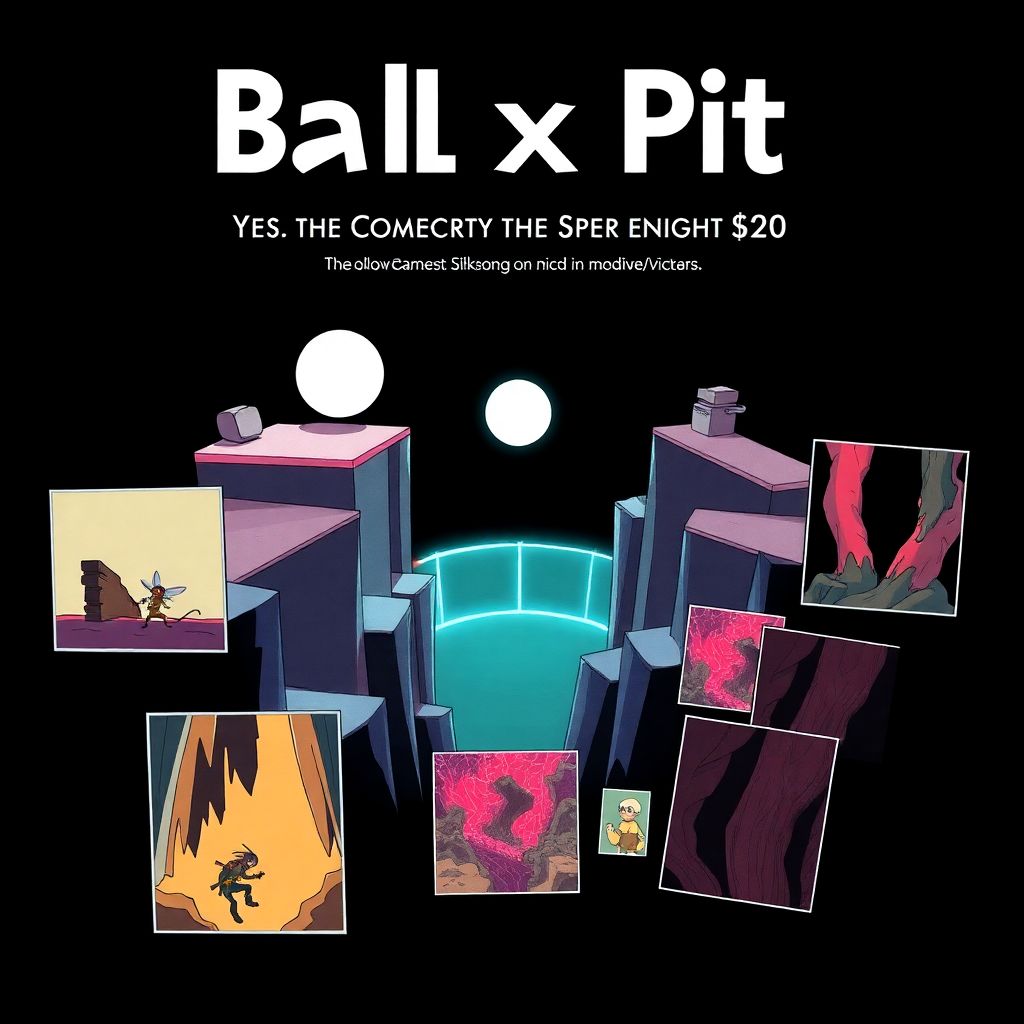
Ball x Pit
On paper, *Ball x Pit* sounds disarmingly simple: you control a ball, there’s a pit, gravity does its thing. But under that minimalist premise lies a razor-sharp physics puzzler that takes the elegance of classic arcade design and fuses it with modern level craft.
The game’s hook is how much it wrings from a tiny ruleset. Each stage introduces a twist—new surfaces, shifting obstacles, strange momentum modifiers—and then explores it to its logical extreme. Failures are instant but fair, and restarts are nearly instantaneous, making “just one more try” a dangerous mantra for your free time.
With abstract but striking visuals and a soundtrack that gently nudges you into a flow state, *Ball x Pit* is the sort of under-$20 purchase that quietly becomes a nightly habit. It’s perfect for short sessions, but good luck actually putting it down.
—
Hollow Knight: Silksong
Few indie sequels have generated as much anticipation as *Hollow Knight: Silksong*, and it lands in 2025 still under the $20 mark—an almost absurd value for the sheer amount of content packed inside. You step into the shoes of Hornet, a nimble warrior whose acrobatic toolkit completely changes how you approach exploration and combat.
*Silksong* takes the foundations of the original—an intricate interconnected world, tight platforming, and demanding, pattern-heavy battles—and amplifies them. The environments are more vertical, the enemy designs more varied, and the movement tech more expressive. Boss encounters in particular feel like balletic duels, rewarding precision, timing, and patience.
The world is dense with secrets: breakable walls, hidden rooms, cryptic NPCs, and lore tucked into environmental details. For players who love methodical exploration and gradually mastering challenging encounters, this is easily one of the richest experiences you can buy for the price of a movie ticket and popcorn.
—
Despelote
*Despelote* is proof that you don’t need bombastic combat or sprawling maps to deliver something powerful. Set in Ecuador in the late 1990s, it’s a quiet, reflective narrative game built around a single unifying thread: football (soccer, if you prefer). You explore a small city, talk with locals, and experience how the sport weaves through everyday life.
Rather than bombarding you with exposition, the game trusts subtlety—snatches of conversation, environmental details, and small, grounded interactions that reveal the social and political mood of the era. The football itself becomes both a literal toy and a metaphorical anchor, tying together community, identity, and hope.
Clocking in at a modest runtime and running happily on low-spec machines, *Despelote* is ideal if you’re more interested in atmosphere, culture, and storytelling than high-octane spectacle. It’s under $20, but it lingers in your memory like a great indie film.
—
Luto
If you like your games unsettling rather than relaxing, *Luto* is one of 2025’s standout horror experiences in the budget bracket. It leans hard into psychological tension instead of cheap jump-scares, trapping you in a looping, shifting domestic space where reality never quite holds together.
The game excels at changing your expectations: corridors subtly stretch, familiar rooms distort, and mundane objects take on a sinister weight as you piece together a story of grief and mental collapse. There’s minimal combat, if any; the fear comes from vulnerability, disorientation, and the constant feeling that the world is just slightly wrong.
Because the focus is on lighting, sound, and clever level design rather than heavy physics or complex AI, *Luto* is surprisingly forgiving on older hardware. If you have a decent CPU and a halfway competent GPU from the last decade, you can experience one of the most effective horror games of the year without spending much on either your rig or the game itself.
—
Megabonk
*Megabonk* embraces the absurd in all the right ways. It’s a chaotic, over-the-top action-platformer that feels like it was built from equal parts Saturday-morning cartoon and late-night game jam. The core mechanic revolves around “bonking” enemies and environmental objects in increasingly ridiculous chains to rack up scores and unleash flashy effects.
Levels are short, punchy, and designed to be replayed as you discover alternate routes and trickier ways to maintain combos. The controls are simple enough for newcomers but have just enough nuance that skilled players can pull off wild stunts and speedrunning lines.
Beneath the comedy and bright color palette is a surprisingly tight game with responsive movement and well-balanced difficulty. For under $20, *Megabonk* offers a satisfying blend of slapstick chaos and genuine mechanical depth, especially appealing if you enjoy score-chasing and tight platforming challenges.
—
No, I’m Not a Human
With a title like *No, I’m Not a Human*, you expect something offbeat, and the game doesn’t disappoint. It’s a narrative-driven adventure about identity, technology, and what it means to be “real” in a near-future world saturated by artificial intelligence.
You navigate branching conversations, puzzle-like social encounters, and low-key exploration segments as a being whose status—human, machine, or something in between—is constantly questioned by those around you. Choices matter less in terms of “good” or “bad” endings and more in how they shape the protagonist’s sense of self.
Mechanically, it’s not demanding; most systems revolve around dialogue, timed decisions, and subtle environmental cues. But its writing and structure invite multiple playthroughs to see how different approaches reframe the narrative. For players who care more about themes and character than reflexes, it’s one of the smartest sub-$20 games of 2025.
—
Nubby’s Number Factory
If math class had felt like *Nubby’s Number Factory*, there might be a lot more people casually solving equations for fun. This puzzle game turns arithmetic and logic into an assembly-line brain teaser, asking you to build increasingly complex “factories” that transform inputs into the correct numerical outputs.
At first, you’re nudging simple numbers through basic operations. Before long, you’re chaining together elaborate systems, optimizing layouts, and trying to shave a few extra steps off your designs. It hits the same satisfying design itch as programming puzzlers and automation games, but with a charming, approachable aesthetic.
Importantly, the game scales its difficulty gradually, making it accessible to players who don’t consider themselves “math people.” Hints, optional challenges, and a forgiving reset system keep frustration at bay. Light on system requirements and heavy on replayability, *Nubby’s Number Factory* is a stellar buy for puzzle fans on a budget.
—
Peak
As the name implies, *Peak* is all about climbing—literally and metaphorically. It’s a minimalist mountain-climbing experience where you guide a lone climber up daunting peaks, balancing stamina, route planning, and environmental hazards.
The controls are deliberately stripped-back, focusing your attention on reading the terrain and planning safe, efficient paths. Wind, ice, and shifting weather force you to adapt on the fly. There’s no giant open world to roam; instead, each mountain is a carefully designed puzzle in vertical form.
What makes *Peak* stand out is its meditative atmosphere. Quiet music, restrained sound design, and a lack of cluttered UI elements create a surprisingly contemplative mood. It’s an ideal game to unwind with, and you can get hours of careful, satisfying climbing for well under $20, without needing cutting-edge hardware.
—
The Séance of Blake Manor
*The Séance of Blake Manor* blends investigative mystery with supernatural tension. You play as a medium summoned to an aging estate to conduct a séance, only to find that the spirits haunting the halls have agendas of their own.
Gameplay alternates between exploring the mansion—collecting clues, examining objects, and piecing together the family’s troubled history—and tense séance sequences where you interpret cryptic messages from beyond. Your choices in conversation and ritual determine which secrets surface and which remain buried.
Visually, the game leans into moody lighting and theatrical staging rather than photorealism, which keeps system demands modest while still delivering an evocative atmosphere. If you enjoy narrative-heavy mysteries with a twist of occult drama, *The Séance of Blake Manor* is a polished, affordable pick for late-night sessions.
—
Why So Many Great Games Are Under $20
The cluster of strong releases at this price point is not an accident. Smaller studios and solo developers are leaning into focused, tightly scoped ideas rather than sprawling open worlds. Without the pressure to justify a massive budget, they can take risks with mechanics, art styles, and storytelling that large publishers often avoid.
This also means playtimes are usually more digestible. Instead of 100-hour grinds, you’ll find compact experiences that respect your time: sharp puzzle campaigns, targeted horror stories, and replayable action loops. For players juggling work, school, or family, these smaller games can be more appealing than another colossal time sink.
—
Hardware-Friendly by Design
Another advantage of these sub-$20 titles is their friendliness to older or modest hardware. Several of the games above are built around stylized visuals, limited 3D complexity, or 2D art, which reduces the need for cutting-edge GPUs. As long as your PC or laptop is from roughly the last 8–10 years—and not completely neglected—you can likely run most of them without major compromise.
Even when a game is more visually ambitious, developers often provide scalable graphic options. Turning down shadows, resolution, or post-processing can dramatically improve performance, allowing players on integrated graphics or budget cards to join in. For many people, that makes a $15 indie game a far more realistic purchase than a $500 console upgrade.
—
Getting the Most for Your $20
While the base prices are already low, a bit of timing can stretch your budget even further. Platform-wide sales—whether on PC or console storefronts—regularly push these games into the impulse-buy range. Holiday events, publisher spotlights, and seasonal promotions can drop a $20 title to under $10 or even less.
If you’re trying to prioritize, consider what kind of experience you want:
– For skill-based challenge and precision combat, *Hollow Knight: Silksong* and *Megabonk* are standout picks.
– If you prefer story and atmosphere, *Despelote*, *No, I’m Not a Human*, and *The Séance of Blake Manor* should be high on your list.
– Puzzle and logic fans will get immense value from *Nubby’s Number Factory* and the route-planning of *Peak*.
– Horror enthusiasts with limited hardware should look closely at *Luto* for a lean but intense experience.
With two or three of these games in your library, you can easily fill months of downtime for less than the cost of a single AAA blockbuster.
—
Why Indie Games Belong in Every 2025 Library
Beyond price and performance, there’s a broader reason to pay attention to these smaller releases: they’re often where the industry’s freshest ideas are born. Experimental structures, unusual themes, and unconventional mechanics are far more common when teams aren’t beholden to massive sales forecasts or franchise expectations.
In 2025, some of the most talked-about moments in gaming aren’t arriving from $100-million marketing campaigns—they’re emerging from games like *Despelote*’s intimate portrait of a city, *No, I’m Not a Human*’s AI-driven identity questions, or the eerie domestic loops of *Luto*. These titles may not dominate sales charts, but they frequently set the creative tone that larger studios eventually follow.
Investing in a handful of sub-$20 games isn’t just a way to save money—it’s a way to experience where the medium is headed. Whether you’re chasing high-skill action, mood-driven storytelling, or clever puzzles, 2025’s indie lineup proves that you don’t need a premium price tag or a top-tier console to have an exceptional time.