
Tokenization and artificial intelligence are no longer niche technologies sitting at the periphery of finance and computing. By 2025, tokenization had matured into a global market worth roughly $1.24 trillion, up from about $865.54 billion the year before, with credible projections suggesting it will reach multiple trillions by decade’s end. That acceleration did not happen in a vacuum: clearer regulatory frameworks in major jurisdictions gave institutions the green light to tokenize a wide range of assets, from financial instruments to real-world infrastructure.
At the same time, something even more radical quietly moved from whiteboards and think-tank papers into hardware and orbital trajectories: the orbital cloud. In 2025, the long-theorized concept of space-based data centers—computing nodes placed on satellites in low Earth orbit (LEO) and powered by space-derived solar energy—transitioned from speculation to early implementation.
This text builds on prior work examining how AI-driven tokenization reshapes markets and infrastructure. Earlier analysis framed 2025 as the inflection point for tokenization. The next step is to understand the energy and computing backbone required to sustain this growth curve—especially as AI models grow more complex and as verification and settlement processes move on-chain. Ultimately, that path leads us off-planet.
From thought experiment to launch pad: the first orbital cloud steps
For years, even researchers who tracked digital assets, sustainability, and regulatory policy doubted they would ever witness operational orbital cloud computing within their career span. Yet 2025 overturned that assumption. A combination of cheap launch services, advanced materials, and public-sector backing converged to make space-based compute viable enough for commercial pilots.
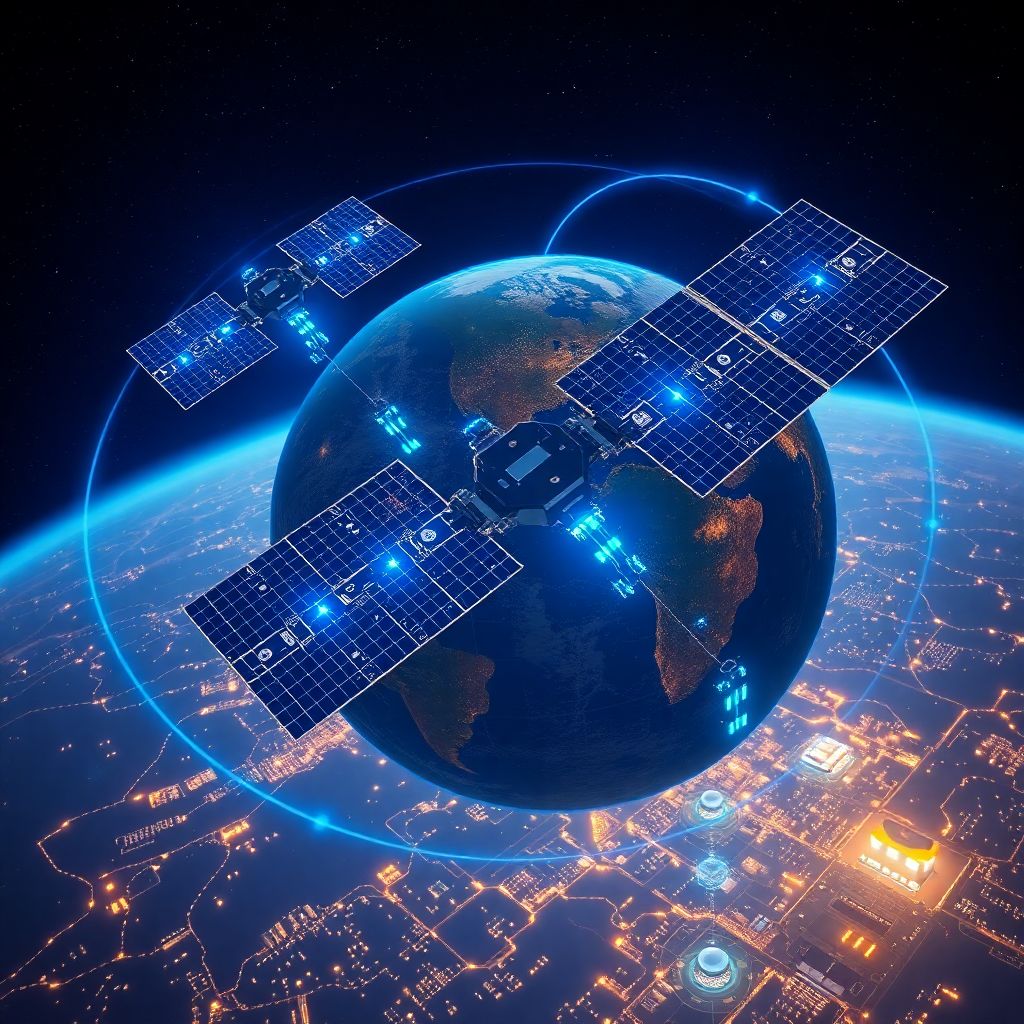
On December 10, 2025, PowerBank Corporation launched the DeStarlink Genesis‑1 satellite. This was more than a standard communications payload: it marked the first building block of Orbit AI’s Orbital Cloud network, an architecture designed to execute AI computation, connectivity, and blockchain-verifiable processing directly aboard LEO satellites. Crucially, these nodes are powered by space solar energy, harvested beyond Earth’s atmosphere.
Orbit AI, headquartered in Singapore, has positioned itself as an aerospace pioneer at the intersection of decentralized networks and orbital infrastructure. Its DeStarlink constellation is conceived as a decentralized LEO satellite network, paired with DeStarAI: orbital AI compute and data center modules that rely entirely on space-based solar power. Each satellite hosts solar-driven computing payloads and blockchain-verified nodes, engineered to operate with minimal susceptibility to terrestrial geopolitical pressure, regional blackouts, or local regulatory chokepoints.
To execute this vision, Orbit AI collaborates with several specialized partners:
– PowerBank Corporation in Canada, focusing on space power and energy systems;
– Intellistake Technologies Corp, also in Canada, contributing decentralized infrastructure and validation expertise;
– NVIDIA in the United States, supplying high-performance GPUs tuned for AI workloads;
– and the Ethereum Foundation in Switzerland, working on blockchain architecture suitable for orbital verification and consensus.
Policy tailwinds: AI strategy meets energy innovation
The arrival of orbital cloud infrastructure did not emerge purely from private-sector ingenuity. It is tightly coupled to policy decisions that placed AI and energy security at the center of national strategy.
An Executive Order from President Donald Trump aimed at “Removing Barriers to American Leadership in Artificial Intelligence” advanced a national AI agenda often described as America’s AI Action Plan. Building on that framework, the U.S. Department of Energy launched the Genesis Mission, a landmark program harnessing AI to accelerate foundational scientific discovery, reinforce national security, and catalyze energy innovation.
These initiatives have catalyzed interest from hyperscale data center operators—those massive global players that already run sprawling data centers on multiple continents. Facing soaring energy demands from AI and blockchain verification, many of them are now exploring how orbital solar energy and off-planet compute might relieve pressure on terrestrial grids and reduce carbon-intensive power consumption.
What hyperscale cloud means in the orbital era
A hyperscale cloud provider runs vast, globally distributed infrastructure capable of spinning up millions of virtual machines and managing immense, varied workloads—everything from consumer apps to enterprise analytics to real-time streaming. Names like AWS, Microsoft Azure, and Google Cloud have come to define this model.
Traditionally, these providers lean on centralized mega–data centers and a growing tier of edge sites: smaller, distributed facilities and network points positioned closer to users to minimize latency and improve performance, particularly in remote or underserved regions.
Orbital cloud infrastructure extends this evolution one step further. Instead of only routing traffic through edge locations on Earth, workloads—especially those requiring intensive AI inference or cryptographic verification—can be executed in orbit. Satellite-based nodes become a new “layer” of the cloud, operating above national borders and powered by uninterrupted solar input, then interfacing with terrestrial edge and core data centers.
Hyperscale players evaluating this model are less interested in replacing their existing facilities and more focused on offloading specific, energy-hungry processes. AI model training, zero-knowledge proof generation, and blockchain verification are prime candidates, as they can be batched, scheduled, and run in environments where continuous power availability is a significant advantage.
Why tokenization needs new energy and compute paradigms
Tokenization’s surge to a $1.24 trillion market in 2025 is not just a financial story; it is an infrastructure story. Every tokenized asset means more data to store, verify, and secure. When combined with AI—used to price assets, detect fraud, orchestrate smart contracts, and automate compliance—the computational burden grows sharply.
Modern AI models demand enormous processing power and energy. Simultaneously, the tokenization ecosystem pushes more transactions and state updates to blockchains or similar distributed ledgers, each requiring cryptographic verification and often consensus across numerous nodes. As tokenization spreads from securities into real estate, supply chains, intellectual property, and even public services, baseline system load multiplies.
If that growth were left entirely to terrestrial data centers, the strain on grids, cooling systems, and local environments would be immense. Power-hungry AI clusters already drive data center electricity consumption up dramatically, prompting urgent questions about sustainability and land use. Orbital cloud infrastructure offers a potential relief valve: by pushing part of this AI and verification workload into space, operators can decouple growth in digital asset markets from proportional growth in Earth-based energy consumption.
Space-based solar power: from theory to infrastructure
The enabling technology behind orbital cloud computing is space-based solar power. In orbit, solar panels operate above the atmosphere, avoiding weather, cloud cover, and the day-night cycle. Geostationary and particular orbital configurations can provide nearly continuous solar exposure, which is then converted into energy to power onboard compute or transmitted to Earth.
Historically, this idea was considered too expensive and complex for serious deployment. That changed as launch costs collapsed—to roughly one-hundredth of what they were in the era of the Space Shuttle—while satellite platforms became smaller, cheaper, and more modular. Simultaneously, breakthroughs in materials and power conversion transformed space solar from a distant aspiration into a realistic component of the global energy system.
By 2025, the space-based solar power market was already valued at around $0.63 billion. Projections suggest it could grow to approximately $4.19 billion by 2040, implying a compound annual growth rate of about 13.46% from 2025 onward. Those numbers are modest compared to terrestrial renewables, but they indicate a clear trajectory toward commercialization, especially as orbital cloud use cases emerge.
Metamaterials, rectennas, and ground infrastructure
One particularly important breakthrough lies in metamaterial-based rectennas—specialized receiving antennas that convert beamed electromagnetic energy into usable electricity. Recent prototypes have surpassed 90% conversion efficiency. That achievement drastically reduces the ground footprint needed for receiving stations and helps lower the cost of energy delivered from orbit.
High-efficiency rectennas mean a space solar system can deliver concentrated power to relatively compact terrestrial sites—industrial zones, large data centers, or power-hungry edge hubs—without requiring vast tracts of land. For orbital cloud infrastructure, these rectennas can serve both as direct power sinks for on-Earth data centers and as a communication and energy interface with space-based nodes.
As rectenna technology improves, the key constraints shift from physics to regulation and local acceptance: how to allocate spectrum, manage beam safety, and integrate orbital solar into existing grids. These questions will shape how quickly space-based energy can complement terrestrial renewables in supporting AI and tokenization growth.
Geopolitical resilience and jurisdictional complexity
A central promise of orbital cloud infrastructure is resilience. Because orbital nodes exist outside any single national territory, they are less exposed to localized power cuts, natural disasters, or unilateral regulatory shutdowns. For AI-powered tokenization systems that underpin cross-border trading, global settlement, and digital identity, this added resilience is strategically attractive.
But jurisdictional ambiguity cuts both ways. Who regulates a decentralized AI node operating in LEO? How do export controls, data protection rules, or sanctions regimes operate when compute takes place outside defined borders? Orbit AI’s design philosophy—combining decentralized validation, blockchain-based auditing, and carefully structured corporate domiciles—is one early attempt to address such questions, but global norms are far from settled.
As orbital cloud networks scale, we can expect new treaty discussions, updated space law, and sector-specific regulations for AI and digital assets that explicitly address off-planet infrastructure. Market participants building tokenization platforms or AI verification systems will need legal and compliance strategies that anticipate this layered regulatory environment.
Taxation, incentives, and the energy transition
Tax policy plays a quiet but powerful role in determining whether orbital cloud and space-based solar power become mainstream or remain experimental. Changes in tax law affecting commercial solar tax credits and the treatment of cloud transactions can significantly alter project economics.
If incentives for space-related solar infrastructure are harmonized with those for terrestrial renewables, we could see blended projects where orbital solar supplements ground-based arrays, and both feed AI-heavy data center clusters. Conversely, if tax codes treat orbital installations as exotic or impose unfavorable depreciation rules, many otherwise viable projects may lag.
For tokenization platforms, the tax angle is twofold. On one side, they stand to benefit from more abundant, cleaner, and potentially cheaper compute, reducing operational costs for smart contract execution, transaction verification, and AI risk analytics. On the other, the legal classification of space-originating power and compute services will influence how those costs are recognized and passed on to users.
How AI-driven tokenization will use orbital compute
In practical terms, how might AI-driven tokenization tap into orbital cloud infrastructure?
1. On-orbit verification and consensus
Blockchain validators hosted on satellites could participate in consensus, timestamping, and transaction verification. Operating outside terrestrial grids, they might provide a baseline layer of censorship resistance and uptime for global token networks.
2. Batch AI inference for risk and compliance
Tokenized assets often require ongoing risk scoring, fraud detection, and compliance checks. These inference tasks can be queued and executed on orbital GPUs when satellite capacity is available, then results synchronized with ground-based systems.
3. Zero-knowledge and cryptographic acceleration
Generating advanced cryptographic proofs—especially zero-knowledge proofs used for privacy-preserving applications—can be computationally intense. Dedicated orbital accelerators could take on this load, freeing terrestrial data centers for lower-latency tasks.
4. Disaster-resistant registries and archives
Critical token registries and state snapshots could be backed up or mirrored in orbit, ensuring continuity in the event of major terrestrial disruptions. This is particularly relevant for high-value tokenized infrastructure, sovereign bonds, or identity networks.
5. Interfacing with edge cloud for ultra-low-latency services
For applications like tokenized prediction markets or sports betting—an emerging segment where immersive, AI-enhanced experiences demand rapid data flows—orbital nodes can complement terrestrial edge clusters. They may not handle the millisecond-level execution path, but they can run continuous analytics, model training, and integrity checks that feed back to edge systems.
Emerging use cases: sports, prediction markets, and beyond
One of the most dynamic application areas for tokenization, AI, and edge cloud is sports and prediction markets. Here, user experience depends on real-time data ingestion, odds computation, and continuous risk modeling. As these platforms adopt tokenized instruments for wagers, fractional event ownership, or fan engagement tokens, they must process and verify massive event streams.
Orbital cloud infrastructure can enhance this ecosystem in several ways:
– High-frequency data analysis: Satellite-based compute can crunch historical and streaming data to refine pricing models that are then deployed at terrestrial edges.
– Trusted randomness and verifiable draws: Space-based nodes can participate in generating and attesting to randomness used in fair draws or lottery-style mechanisms.
– Cross-border settlement: For global events and international betting markets, orbital validators can contribute to neutral settlement layers less exposed to any single jurisdiction’s regulatory swings.
As immersive experiences grow—combining live video, augmented reality, AI commentary, and tokenized rewards—the pressure on infrastructure will intensify. Orbital cloud is positioned as a strategic complement that absorbs back-end complexity while keeping front-end latency low via local edge nodes.
The road ahead: constraints and open questions
Despite significant progress, orbital cloud infrastructure is still in its infancy. DeStarlink Genesis‑1 is a prototype, not a fully mature network. Several hurdles remain:
– Launch risk and cost volatility: Even with lower launch prices, failures can be catastrophic and capital-intensive.
– Hardware lifecycles: Satellites face radiation, micrometeoroids, and thermal cycling; designing AI-grade hardware that remains reliable over years in orbit is non-trivial.
– Spectrum and interference: Balancing data links, power beaming, and existing orbital services will demand careful coordination and regulation.
– Standardization: Interoperability between different orbital providers, terrestrial clouds, and blockchain ecosystems is still largely uncharted territory.
Yet the fundamental drivers—soaring AI workloads, explosive tokenization growth, and an urgent need for sustainable energy—are unlikely to weaken. If anything, they will intensify, pushing both public and private sectors to experiment with architectures that were once the stuff of science fiction.
Conclusion: tokenization’s orbit-bound future
By the end of 2025, it became clear that the future of tokenization and AI will not be confined to Earth. The combination of regulatory clarity, market expansion, and technological breakthroughs in launch services, space solar power, and metamaterial rectennas has opened a path toward orbital cloud infrastructure.
Hyperscale data center providers, tokenization platforms, and AI developers are beginning to recognize that sustaining multi-trillion-dollar digital asset markets hinges on reinventing the underlying energy and compute stack. Space-based solar power and LEO computing nodes offer one of the most promising—and radical—answers to that challenge.
As the decade unfolds, the core questions will not be whether orbital cloud is technically feasible—that threshold is already being crossed—but how quickly it can scale, how equitably its benefits will be distributed, and how effectively law and policy will adapt to this new stratum of the digital economy. In that sense, DeStarlink Genesis‑1 is less a singular launch than the opening salvo in a profound reconfiguration of where, and how, our most valuable data and assets are processed, verified, and stored.