
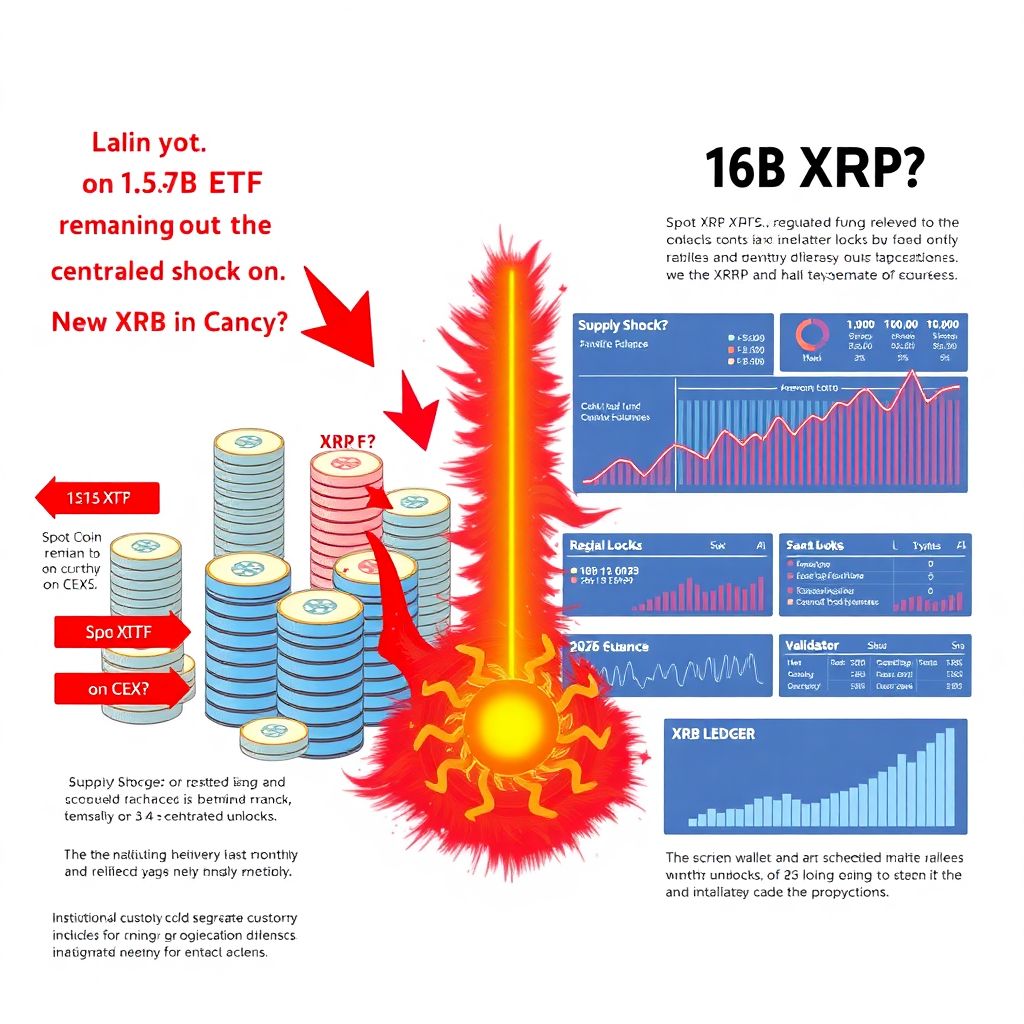
XRP ETF ‘supply shock’ narrative questioned as on‑chain data points to 16B tokens on exchanges
Concerns that newly launched spot XRP exchange-traded funds are draining liquidity from centralized exchanges are facing increasing scrutiny, as on-chain figures suggest the available supply may be far larger than some viral claims imply.
A fresh debate broke out among XRP market participants after conflicting interpretations of exchange balance data began circulating. One side argues that the combination of spot ETFs, escrow mechanics, and institutional accumulation is steadily tightening the effective circulating supply. The other insists that fears of an imminent “supply shock” are overstated, pointing to tens of billions of XRP that remain accessible to traders.
Viral claim: Only 1.5B XRP left on exchanges
On Dec. 27, an account under the handle unknowDLT claimed that spot XRP ETFs are quickly absorbing tradable supply. According to their analysis, just around 1.5 billion XRP remained on centralized exchanges, with roughly 750 million XRP allegedly removed from exchange balances in recent weeks.
The post went even further, projecting that a major supply crunch could emerge by early 2026. This scenario was linked to expected regulatory developments, including a proposed legislative framework informally labeled the “Clarity Act,” which some believe could accelerate institutional adoption and ETF inflows.
Under this narrative, constrained supply on exchanges, combined with rising demand via regulated investment vehicles, would set the stage for an aggressive upward repricing of XRP once market participants realize how little liquidity is supposedly left.
Validator counters: 16B XRP available on CEXs
That interpretation was swiftly challenged. On Dec. 28, an XRP Ledger dUNL validator known as Vet published a rebuttal, arguing that the numbers used in the viral ETF-supply thesis significantly understate the actual amount of XRP sitting on trading platforms.
Drawing on on-chain wallet classifications and exchange address analysis, Vet estimated that centralized exchanges collectively hold closer to 16 billion XRP, not 1.5 billion. In their view, this larger figure better reflects the tokens that are readily available to be bought and sold by market participants at relatively short notice.
Vet stressed that while exchange balances do fluctuate with flows, market-making, and arbitrage activity, there is no sign of an abrupt depletion that would justify describing the situation as a looming supply shock.
Dynamic markets vs. static shock models
Central to Vet’s argument is the nature of liquidity in highly digital, fast-moving markets. The validator emphasized that supply shock scenarios typically arise when there is a sudden, acute mismatch between available supply and surging demand — often within a compressed time frame.
By contrast, the ETF-related flows observed so far appear gradual and predictable. XRP holders can send tokens from self-custody to an exchange in approximately three to four seconds, thanks to the speed of the XRP Ledger. This near-instant transfer capability means that a large portion of the total supply can, in theory, be mobilized quickly in response to changing prices and incentives.
“Markets are too dynamic to statically plot movements,” Vet wrote, underscoring that identical levels of buying pressure can have very different price impacts depending on order-book depth, spread, and overall risk appetite at a given moment. From this vantage point, long-term ETF accumulation does not automatically translate into an imminent supply crunch.
Data quality and wallet identification questioned
During the back-and-forth, another layer of complexity emerged: how accurately can anyone track exchange holdings in the first place? Cryptocurrency commentator Zach Rector highlighted potential weaknesses in how some wallets were being classified as exchange addresses in the circulating datasets.
Vet responded that the 16 billion XRP estimate should be viewed as conservative rather than aggressive. As an example, they pointed to the Korean platform Upbit, which was identified as holding about 2 billion XRP across four known wallets — a figure that likely captures only a subset of its total reserves. Unlabeled or newly created exchange wallets, omnibus accounts, and custodial arrangements can make precise accounting difficult.
This underscores a broader issue in on-chain analytics: while blockchains are transparent, identifying which addresses belong to which entities is an evolving exercise that often relies on heuristics and partial disclosures.
The argument for tightening effective supply
Despite the higher exchange balance figures, not everyone is convinced that XRP liquidity is as abundant as the headline number suggests. Market participant Dman Trader argued that what really matters is the effective circulating supply — the portion of tokens that are realistically available for trading at any given time, considering custody setups and behavioral patterns.
They pointed to several structural features that could gradually tighten this effective float:
– Escrow release schedules: Large allocations of XRP are locked in escrow and released according to predefined timelines. Not all of these released tokens are immediately sold; some may be re-escrowed or directed into strategic allocations.
– Institutional custody arrangements: ETF providers and institutional investors often hold assets in segregated or cold storage wallets. These balances tend not to circulate actively on retail-facing exchanges.
– Accumulation by long-term holders: As XRP is accumulated and held with a long-term thesis, fewer tokens may be available for short-term trading, especially if these holders are price-insensitive on the downside.
Dman Trader claimed that dedicated wallets used to custody ETF assets now hold XRP equivalent to roughly 1% of the total supply, accumulated over a span of just a few months. While that figure is still relatively modest, the pace and sustainability of such accruals could matter over a multi-year horizon.
Ripple’s role and the nature of true supply shocks
Vet did not dispute that Ripple plays a role in supplying ETFs, acknowledging company disclosures that it facilitates transfers of XRP into ETF structures. However, the validator remained skeptical that this process resembles a classic supply shock.
In Vet’s view, genuine shocks occur when demand concentrates in a short window while available supply is temporarily constrained or misallocated. Examples might include a sudden regulatory green light that triggers a wave of new buyers, or unexpected restrictions on large holders that prevent them from selling.
By contrast, ETF-fueled demand has so far appeared as a steady stream rather than a vertical spike. With an estimated 16 billion XRP distributed across exchanges and more held in Ripple’s operational accounts and other liquid venues, Vet argued that the ecosystem still has ample capacity to absorb current and near-term demand without forcing an extreme repricing.
How ETFs can reshape liquidity without “running out” of XRP
The dispute highlights a nuance often lost in social-media narratives: a market does not need to literally “run out” of tokens for prices to move sharply. Even with billions of XRP technically available, key aspects of market structure can amplify or dampen price changes:
– Order-book depth and slippage: If large chunks of liquidity are posted far from the current price, aggressive buyers can still move the market quickly, creating the perception of scarcity.
– Market-maker behavior: Professional liquidity providers adjust spreads and inventory based on volatility, funding rates, and risk. If they pull back during stressed periods, the practical supply at tight spreads can drop sharply.
– Fragmentation across venues: XRP liquidity is spread across multiple centralized exchanges and over-the-counter (OTC) channels. Limited cross-exchange arbitrage or regional frictions can lead to localized tightness even when global balances remain high.
Spot ETFs add another layer by channeling demand through regulated investment rails. While these vehicles hold underlying XRP, the tokens are generally parked in custody, not continuously rotated through order books the way swing traders might. Over time, this can reduce circulating float at the margin, even if the total supply and total exchange balances remain substantial.
The role of escrow and long-term token economics
XRP’s escrow mechanism has long been a focal point in discussions of the asset’s supply dynamics. Large tranches of XRP are locked and released on a scheduled basis, with Ripple historically controlling many of these escrowed funds.
From a macro perspective, this structure aims to provide predictability: the market can model how much new XRP could become sellable over time. However, what happens after release is not automatic. Tokens can be:
– Sold gradually to institutions or through programmatic channels
– Returned to escrow
– Retained for operational use, partnerships, or strategic expansions
For traders worried about a supply shock, the key question is how much of the released XRP is hitting the open market versus being parked in long-term arrangements, including ETF structures and institutional custody. A scenario in which more and more of each month’s release is absorbed off-exchange — and not reintroduced into trading venues — would tighten liquidity more meaningfully than simple headline supply metrics suggest.
Price discovery in the era of on-chain transparency
The clash over XRP’s available supply also illustrates how on-chain transparency can lead to divergent interpretations. With access to ledger data, analysts can build competing narratives from similar raw information — especially when wallet labeling and behavioral assumptions differ.
Some participants lean toward a thesis that emphasizes potential scarcity: ETFs, corporate treasuries, and long-term holders gradually pull XRP off exchanges, forcing future buyers to compete over a shrinking pool. Others emphasize adaptability: fast settlement, high exchange balances, and responsive arbitrage should, in theory, prevent an abrupt dislocation in a market with deep infrastructure and global participation.
In reality, both perspectives capture part of the picture. Supply constraints are rarely absolute; they are relative to demand, trading venue health, and macro conditions. A moderate tightening of effective float, combined with a surge in risk appetite, could still fuel large rallies without the market being anywhere close to literally “running out” of XRP.
What XRP traders should watch going into 2026
With speculation centered on the 2026 horizon, several indicators may help traders and analysts better gauge whether a genuine supply squeeze is forming:
1. Net exchange flows: Persistent, large net outflows from exchanges over many months — without offsetting inflows during rallies — would be stronger evidence of structural tightening.
2. ETF inflow trajectories: Whether ETF demand remains steady, accelerates with new regulatory clarity, or tapers off will shape how much XRP is locked into long-term vehicles.
3. Escrow utilization patterns: Tracking how much of each release is sold, re-escrowed, or redirected into strategic partners and products can clarify whether newly unlocked supply is really accessible to the open market.
4. On-chain concentration: Rising concentration of XRP in a small number of long-term wallets, particularly those unlikely to sell into rallies, would suggest a slower, but meaningful, reduction in free float.
5. Order-book analytics: Depth, spreads, and slippage statistics across major exchanges during periods of high volatility will reveal how resilient or fragile XRP liquidity truly is under stress.
Beyond the “supply shock” headline
The current disagreement over whether there are 1.5 billion or 16 billion XRP on exchanges is, in part, a debate over framing. One side uses a dramatic narrative to warn of impending scarcity; the other counters with a broader, more conservative data set to argue that liquidity remains plentiful.
What is clear is that spot ETFs, escrow releases, institutional accumulation, and on-chain transparency are all reshaping how participants think about XRP’s market structure. Whether these forces culminate in a genuine supply crunch or simply a more nuanced, gradually tightening environment will depend on how demand evolves alongside these supply mechanics.
For now, the data suggests that the XRP market is far from empty-handed. But as ETFs grow, regulation advances, and more tokens migrate into long-term custody, the balance between available float and new demand will remain a central theme for traders watching XRP’s path into 2026 and beyond.