
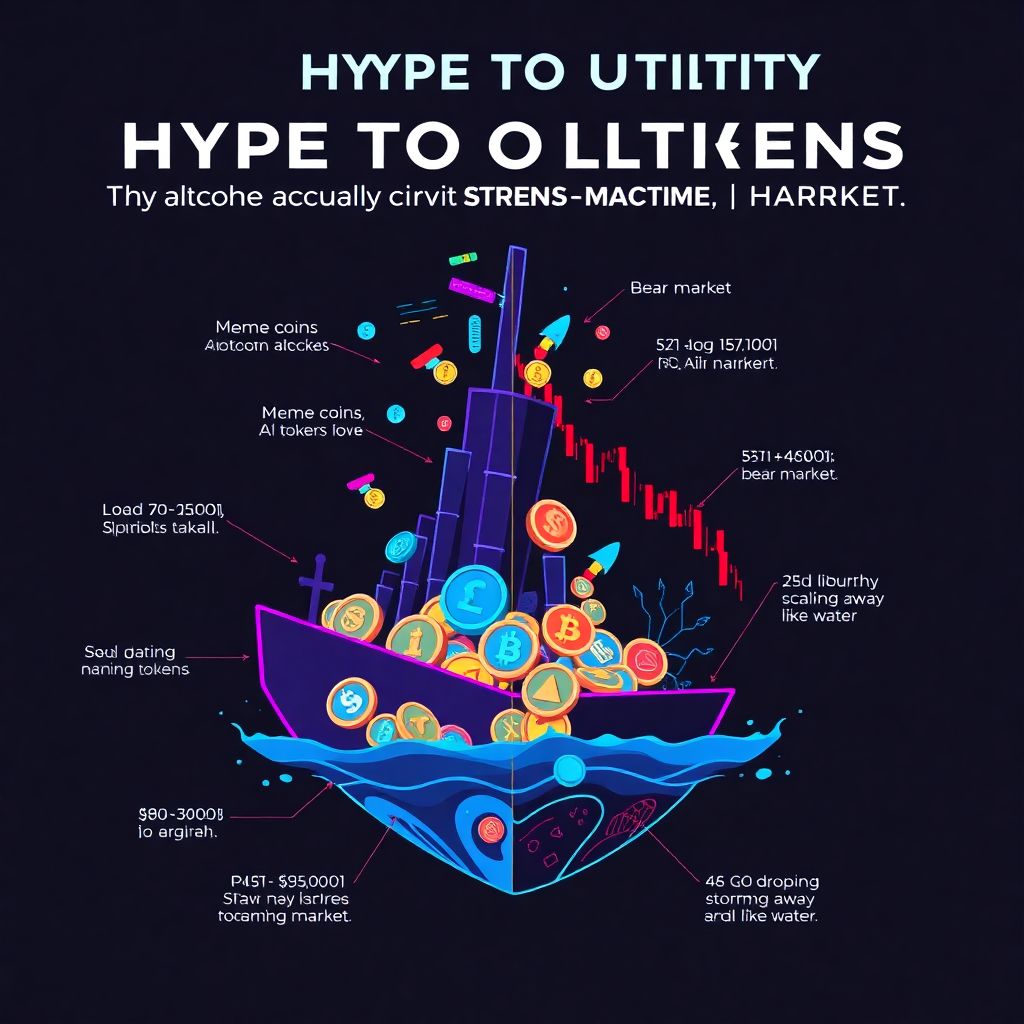
Hype to utility: why some altcoins actually survive bear markets
Bear markets are often framed as brutal periods that “kill” altcoins, but in practice they function more like stress tests. When speculative money drains out of the system, projects that were floating purely on narrative and momentum sink quickly. A smaller set of altcoins, however, keeps attracting users, processing transactions, and building out real products.
The defining line between those two groups is not marketing, branding, or even short-term performance. It’s utility. Projects that solve real problems, generate organic demand, and have sustainable economic models tend to endure, while hype-driven tokens fade into irrelevance once the music stops.
Understanding *why* certain altcoins survive downturns is essential for anyone thinking beyond the next pump. It reveals how the crypto market is maturing and offers a framework for distinguishing durable networks from passing fads.
—
How hype-driven tokens rise – and why they usually don’t come back
In bull markets, capital chases stories. Tokens can skyrocket not because people are using them, but because they fit a hot narrative:
– Meme coins that tap into internet culture
– AI tokens riding the artificial intelligence boom
– Gaming tokens promising “the next big metaverse”
– Scaling plays tied to layer-2 and infrastructure buzz
In this phase, narrative matters more than fundamentals. Price appreciation becomes its own marketing engine: people buy because it’s going up, and it goes up because people keep buying. Liquidity is abundant, risk appetite is high, and almost any token with a compelling story can attract attention.
The problem emerges when the cycle turns. As macro conditions tighten and liquidity leaves the market, the fuel that sustained these hype coins vanishes. Without a real product, identifiable users, or concrete value proposition, there’s nothing left to support demand once the excitement fades.
That’s why so many tokens never recover from a severe drawdown. They weren’t built for harsh conditions. Their purpose was to capitalize on a bull run, not to operate through several years of slower growth, lower volumes, and stricter investor scrutiny.
—
Utility as a foundation: creating real, repeatable demand
Altcoins that remain relevant in bear markets usually share one common trait: they are actually used. Their tokens are tied to functions that people or businesses need, independent of price.
This utility can take many forms, including:
– DeFi infrastructure – tokens used to pay fees, provide collateral, govern lending protocols, or access liquidity
– Data and oracle networks – tokens required to pay for secure off-chain data feeds and verification
– Payments and settlement – tokens facilitating cross-border transfers, micropayments, or on-chain commerce
– Security and validation – tokens used for staking, securing networks, or participating in consensus
– Real-world asset (RWA) integration – tokens that underpin platforms connecting traditional assets to blockchain rails
When people depend on a network for actual services—data, financial operations, security, or settlement—token demand becomes *structural*. This means activity doesn’t vanish just because the price chart turns red. Businesses still need to process payments; protocols still need data; traders still need collateral.
That baseline of real-world or on-chain activity is what separates speculative bubbles from functioning ecosystems. It doesn’t guarantee a smooth price chart, but it does provide a constant flow of organic demand that pure meme or narrative tokens simply do not have.
—
Why baseline demand matters in a downturn
In a bull market, almost everything goes up together. In a bear market, correlations break, and only certain forms of demand remain. This is where baseline utility becomes so important.
Stable, recurring usage helps to:
– Dampen extreme volatility – when there is continuous need for a token, sell pressure doesn’t hit an empty order book
– Preserve liquidity – active users keep trading, swapping, and transacting, supporting markets even when speculation slows
– Attract longer-term holders – participants who understand the product and revenue model are less sensitive to short-term sentiment
– Maintain relevance – protocols that remain useful don’t disappear from developer or user conversations just because prices fall
This doesn’t mean utility tokens are immune to drawdowns—they can and do fall sharply. But they tend to retain some floor of activity and interest. That floor is what allows them to survive long enough to participate in the next expansion phase.
—
The role of developers: who keeps building when nobody is watching?
Alongside utility, developer commitment is one of the strongest predictors of survivability. Bear markets slow down the entire industry: funding becomes harder to secure, user numbers shrink, and media attention shifts elsewhere.
In that environment, weaker teams stall or disappear. Stronger teams treat the downcycle as a building phase. They:
– Ship protocol upgrades and security improvements
– Refine tokenomics and governance models
– Launch new products or expand into adjacent verticals
– Improve documentation, tooling, and developer experience
– Engage with their communities on roadmaps and priorities
This persistent development has two critical effects. First, it compounds over time: every upgrade, integration, and UX improvement increases the chance that the protocol will be more attractive once markets recover. Second, it becomes a clear signal to serious investors that the team is credible and focused on long-term value, not just short-term speculation.
When liquidity returns, capital typically flows first into projects that *proved* their resilience during the bear market—those that kept shipping, not those that disappeared for 18 months and reappeared when prices started moving.
—
Ecosystem growth: networks, not just tokens
Altcoins do not operate in isolation. Their survival is closely linked to the health of the ecosystems they are part of or help create. During bear markets, projects that focus on ecosystem expansion are quietly planting the seeds for future demand.
Key aspects of ecosystem growth include:
– Partnerships and integrations – working with wallets, exchanges, DeFi protocols, or enterprise partners to expand real-world use
– Developer ecosystem – grants, hackathons, SDKs, and tooling that make it attractive for others to build on top of the protocol
– User experience upgrades – simpler onboarding, better interfaces, improved security for non-technical users
– Interoperability – bridges, cross-chain messaging, or multichain deployments that bring in new user bases
These efforts rarely cause parabolic price action in the short term, but they dramatically increase the surface area for demand. When sentiment improves, protocols with a dense network of integrations and partners are positioned to scale much faster than isolated projects.
—
Tokenomics: when economic design decides who survives
Even with strong utility and active development, poor token economics can crush an altcoin in a bear market. The structure of supply, emissions, and incentives determines how a token behaves under stress.
Common weaknesses exposed in downturns include:
– Excessive inflation – high emissions that made sense for a growth phase become unsustainable when demand drops, overwhelming buyers
– Front-loaded unlock schedules – large cliffs for investors or team tokens that flood the market during low-liquidity periods
– Misaligned incentives – rewards that encourage mercenary behavior (farming and dumping) rather than long-term participation
– Lack of fee capture or value accrual – tokens that are loosely tied to protocol usage struggle to maintain any economic floor
By contrast, projects that weather bear markets usually feature:
– Controlled or declining emissions designed for multi-year sustainability
– Mechanisms tying token value to usage, such as buybacks, staking rewards funded from protocol fees, or discounts for token-based payments
– Incentive models that reward long-term involvement, such as time-locked staking, governance power, or revenue sharing
Bear markets rapidly expose inefficient token designs. When speculative flows dry up, only tokens that can balance supply and demand on fundamentals have a chance of remaining relevant.
—
What this means for long-term investors and builders
For participants thinking beyond the current cycle, bear markets are not purely negative events. They are filtering mechanisms that clear out unsustainable projects, leaving a smaller field of more robust contenders.
For investors, this environment rewards a different approach:
– Evaluating *why* a token should be used, not just *why* it might go up
– Studying developer activity, code repositories, and public roadmaps
– Looking at fee generation, cash flows, and how they relate to the token
– Assessing how the project behaved in previous periods of stress, if applicable
For builders, bear markets can be strategic opportunities:
– Competition for user attention is lower, allowing serious teams to stand out
– Talent is easier to hire as speculative projects shut down
– There is more room to experiment with product-market fit without hype-driven pressure
– Infrastructure upgrades and refactors can be done with less disruption to users
The projects that emerge strongest from a downturn are often those that treated it as a chance to refine their core value proposition rather than simply waiting for “the next bull run.”
—
How to tell if a token is hype or has real staying power
Differentiating between hype and durable utility is not always obvious, especially in fast-moving markets. A practical framework is to ask a few simple but revealing questions:
1. If the token price went sideways for two years, who would *still* need or want to use it?
2. What concrete problem does the project solve, and for whom?
3. Are there visible signs of ongoing development—code commits, audits, product releases, ecosystem growth?
4. Is token demand directly linked to protocol usage, or is it mostly about speculation and yield?
5. How does the token supply evolve over time, and who is receiving new tokens?
Tokens that struggle to provide clear answers to these questions are generally more exposed in bear markets. Those that pass this test are not guaranteed winners, but they are much more likely to remain in the conversation when speculative noise dies down.
—
Looking ahead: what to expect in future cycles
As the crypto industry matures, each cycle looks less like a pure boom-and-bust and more like a process of creative destruction. Hype coins will continue to appear, draw attention, and vanish. At the same time, a growing base of utility-driven altcoins will quietly entrench themselves as core infrastructure.
Future bear markets are likely to:
– Put increasing pressure on unsustainable tokenomics and shallow narratives
– Reward protocols that generate real fees and have measurable usage
– Highlight the value of security, reliability, and regulatory resilience
– Strengthen the divide between speculative experiments and foundational networks
For those willing to look past short-term volatility, the key question is no longer, “Which token will pump the hardest next month?” but rather, “Which networks are becoming indispensable, regardless of price?”
—
The enduring lesson of bear markets
Bear markets do not merely reduce prices; they reorder priorities. They redirect focus from attention and momentum to actual functionality, economic robustness, and persistent building.
Hype-driven altcoins may dominate headlines during exuberant phases, but it is the tokens embedded in real, ongoing use cases that tend to survive the harshest conditions and often lead the next wave of innovation.
For anyone serious about the long game in crypto—whether as a builder, investor, or power user—bear markets are less about panic and more about clarity. They reveal which projects are anchored in substance and which were only ever floating on hype.