
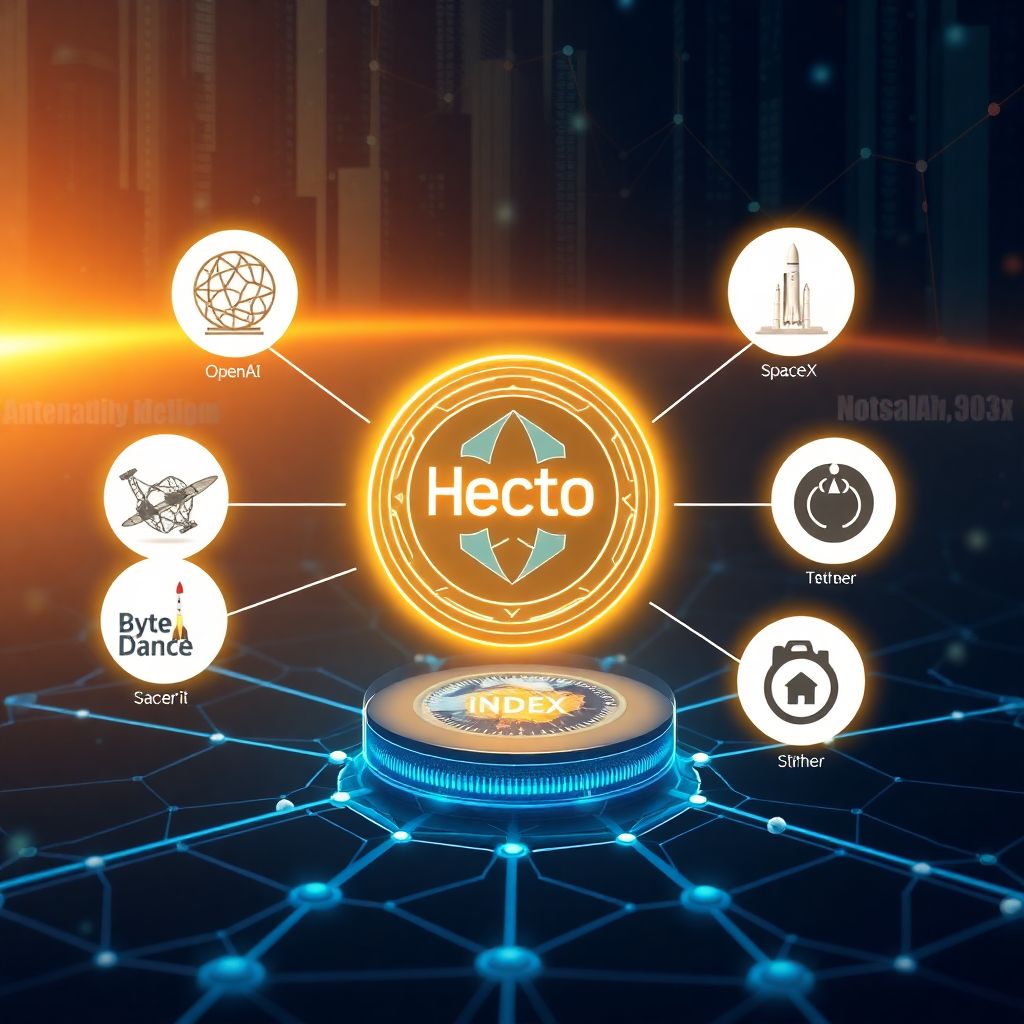
Before an IPO ever hits the headlines, trillions of dollars in value are already locked up behind closed doors. For years, the world’s most coveted technology companies—especially the AI and infrastructure giants—have been off-limits to everyday investors and even difficult to access for many institutions. Hecto is trying to dismantle that wall by turning the largest private tech firms into a single, tradable on-chain token.
At the center of this push is Ultan Miller, CEO of Hecto and managing partner at FCA‑regulated digital asset advisory firm Saxon. Miller has spent years at the intersection of venture capital, blockchain infrastructure, and institutional finance. He has advised on more than $300 million in blockchain and fintech deals, deployed millions of his own capital into early-stage technology, and built companies from both the founder and investor sides. Now he’s applying that experience to a much bigger question: how should the world gain exposure to the next generation of trillion‑dollar technology platforms?
Hecto’s answer is an ambitious one: the world’s first tokenized pre‑IPO index focused on the most valuable private tech companies on the planet. The inaugural product aggregates exposure to seven late-stage giants—OpenAI, SpaceX, ByteDance, xAI, Stripe, Tether, and Anthropic—into a single token issued on Canton, an institutional blockchain backed by major financial players.
Miller calls these companies not unicorns, or even decacorns, but “Hectocorns”: private firms with valuations exceeding $100 billion that are reshaping the global economy, particularly through AI and capital‑intensive infrastructure. These businesses are defining a technological era, yet most of the value creation happens while they’re still private. By the time an IPO finally arrives, insiders and select institutions have already captured the steepest part of the growth curve.
In that sense, Hecto is less about crypto speculation and more about rewriting the access model. If public equity markets were once where generational companies were built and discovered, today that process has moved upstream into opaque private rounds, structured secondary deals, and closed‑door agreements. Tokenization, in Miller’s view, is the crucial bridge that reconnects those private markets with a broader investor base—without sacrificing institutional-grade controls.
How do you put seven Hectocorns into one token?
At a technical level, each Hecto token represents exposure to a basket of seven late-stage private companies, each assigned predefined weights in the index. The valuation methodology and rebalancing rules are designed to be transparent and systematic, relying on observable information such as recent funding rounds, secondary-market transactions, and comparable public-company multiples where relevant.
Investors gain exposure by depositing capital into a dedicated vault. In return, the protocol mints a specific series of the token whose value tracks the aggregated performance of the underlying basket. The token effectively acts as a programmable wrapper for diversified pre-IPO exposure, with the underlying positions held and managed according to pre‑set institutional standards.
Canton, the blockchain environment on which the token operates, plays a crucial role here. Unlike permissionless public chains, Canton is built for regulated institutions, offering privacy‑preserving settlement, configurable permissioning, and compliance‑ready workflows. This lets Hecto structure products that resemble traditional financial instruments in terms of legal, operational, and risk‑management standards, while still delivering the composability and programmability of tokenized assets.
The shared ledger and synchronisation layer of Canton also allow multiple participants—custodians, brokers, asset managers, and compliance functions—to operate against a single source of truth. For Hecto, that means the token can be settled, transferred, and audited in a way that meets the expectations of institutional allocators, rather than just crypto-native traders.
Can companies be added to the token over time?
The design of the Hecto index is not static. While the inaugural basket includes OpenAI, SpaceX, ByteDance, xAI, Stripe, Tether, and Anthropic, the structure is intended to accommodate future additions or substitutions, governed by clear rules.
Eligible companies must typically meet several criteria: a minimum valuation threshold (the “Hectocorn” profile), sustained strategic relevance in AI or adjacent infrastructure, and sufficient data to support robust valuation and risk assessment. If a new private company surpasses $100 billion in value, achieves global strategic importance, and demonstrates stable financing and governance, it could be considered for inclusion.
Rebalancing events—such as the addition of new names or the removal of existing ones—would be handled through predefined procedures. For example, if one of the basket companies goes public or undergoes a major liquidity event, Hecto could realize that exposure and, depending on the product design, either distribute the benefit to tokenholders, reallocate into other qualifying private names, or adjust the index composition towards remaining Hectocorns.
This dynamic architecture ensures the token does not become a frozen snapshot of a specific moment in tech history. Instead, it seeks to remain an evolving representation of the most systemically important, late-stage private AI and technology platforms.
Is there an AI or tech “bubble” that will pop in 2026?
One of the most common questions Miller faces is whether Hecto is effectively building a structured bet on an AI/tech bubble that might burst around 2026. The team’s thesis is that the current environment is fundamentally different from previous mania-driven cycles.
In their view, what’s unfolding is less about frothy speculation and more about a structural shift in how economic value is created. AI is already driving measurable revenue growth across sectors, from cloud infrastructure and semiconductors to enterprise software and consumer platforms. Productivity gains are starting to show up in real-world workflows. Crucially, the capital behind these companies is not dominated by leveraged retail investors, but by large institutions with long-duration horizons.
That doesn’t mean the journey will be smooth. Volatility, repricings, and periods of over-exuberance are almost guaranteed. But Hecto argues that the underlying fundamentals—recurring revenues, defensible moats in data and infrastructure, and deep integration into corporate and government operations—bear little resemblance to past bubbles fueled primarily by cheap leverage and momentum trading.
A potential IPO of SpaceX is another factor in their outlook. A listing of that scale is expected to inject substantial liquidity into late-stage private markets, establish clearer price discovery for comparable firms, and provide new public-market benchmarks for aerospace, satellite connectivity, and space infrastructure. This, in turn, could support more rational and transparent valuations across other Hectocorns.
What about macro risk—especially going into 2026?
On the macro side, Hecto’s framework assumes a broadly supportive environment for risk assets, even if the path is uneven. Expectations of continued monetary-policy easing and prospective rate cuts by the U.S. Federal Reserve historically favor long-duration and growth-oriented assets, including advanced technology and AI.
In parallel, modern liquidity mechanisms—such as targeted asset purchases, balance-sheet tools, and reserve-management programs—often provide de facto support to the financial system, even when policymakers avoid labeling them as traditional quantitative easing. The net effect, from Hecto’s perspective, is an environment where capital remains broadly accessible for large, strategically important technology platforms.
That said, the team acknowledges several key risks: persistent inflation that forces central banks to re-tighten, regulatory shocks to AI or crypto infrastructure, and geopolitical tensions that disrupt global supply chains. The index structure is not designed to eliminate macro risk; rather, it packages that risk into a diversified exposure to companies that are most likely to shape, and benefit from, long-term technological trends.
xAI and the GPU question: what if the hardware bet goes wrong?
One of the more pointed concerns around the basket is xAI’s aggressive spending on GPUs such as Nvidia’s H100s. Critics and short-sellers argue that pouring capital into current-generation hardware could leave xAI holding a rapidly depreciating asset base if new architectures render today’s chips obsolete within a few years.
Miller’s response starts by reframing how these assets are viewed. First, GPUs in the current cycle are not just capital expenditures; they are revenue-generating infrastructure. Access to compute is the gating factor for training, fine-tuning, and serving frontier models. For a company positioned at the core of AI development, GPUs are closer to income-producing factory equipment than to speculative collectibles.
Second, while hardware does depreciate, the depreciation is functional and anticipated. Pricing models, leasing strategies, and cloud-style access models all factor in the useful life of each generation of chips. As long as demand for AI compute remains structurally strong—which Hecto’s thesis assumes—there is an active market for both primary and secondary use of these assets, from training large models to running smaller, specialized workloads.
Third, the risk of technological obsolescence is not unique to xAI. Every Hectocorn in the basket faces some version of platform, regulatory, or competitive risk. The purpose of a diversified token is precisely to avoid concentration in any single hardware or business-model bet. Even if xAI’s GPU strategy underperforms, the overall index remains anchored in multiple, distinct revenue engines across AI models, payments, space infrastructure, content platforms, and digital asset ecosystems.
How does the token respond if the AI boom stalls?
A natural question follows: what if AI demand moderates or the market re-rates AI valuations downward?
In a downside scenario where AI multiples compress or growth slows, the index would, by design, reflect that repricing. The token does not attempt to hedge away sector risk; it is explicitly a vehicle for capturing the upside (and managing the downside) of late-stage AI and technology platforms.
However, several features help cushion idiosyncratic shocks. The basket spans different layers of the stack—model providers (OpenAI, Anthropic, xAI), infrastructure and connectivity (SpaceX), payments and fintech (Stripe), consumer and content distribution (ByteDance), and digital asset infrastructure (Tether). These businesses do not all respond identically to the same macro or sector-specific shocks.
Moreover, many of these companies are not pure AI stories. Stripe is tied to global commerce and financial infrastructure; Tether is deeply intertwined with liquidity in digital-asset markets; SpaceX has multiyear commercial and government contracts. Even if AI sentiment sours, these revenue bases can continue to grow or remain resilient, offering some diversification within the AI‑centric theme.
What are the expectations for the token by 2026?
Looking specifically toward 2026, Hecto’s internal expectations focus less on a specific price target and more on three dimensions: maturity of the product, breadth of adoption, and integration into institutional workflows.
First, by 2026, the platform aims for a fully proven lifecycle across multiple events: rebalancings, new company additions, partial or full exits following IPOs, and corporate actions handled seamlessly on-chain. A key milestone is demonstrating that tokenholders can participate in the economic upside of liquidity events—such as a SpaceX IPO or major funding round repricings—without operational friction.
Second, adoption. Hecto expects that, by then, a meaningful portion of demand will come from allocators who historically sat outside of crypto: family offices, hedge funds, multi-asset managers, and potentially even pension or sovereign-wealth capital, subject to jurisdictional constraints. For these actors, the token is not “just another coin” but a structured, digitally native instrument that fits into an alternatives or growth-equity allocation.
Third, infrastructure integration. By 2026, the goal is for Hecto’s token to plug into custodial, reporting, and risk systems used by mainstream finance. That includes standard portfolio analytics, audited NAV reporting, and interoperability with trading and settlement venues operating on or connected to Canton. In that scenario, the token becomes one building block in a broader universe of tokenized private-market products.
Why use blockchain at all, instead of a traditional fund?
A recurring question is why any of this needs a blockchain, instead of a conventional closed-end fund or private equity vehicle.
Hecto’s argument is that tokenization solves three interlinked problems: access, liquidity, and programmability. Traditional pre-IPO funds often lock capital for years, restrict participation to certain investor categories, and offer limited or no secondary liquidity. By contrast, a tokenized index can, in principle, be traded more frequently, integrated into on-chain collateral systems, and used as a component in structured products, all while retaining strict permissioning where required.
Programmable compliance is another advantage. On Canton, identity, eligibility, and jurisdictional constraints can be enforced directly at the protocol level. That allows for controlled secondary markets, whitelisting, and transfer rules that satisfy regulatory obligations while still enabling more fluid capital flows than legacy private-market structures.
Finally, tokenization reduces operational friction. Corporate actions, distribution events, and rebalancings can be reflected directly in the token’s state, rather than through multiple layers of manual reconciliation. For allocators who manage complex multi-asset portfolios, this operational clarity is increasingly important.
Who is this product really for?
Hecto’s token is not aimed at speculative day-traders chasing short-term volatility. The intended audience is long-term investors who want systematic exposure to the most important private technology platforms without having to negotiate cap tables, secondary deals, or bespoke side letters.
This includes family offices seeking growth exposure, hedge funds that want a liquid proxy for pre-IPO AI and infra, and institutions experimenting with tokenized alternatives as a complement to traditional private equity, venture, and growth funds. Over time, as regulation and infrastructure evolve, the addressable investor base could expand further.
At the same time, the product forces a shift in mindset: instead of asking “How do I get into OpenAI or SpaceX directly?” investors can ask “How do I own a slice of the entire Hectocorn universe, with transparent rules and institutional safeguards?” The token is designed to be that slice.
The bigger picture: pre-IPO markets at internet speed
Underlying all of this is a conviction that pre-IPO markets are about to accelerate. Historically, secondary trades in late-stage private names were slow, bilateral, and highly fragmented. Pricing was opaque, access was limited, and every transaction felt bespoke. By moving exposure into programmable, on-chain instruments, Hecto believes these markets can start to operate at “internet speed,” with clearer price signals and more efficient capital flows.
For decades, the most valuable technology companies in the world remained effectively inaccessible until ringing the opening bell. A small circle of insiders decided valuations; institutions bartered for exposure in private; retail arrived last. Hecto’s bet is that this model is no longer fit for an era where the most important companies are staying private longer, raising larger rounds, and shaping the global economy long before they disclose a single quarterly earnings report.
In that context, turning Hectocorns into public tokens is less a gimmick and more an attempt to rewire how ownership, access, and price discovery work in the age of AI. Whether the AI cycle soars, stalls, or simply normalizes by 2026, Hecto’s thesis is clear: the bridge between private and public markets will be built on-chain, and it intends to be one of the first to cross it.