
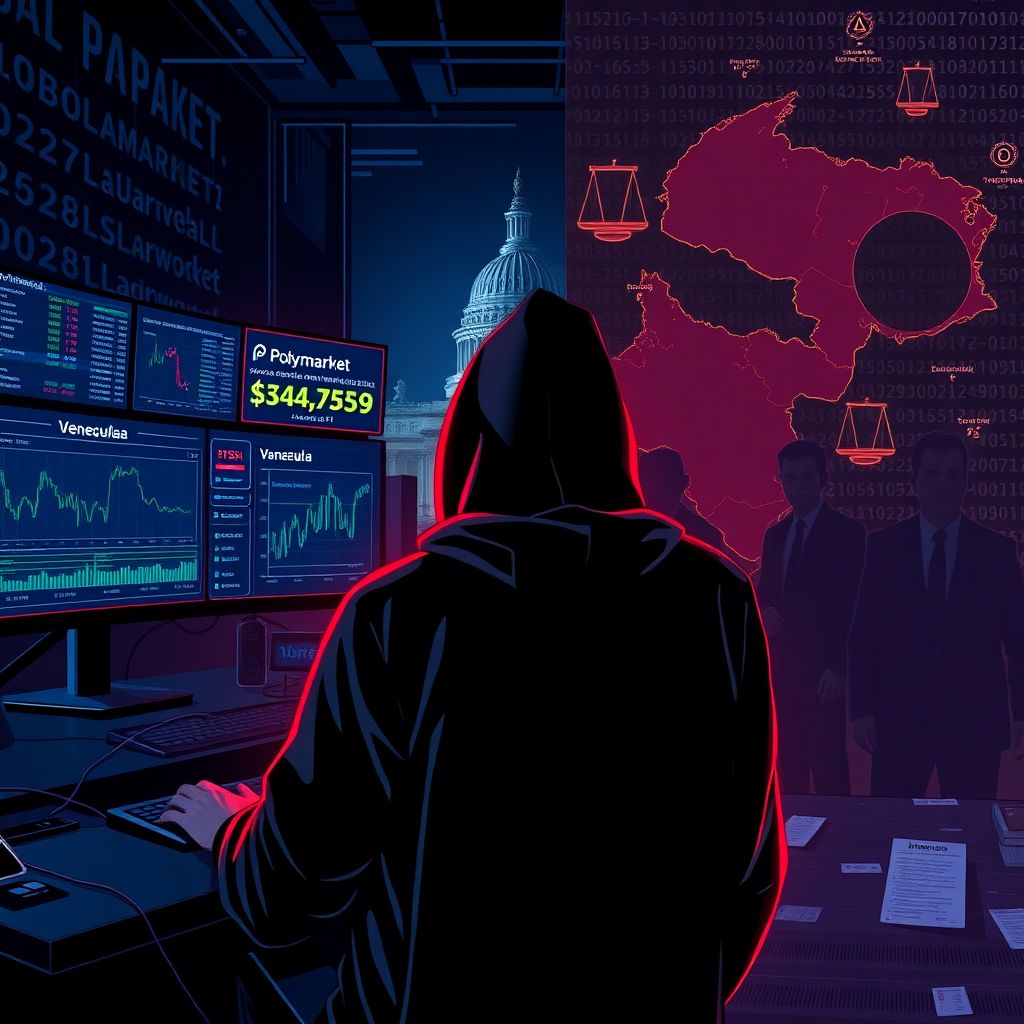
A massive winning bet on the fall of Nicolás Maduro has pushed crypto prediction markets into the center of a growing storm over insider trading and political ethics.
A trader on Polymarket, the popular blockchain-based prediction platform, reportedly walked away with $436,759 after correctly wagering that Maduro would be removed from power before January 31. What turned a profitable speculation into a political flashpoint was the timing: the position was placed only hours before U.S. special forces apprehended the former Venezuelan leader.
That narrow window between the trade and the arrest immediately raised suspicions that the bettor may have acted on confidential information, rather than public news or ordinary analysis. The incident has accelerated a long-brewing debate about whether prediction markets should be treated like financial markets when it comes to insider trading rules—and whether government officials should be allowed anywhere near them.
The controversy has already triggered a concrete response in Washington. U.S. Representative Ritchie Torres, a Democrat from New York, is drafting legislation that would make it illegal for federal employees to use political prediction markets while in possession of “material non-public information” about the events those markets track. In other words, if a government insider knows something the public doesn’t—such as an imminent arrest, a planned military operation, or a sealed diplomatic deal—placing a bet on a corresponding outcome would be banned.
Torres’s proposal borrows the logic of traditional securities law, which prohibits trading stocks on material non-public information, and tries to extend it into the world of on-chain betting. While prediction markets aren’t stocks and don’t represent ownership in companies, they do allow people to profit from events that may be influenced or foreseen by policymakers and insiders, often with far less oversight than Wall Street.
Industry advocates, however, argue that what looks like a regulatory flaw is in fact the whole point. Many prediction market theorists have long claimed that allowing informed actors—including insiders—to participate is what makes these platforms valuable. If people with superior knowledge are incentivized to trade, their actions should, in theory, push market prices closer to the true probability of an event.
From that perspective, insider information is a “feature, not a bug.” By embedding private knowledge into public prices, prediction markets can become highly efficient forecasting tools for everything from elections and policy decisions to conflicts and macroeconomic trends. Some academics and technologists contend that forbidding insiders from participating would blunt this mechanism and make the markets less accurate and less useful.
Still, defenders of this view tend to gloss over the ethical and democratic implications. If government officials are allowed to quietly monetize their privileged position by betting on the outcomes they help shape, the line between public service and personal enrichment blurs dangerously. The Polymarket–Venezuela case illustrates how quickly suspicion arises when an opaque trade coincides with a covert state action.
The Maduro market also highlights the broader challenge of regulating decentralized and global platforms. Unlike regulated betting shops or stock exchanges, on-chain prediction markets can be accessed from almost anywhere, often pseudonymously, using a crypto wallet. Even if U.S. law bars federal workers from specific behaviors, enforcing those rules in practice—especially across borders and on-chain identities—will be difficult.
Another complication is definitional. What exactly counts as “material non-public information” in the context of geopolitics or national security? Intelligence briefings, draft sanctions, planned military operations, and confidential diplomatic negotiations could all affect the probability of an outcome. But policy staff, analysts, and even external contractors are frequently exposed to fragments of such information. Drawing a bright legal line between lawful informed speculation and illegal insider betting may prove more art than science.
Despite these challenges, pressure for some kind of regulatory framework is growing. As prediction markets gain visibility—thanks in part to high-dollar wins like the Polymarket Maduro trade—lawmakers are increasingly wary of the perception that powerful insiders can secretly gamble on the fate of nations. For public officials, even the appearance of profiting from privileged knowledge can erode trust in institutions already under strain.
Meanwhile, the platforms themselves face a strategic crossroads. Some operators have hinted at implementing stronger know-your-customer procedures, geographic restrictions, and explicit bans on certain types of participants, including government employees or individuals tied to sensitive agencies. Others insist that the open, permissionless nature of prediction markets is non-negotiable, arguing that over-regulation would strip them of their core innovation and push activity into even more opaque corners of the internet.
At a deeper level, the Polymarket incident forces a reconsideration of what society wants prediction markets to be. Are they primarily speculative casinos wrapped in a forecasting narrative? Are they experimental tools for aggregating information to guide decision-making? Or are they emerging financial infrastructures that, like securities markets, inevitably require robust rules to prevent abuse by those with power and inside access?
The answers will shape not just the future of one platform, but the entire category of on-chain speculation. If policymakers treat prediction markets as harmless curiosities, insider betting might be tolerated in the name of better predictions. If, instead, they view these venues as politically sensitive instruments with real economic and governance implications, restrictions like the one proposed by Representative Torres will likely be just the beginning.
Whatever direction regulation takes, the $436,759 win on Maduro’s ouster has already achieved one thing: it has turned a niche crypto subculture into a test case for how 21st-century democracies handle the collision of state power, secret information, and permissionless financial technology. Going forward, traders, platforms, and public officials will all need to navigate a much more scrutinized landscape—where every well-timed bet may be seen not just as sharp analysis, but as a potential clue to what the rest of the world isn’t yet supposed to know.