
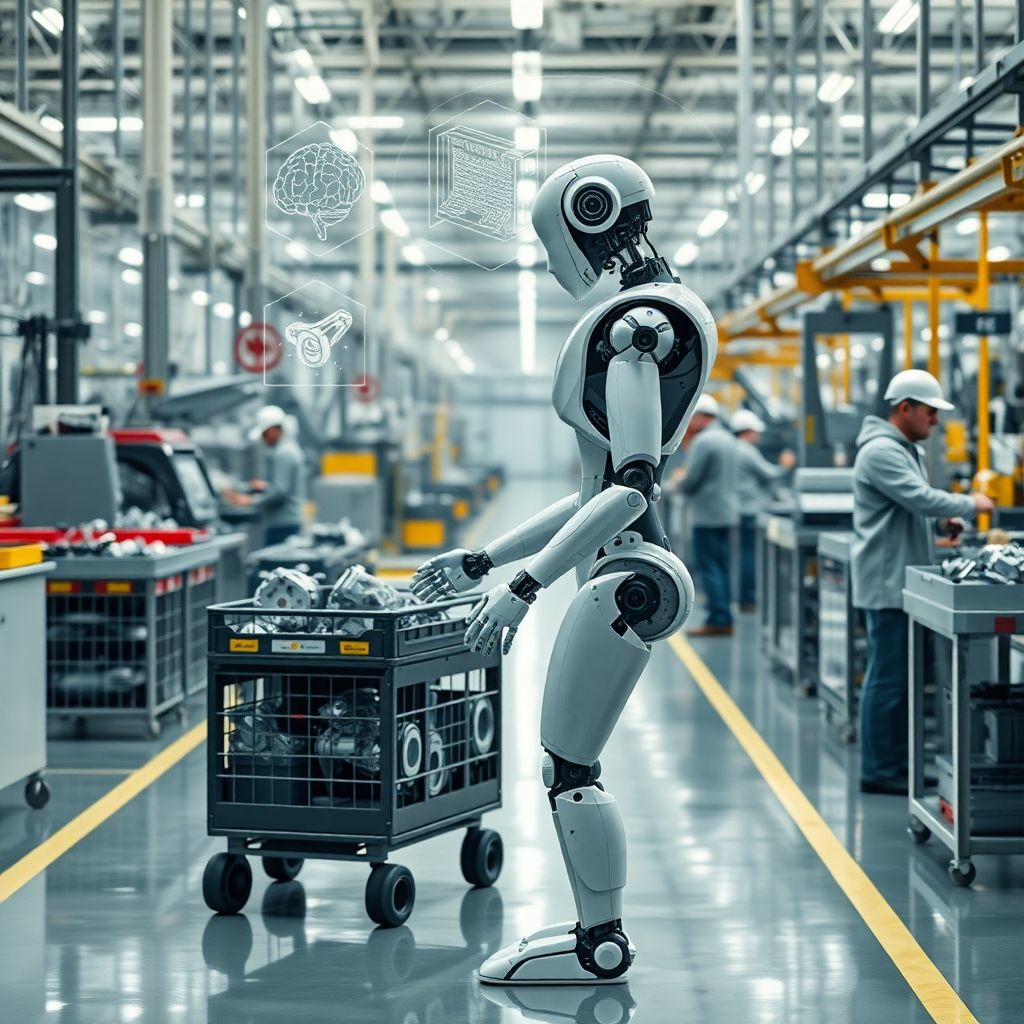
Google’s Gemini AI is headed for the factory floor, powering Boston Dynamics’ Atlas humanoid robots in trials modeled on Hyundai-style industrial production lines. The collaboration is designed to move Atlas beyond tightly scripted demonstrations and into semi-autonomous work in real-world manufacturing environments.
Under the partnership, Boston Dynamics is integrating Google DeepMind’s Gemini model into the Atlas platform to give the robot more advanced perception, planning, and decision-making abilities. Instead of following only pre-programmed routines, Atlas will be able to understand new tasks, interpret complex surroundings, and adapt its behavior on the fly.
According to the companies, the upgraded Atlas robots are being tested on jobs typically performed by human workers in factories: sorting and organizing components, fetching and delivering parts, manipulating objects of different shapes and sizes, and helping manage multi-step workflows that change throughout the day. The aim is not just to automate repetitive motions, but to handle the messy, unpredictable aspects of real industrial work.
Gemini’s role is to provide the “brain” that makes this possible. The AI system fuses advanced computer vision, spatial reasoning, and high-level planning so that Atlas can navigate unfamiliar layouts, avoid obstacles, and understand how objects relate to each other in three-dimensional space. This enables the robot to make real-time decisions in dynamic, partially unstructured environments rather than relying on a perfectly controlled setting.
Boston Dynamics is positioning Atlas as a development and testing platform for refining Gemini’s control stack. The humanoid form factor allows researchers to explore how AI handles tasks that require balance, dexterity, and coordination resembling those of a human worker. As Atlas executes tasks, Gemini adjusts its strategies based on feedback, learning how to deal with slippery floors, shifting loads, or unexpected interference on the line.
Safety is a major focus of the integration. The system is being built with multiple layers of safeguards to ensure Atlas can operate around people, sensitive equipment, and high-value components without causing harm or damage. This includes collision avoidance, force limits on physical interactions, and fail-safe behaviors if the robot encounters a situation it cannot confidently handle.
Hyundai, which owns Boston Dynamics, is reported to be among the first industrial players seriously evaluating how Gemini-powered Atlas robots could fit into actual production. The automaker is studying use cases like assisting workers with heavy or ergonomically difficult tasks, supporting flexible assembly lines, and stepping in for tasks that currently cause fatigue or injury risk.
For manufacturers, the promise is flexibility rather than simple replacement of existing machines. Traditional industrial robots excel at fixed, repetitive motions within cages or clearly defined zones. Humanoid robots controlled by systems like Gemini are intended to work in more open, mixed environments, taking on jobs that change frequently or require a level of judgment that has historically been beyond automation.
The partnership also signals a shift in how AI and robotics are being developed. Instead of treating perception, motion, and planning as separate modules, Gemini is designed to integrate them into a single, general-purpose intelligence layer. That means the same core model can interpret spoken or written instructions, understand visual context, and then translate that into precise, coordinated movements of Atlas’s limbs and hands.
In a typical future use case, an operator might brief the robot in natural language—describing the parts to be handled, the order of operations, and any safety constraints. Gemini would then break down that description into a sequence of actions, use vision to verify it has found the correct components, and continually adjust its movements as people and equipment move around it. This stands in contrast to traditional programming, where every motion and condition has to be explicitly encoded.
Beyond automotive factories, Google DeepMind and Boston Dynamics see opportunities in logistics centers, electronics manufacturing, and other sectors that need a mix of precision and adaptability. Atlas could, in theory, be reassigned from one type of task to another—say, from unloading pallets to assembling kits—largely through changes in instructions and minimal reconfiguration of the environment.
This evolution also raises key questions about the future of work. While the companies emphasize that the technology is meant to augment human workers by taking on dangerous, dirty, or monotonous jobs, the introduction of capable humanoid robots is likely to reshape roles on the factory floor. New types of jobs will emerge around supervising, maintaining, and instructing robots, while certain purely manual roles may be reduced or eliminated.
Another important dimension is reliability. Industrial customers will demand that AI-driven robots operate with the consistency of traditional automation. That means Gemini and Atlas need to cope with edge cases: poorly lit areas, irregular components, minor collisions, and unpredictable human behavior. The use of Atlas as a testbed is intended to expose the AI to exactly these kinds of real-world complications before large-scale deployment.
Data collection will be crucial. Every task Atlas attempts—successful or not—provides additional information that can be used to improve Gemini’s understanding of physics, materials, and human-centric environments. Over time, this should allow the system to generalize from one factory to another, reducing the amount of custom engineering traditionally required to introduce robots into a new facility.
There are also broader strategic implications. For Google, integrating Gemini into physical robots is a way to prove that its general-purpose AI can handle not just text and images, but high-stakes, embodied decision-making. For Hyundai and other industrial partners, it is an opportunity to redesign production lines around more adaptive automation, potentially shortening time-to-market for new vehicle models or product variants.
Ethical and regulatory considerations will follow close behind. Humanoid robots that can make autonomous decisions in shared workspaces will likely face scrutiny from labor groups, safety regulators, and policymakers. Standards around transparency, override controls, and accountability for failures will have to evolve alongside the technology.
Still, the direction is clear: intelligent, adaptable robots are moving from research labs and choreographed demos into pilots that reflect the complexity of real factories. The integration of Gemini into Atlas marks a step toward robots that can perceive, reason, and act with a level of autonomy that begins to approach human problem-solving, while maintaining the precision and endurance of machines.
If these trials prove successful, manufacturers could gain a new class of workforce: robots that are not locked into a single task or line, but can be re-deployed wherever they are needed most. In a global industry strained by labor shortages, rising customization demands, and pressure for higher productivity, the combination of AI like Gemini with platforms like Atlas could become a defining feature of the next generation of industrial automation.
Комментарии