
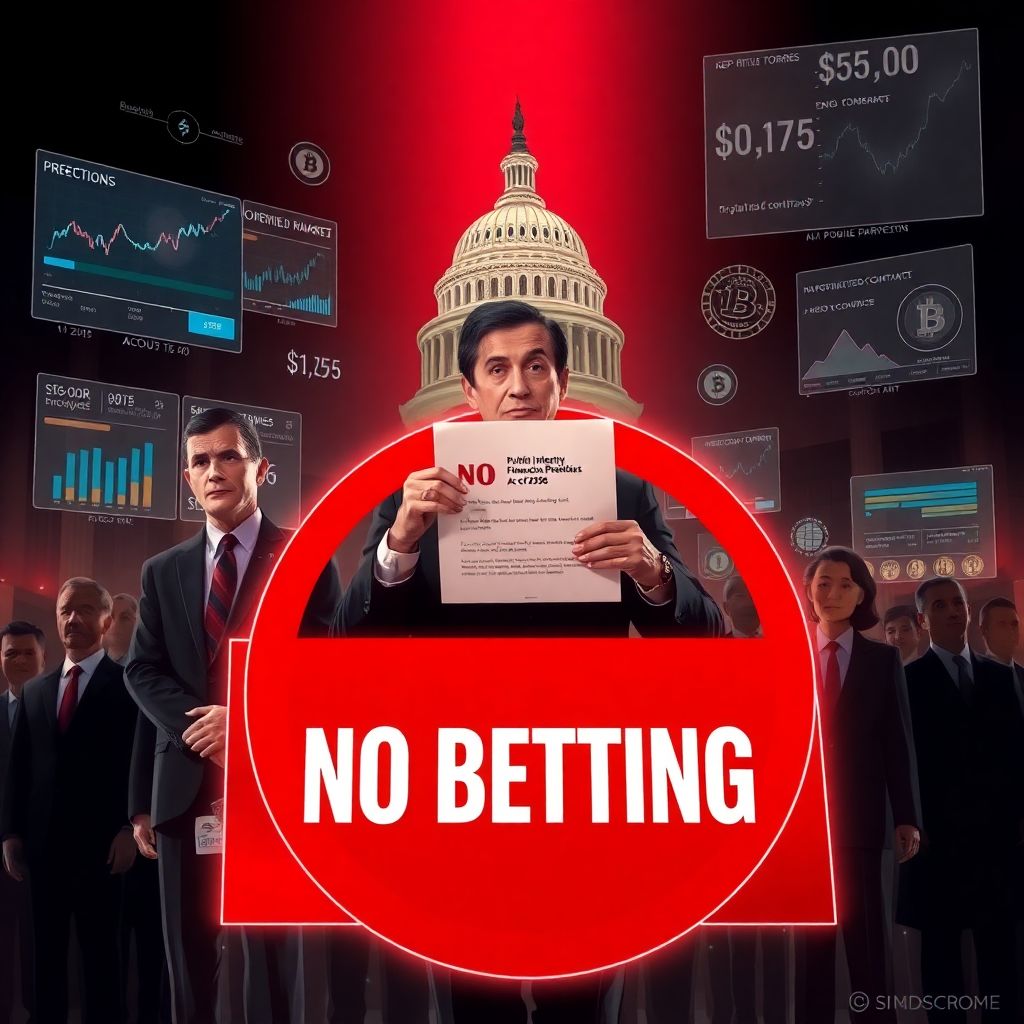
Should politicians and top government staff be allowed to bet on political outcomes—and potentially profit from inside knowledge? A new bill in the U.S. House says no.
Rep. Ritchie Torres (D‑NY), together with 30 co-sponsors that include former House Speaker Nancy Pelosi (D‑CA), has introduced legislation aimed squarely at banning public officials from using prediction markets. The proposal, titled the Public Integrity in Financial Prediction Markets Act of 2026, seeks to draw a bright ethical line between those who shape government decisions and the markets that attempt to anticipate them.
Under the bill, a wide range of government personnel would be prohibited from participating in prediction markets. The restrictions would apply not only to members of Congress, but also to their staff, political appointees, and employees across the executive branch. That includes workers in federal agencies as well as staff in both the House of Representatives and the Senate. In other words, anyone who could reasonably be considered a Washington insider with access to sensitive information would be covered.
The core concern driving the bill is the risk of insider trading in a new, fast-growing category of markets. The text argues that officials in Washington routinely have access to “material non-public information” about policy decisions, regulatory moves, investigations, or geopolitical events—exactly the kind of knowledge that can dramatically swing the outcome of a prediction market. Allowing those insiders to place bets would, in the bill’s view, open the door to both corruption and the perception of corruption.
Prediction markets are platforms where traders buy and sell contracts tied to the outcome of future events: elections, legislative votes, court decisions, economic data releases, even specific regulatory actions. Payouts are usually binary—if the event happens, the contract pays out at a fixed amount; if not, it expires worthless. The resulting prices are often treated as crowd-sourced probabilities. When those markets touch on public policy, the incentives can become complicated: a lawmaker can both influence and bet on the same outcome.
Supporters of the bill argue that this combination is inherently toxic. A senator or regulator could, for example, wager on the outcome of an antitrust case or a major piece of legislation, then use inside briefings or their own decision-making power to tilt the playing field in their financial favor. Even if no actual manipulation occurred, the optics alone could further erode public trust in institutions already seen as compromised by conflicts of interest.
The proposed ban is also an attempt to get out ahead of technological change. Prediction markets have existed for decades, but the rise of crypto and decentralized finance has made it easier than ever to create and access these platforms. Some markets operate on public blockchains, offering pseudonymous trading to anyone with a digital wallet. That makes them both more accessible and harder to regulate using traditional tools, which raises the stakes for a clear policy on who in government can participate.
Critics of a blanket prohibition, however, may argue that prediction markets can play a valuable role in aggregating information and improving forecasts about political and economic outcomes. Some economists view them as a more accurate alternative to traditional polling, because traders have financial skin in the game. From this perspective, banning an entire class of informed participants—government insiders—could reduce market efficiency and make the signals less useful.
There is also a philosophical debate over where to draw the line between ordinary investing and prediction markets. Lawmakers are already subject to rules about trading individual stocks, and there have been repeated scandals around members of Congress profiting from sectors they oversee. Some ethicists contend that reform should begin with a broad ban on individual stock picking by officials, rather than focusing narrowly on prediction markets, which are still niche by comparison.
Proponents of the Torres bill would respond that prediction markets differ in a crucial way: they are explicitly tied to specific, often short-term political and regulatory events. A congressional aide trading a technology ETF might be hard to prosecute as insider trading; an aide betting on the exact outcome of a vote they know is locked in behind closed doors is a much clearer case of abuse. The bill’s focus on “material non-public information” is designed to capture this narrower, more obvious conflict.
If enacted, the legislation would also pose compliance and enforcement challenges. Regulators would need to define which platforms qualify as “financial prediction markets,” especially in a world where decentralized protocols, tokenized wagers, and peer-to-peer contracts can blur categories. Officials might attempt to route trades through family members, shell entities, or foreign platforms, forcing ethics offices and oversight bodies to develop new tools for monitoring and enforcement.
For crypto-native prediction platforms, the bill sends a strong signal that Washington is increasingly wary of mixing public office with speculative betting on governance outcomes. Some platforms might respond by geofencing U.S. government IP ranges, modifying their terms of service, or rolling out tools to help public employees prove they are not participating. Others might lean further into decentralization, arguing that they cannot practically ban any specific user group.
Beyond prediction markets themselves, the debate highlights a broader question: how should democracies handle the intersection of public service, financial markets, and emerging technologies? The existing patchwork of ethics rules was largely written for a pre-crypto world, when trading took place mostly through regulated brokerages and could be more easily tracked. As blockchain-based instruments blur national boundaries and enable 24/7 speculation on political risk, traditional conflict-of-interest frameworks are straining.
The Torres bill may also influence parallel discussions about transparency. Some reformers are pushing for real-time or near real-time disclosure of financial activities by elected officials, rather than the delayed, often opaque filings that exist today. If prediction markets remain accessible to the general public but off-limits to insiders, calls could grow louder for better public visibility into whether politicians are attempting to skirt the ban through derivatives, options, or other indirect instruments.
At the same time, the proposal raises the question of whether similar restrictions should eventually apply at the state and local levels. Governors, mayors, and state legislators also routinely handle non-public information about contracts, economic development deals, and investigations. If Congress decides that prediction markets are off-limits for federal insiders, pressure could build for a more uniform nationwide standard covering all public officials with meaningful access to government secrets.
For voters and investors, the outcome of this legislative push will help shape the ethical boundaries of how public servants interact with new financial tools. A strong ban might reassure citizens that policymakers cannot quietly profit from political outcomes they help engineer. A softer approach—or a failure to pass any rules—could leave more room for experimentation, but at the risk of scandals that might be even more damaging down the line.
Whatever its final form, the Public Integrity in Financial Prediction Markets Act of 2026 signals that prediction markets have moved from the margins of academic curiosity into the heart of live policy debate. As more capital flows into markets that trade on the future of democracy itself, the question of who is allowed to participate—and under what conditions—is no longer theoretical. Lawmakers will now have to decide whether the potential benefits of insider-free markets outweigh the costs of shutting public officials out of one of the newest frontiers in finance.