
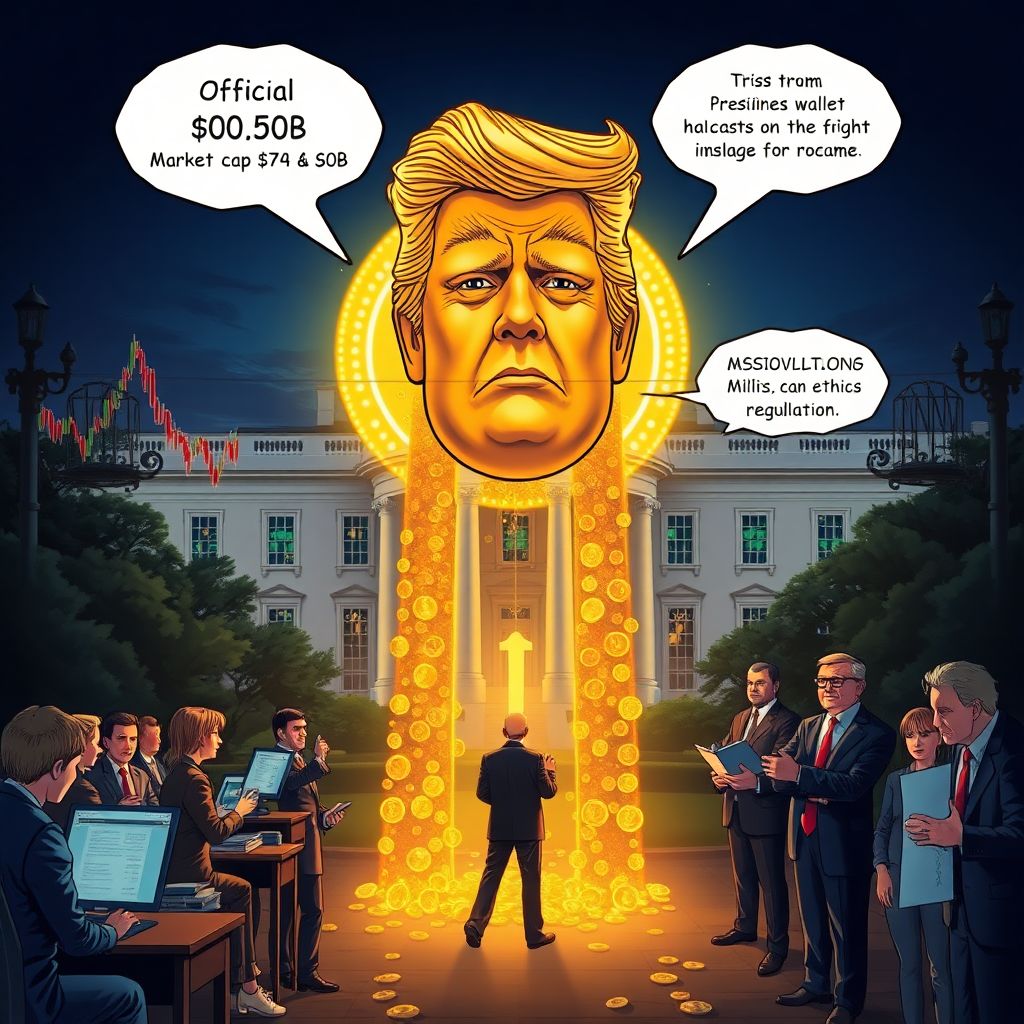
Trump Meme Coin’s First Year: Soaring Hype, Sinking Price, and a Policy Vacuum
It landed like a political and financial grenade.
On a Friday night, just three days before his second inauguration in January last year, President Donald Trump’s social media feeds exploded with the announcement of Official Trump (TRUMP), a Solana-based meme coin built entirely around his name, persona, and political movement.
Within hours, the coin rocketed to a $10 billion market capitalization, briefly trading at $73 per token. Speculators piled in. Trading volumes surged. Solana infrastructure partners struggled to keep up, with Phantom Wallet reportedly slammed by over 8 million requests per minute, straining capacity and freezing out users trying to buy, sell, or even check balances.
Twelve months later, the adrenaline has worn off.
TRUMP is now trading just under $5, down around 93% from its all-time high, yet still commanding a market cap of roughly $1 billion. The token remains one of the largest and most visible political meme coins in existence—less a joke than a durable financial asset tethered directly to a sitting U.S. president.
And that’s where the problems really begin.
—
A President, a Brand, and a Tradable Asset
Unlike celebrity-endorsed tokens that can be shrugged off as marketing stunts, TRUMP was positioned from day one as “official”—not just a meme, but a branded financial instrument closely associated with the President and his family.
Multiple reports and blockchain traces indicate that wallets linked to Trump family entities, campaign-adjacent structures, and known associates accumulated substantial allocations of TRUMP early on. These holdings appreciated into the billions of dollars on paper at the token’s peak, before retreating sharply alongside the broader market and the coin’s own hype cycle.
That dynamic has left ethics lawyers and policy analysts focused on several unresolved questions:
– Is the President personally profiting from speculative trading around a token bearing his name?
– Did insiders receive privileged allocations ahead of the public listing?
– Can policy decisions affecting crypto markets indirectly move the price of TRUMP—and thus enrich the President and his inner circle?
The intersection of political power and a thinly regulated, hyper-volatile asset has turned TRUMP into a case study in what modern conflict-of-interest scenarios can look like when financial markets are programmable and global.
—
Ethics Rules Designed for Stocks, Not Solana
Traditional U.S. ethics frameworks were built around relatively slow-moving, easily documented assets—public equities, bonds, real estate. They assumed:
– disclosed holdings,
– periodic transaction reports,
– and relatively stable asset classes.
Crypto shatters those assumptions. TRUMP trades 24/7, across multiple platforms, with on-chain liquidity that can respond instantly to presidential statements, legislative threats, or geopolitical shocks. A single tweet or policy hint from the White House can plausibly move the market for a token that may also sit in the President’s own portfolio.
Ethics watchdogs argue that existing rules are:
– Too narrow – Many disclosure forms do not explicitly address token allocations, airdrops, or yield-generating strategies.
– Too slow – Quarterly or annual reporting is meaningless in markets where fortunes can be made or lost in hours.
– Too easy to route around – Holdings can be split, wrapped, staked, or parked in complex on-chain structures that obscure beneficial ownership.
TRUMP’s first year has highlighted this gap more starkly than any other single crypto asset linked to a public figure.
—
Legislative Battle Lines: Democrats vs. a Digital Trump
As TRUMP’s price soared and then cratered, the political fight around it escalated.
Democratic lawmakers have seized on the coin as Exhibit A in a broader campaign to tighten crypto oversight, focusing on:
– Mandatory real-time or near real-time disclosure of digital asset holdings for senior officials.
– Bans or strict limits on trading or holding certain high-volatility or politically sensitive tokens while in office.
– New definitions of “official endorsement” of financial products, especially when branding overlaps with public office.
Several draft bills introduced in the last year directly reference “personalized digital assets” or “political-brand tokens” without naming TRUMP, but the target is obvious.
Meanwhile, Republican allies of Trump have largely framed the controversy as an attack on innovation and free markets. Their counterarguments typically include:
– The President has the same right to support digital assets as any private citizen.
– Markets—not regulators—should determine the value and fate of meme coins.
– Overregulation of crypto would push innovation offshore and harm U.S. competitiveness.
The result: stalemate. Various committees have held hearings, experts have warned of systemic and ethical risks, and both sides have drafted aggressive proposals. But no comprehensive framework has yet emerged that clearly answers how a sitting president can—or cannot—engage with tokens tied directly to their personal brand.
—
Industry Backlash: From Opportunity to Liability
Initially, large parts of the crypto industry embraced the TRUMP launch as a watershed moment: the sitting President of the United States publicly associating with a blockchain-based asset. Some investors and entrepreneurs saw it as implicit validation that the highest levels of government were now unafraid of digital tokens.
That optimism has eroded. Over the past year:
– Major exchanges have faced questions about how they list and promote politically branded tokens.
– Venture investors worry that regulators will use TRUMP as a justification to clamp down far more widely on crypto, punishing the entire ecosystem.
– Compliance teams are wary that trading TRUMP might be perceived as a bet not only on market conditions, but on U.S. policy outcomes and specific presidential actions.
Behind the scenes, executives and legal advisers increasingly view TRUMP as a regulatory magnet: a token that might generate volume and fees in the short term, but carries reputational and legal risk if conflict-of-interest allegations evolve into formal investigations.
—
What Makes TRUMP Different From Other Meme Coins
Meme coins are not new. Dogecoin, Shiba Inu, and countless copycats built huge communities and roller-coaster price charts long before TRUMP existed. But analysts point out several features that make TRUMP uniquely sensitive:
1. Direct branding on a sitting head of state
This is not a casual celebrity endorsement—it’s a coin that markets itself on the name, likeness, and political power of the most powerful elected office in the country.
2. Policy feedback loop
The same person whose image drives the token’s value can also influence regulatory conditions that affect not just TRUMP, but the crypto sector as a whole.
3. Cross-over with campaign finance
Even where legal walls are proclaimed between TRUMP and campaign structures, questions persist:
– Are token-related revenues indirectly enabling campaign activities?
– Could speculative trading of a president-branded asset become a shadow form of political financing?
4. Global impact
International investors can buy TRUMP, effectively turning geopolitical sentiment into a tradable instrument. This blurs the line between political prediction markets, foreign wagering on U.S. politics, and speculative asset trading.
—
The Family’s Expanding Crypto Footprint
TRUMP isn’t the Trump family’s only venture into digital assets. Over the past few years they have:
– Launched and promoted NFT collections featuring the President’s image and themes from his political career.
– Explored partnerships with blockchain platforms, including revenue-sharing arrangements and licensing deals.
– Signaled interest in building an ecosystem of Trump-branded tokens, collectibles, and “utility” projects.
With the President now in office, these ventures no longer exist in a purely private, commercial context. Every announcement, collaboration, or token launch is filtered through the lens of public office and national governance.
Critics warn that this creates a perverse incentive structure: the more controversy, polarization, and online attention Trump generates, the more demand there could be for his digital assets—potentially rewarding behavior that destabilizes norms for personal gain.
—
Legal Gray Zones: Is This Even Regulated?
Despite the intense scrutiny, the legal classification of TRUMP remains murky:
– Is it a security?
If regulators decide that TRUMP meets criteria associated with investment contracts—such as expectations of profit based on the efforts of a central team—then both the Trump camp and exchanges listing the coin could face enforcement risk.
– Is it just a branded commodity or collectible?
Supporters argue that TRUMP is more akin to digital merchandise: a speculative, community-driven meme coin whose value is primarily narrative-based, not tied to formal promises of development or yield.
– What about manipulation?
If official statements or policy moves that obviously affect the token’s price are made by someone who may hold a personal stake, does that cross into market manipulation territory—or remain protected political speech?
So far, no definitive enforcement action has drawn clear boundaries, leaving TRUMP as a live-fire test case playing out in real time.
—
Why Regulation Has Stalled
Despite mounting concern, comprehensive crypto legislation has remained stuck in a tug-of-war. TRUMP’s first year has actually complicated, rather than accelerated, progress. Several factors explain why:
1. Partisan entrenchment
Any rule that appears to directly target Trump-branded assets is framed as political retaliation. Conversely, any attempt to carve out exceptions for presidential tokens is attacked as favoritism or corruption.
2. Regulatory turf wars
Agencies differ on how to classify and oversee tokens: as securities, commodities, payments instruments, or something else entirely. Multiple regulators claim partial jurisdiction, making coordinated action difficult.
3. Fear of unintended consequences
Lawmakers worry that writing rules around TRUMP may inadvertently capture or crush large portions of the broader crypto market, or set precedents that stifle innovation in digital identity, collectibles, and tokenized brands.
4. Rapid market evolution
By the time a new framework is debated, drafted, and proposed, the technology and market structures have often moved on. TRUMP itself is tied to Solana, but new political tokens now appear on other chains with different features and governance.
—
How TRUMP Is Reshaping the Crypto Policy Debate
Even without producing clear regulations, the TRUMP saga has fundamentally changed how policymakers think about digital assets. A few key shifts:
– From abstract risk to concrete example
For years, experts warned theoretically about what would happen if a senior official or world leader launched a token. TRUMP turned that into a reality, forcing agencies to confront specific scenarios instead of hypotheticals.
– New focus on personal-brand tokens
Lawmakers are increasingly discussing categories like “political tokens,” “celebrity coins,” and “influencer-linked assets” as distinct from more neutral infrastructure tokens such as Bitcoin or Ethereum.
– Ethics modernization
Calls are growing to update ethics and disclosure rules to explicitly include:
– wallets, tokens, NFTs,
– staking and yield strategies,
– and opaque off-chain entities that control or benefit from digital assets.
Whether or not immediate laws emerge, TRUMP has set the agenda for how digital reputation, personality cults, and programmable money collide.
—
Investor Behavior: From FOMO to “Regulatory Risk Premium”
On-chain data and exchange analytics over the year show a pattern familiar to meme-coin veterans—but amplified by politics:
– Early speculative rush
Traders rushed in on launch, treating TRUMP as both a meme trade and a proxy bet on the President’s political future.
– Volatility tied to headlines
News about investigations, elections, policy statements, and international crises repeatedly triggered sharp price spikes and collapses.
– Emerging caution
As legal and ethical debates intensified, more sophisticated investors began pricing in “regulatory risk”—the possibility that future rules or enforcement could severely impair liquidity, listings, or even legality of trading the token.
That shift has led some funds and professional traders to reduce exposure, while a core base of retail holders maintains TRUMP as part financial bet, part political signal.
—
What Comes Next: Several Possible Paths
As TRUMP enters its second year, there are several plausible trajectories:
1. Regulatory crackdown
A high-profile enforcement action or new law could:
– Restrict trading of politically branded tokens,
– Force extensive disclosures from public officials holding such assets,
– Or classify TRUMP under a more stringent regulatory regime.
2. Gradual normalization
TRUMP might simply become one more volatile meme coin in a crowded market, with its political implications fading as price stabilizes and attention shifts elsewhere.
3. Precedent for global leaders
If no major consequences follow, other politicians worldwide might attempt similar launches, turning personal tokens into a new tool of political branding and fundraising.
4. Integration into a broader Trump digital ecosystem
The coin could be tied more deeply to perks, events, media platforms, or loyalty programs—blurring the line between political movement, brand, and on-chain economy.
—
The Policy Vacuum Endures
One year after launch, the core dilemma remains unresolved:
Can a sitting president meaningfully participate in, influence, or profit from a tokenized market built around their own identity without undermining public trust and the integrity of policymaking?
TRUMP’s price chart tells only part of the story. The more consequential legacy may be the gaps it exposed in modern governance:
– Ethics rules not built for programmable money,
– Regulatory categories that lag far behind technological reality,
– And a political system still struggling to decide where personal branding ends and public duty begins.
Until lawmakers and regulators answer those questions in clear, enforceable terms, TRUMP will continue to trade in a gray zone—half meme, half political instrument, and a live symbol of how far crypto has outpaced the rules meant to contain it.