
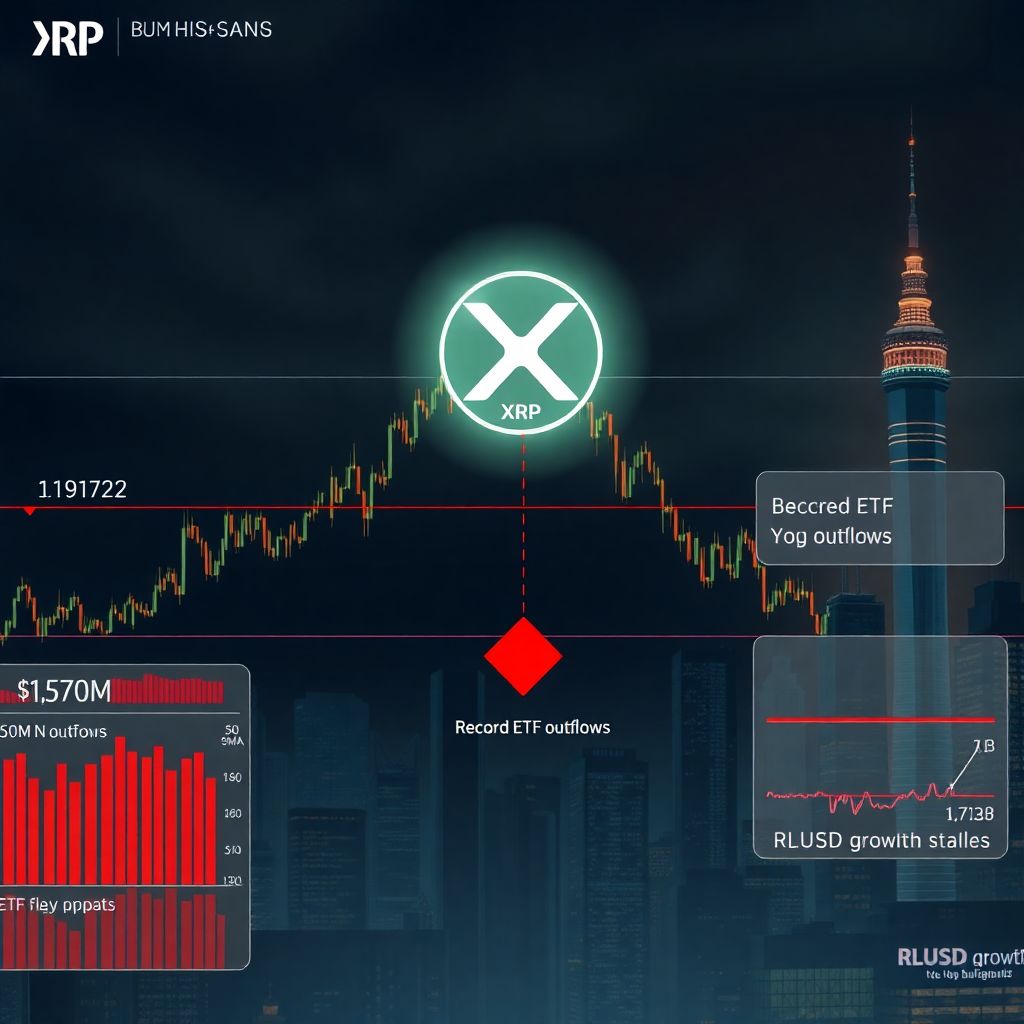
XRP price flashes bearish signals as ETF outflows top $40 million
XRP is trading in an increasingly fragile technical setup just as demand for spot XRP exchange-traded funds (ETFs) cools sharply, raising the risk of a downside break in the weeks ahead.
The token has been locked in a tight consolidation band this week, with spot trading volumes fading and ETF products seeing their heaviest redemptions on record. At the time of writing, Ripple’s native asset changes hands near $1.9172, a level it has hovered around for several sessions. Despite its relative stability, XRP still trades roughly 20% below its year‑to‑date peak around $2.41, underscoring a loss of momentum since its last major rally.
According to SoSoValue data, spot XRP ETFs just endured their worst week since debuting in November of last year. Investors pulled more than $40 million from these products, marking the first weekly net outflow since their launch. Cumulative net flows since inception now sit near $1.23 billion, meaning that while the overall balance is still positive, appetite has clearly cooled. Among the listed products, 21Shares’ TOXR fund was hit the hardest, leading the outflow statistics for the week.
The weakness is not limited to the ETF segment. On-chain and third‑party data also indicate that Ripple USD (RLUSD), Ripple’s own stablecoin, has stalled in terms of growth. RLUSD’s market capitalization is currently around $1.3 billion and has been effectively flat for several months, suggesting that the initial expansion phase may be slowing as the market reassesses stablecoin risk and yield opportunities.
There are, however, a few constructive developments on the fundamental side. This week, Binance announced the listing of RLUSD, making the stablecoin accessible to a significantly larger pool of retail and institutional users. Greater exchange availability could, over time, boost RLUSD’s liquidity and utility in trading pairs, lending protocols, and remittance rails. In addition, RLUSD is set to expand to more chains through an integration with the Wormhole interoperability protocol, which should make it easier to move the stablecoin across different ecosystems and integrate it into multi‑chain DeFi strategies.
Despite these pockets of optimism, XRP’s recent underperformance reflects a broader malaise in the digital asset market. Over the past several weeks, major cryptocurrencies have remained under pressure. Bitcoin has slipped to about $89,000, while Ethereum has retreated below the $3,000 threshold. The pullback suggests that large‑scale speculators and institutions are taking risk off the table after a prolonged risk‑on phase in crypto.
One major factor behind the softness in digital assets is the growing appeal of traditional markets. Many investors have rotated capital into equities as the Dow Jones Industrial Average and the S&P 500 trade near or at record highs, supported by resilient earnings and economic data. At the same time, safe‑haven assets like gold and silver have also hit new all‑time highs this year, drawing in capital from investors seeking diversification or hedging against macro uncertainty. This combination of a roaring stock market and surging precious metals leaves less room, at least in the short term, for a strong bid in speculative assets like XRP.
Technical picture: Bearish pennant takes shape
On the eight‑hour chart, XRP’s structure has deteriorated gradually over the past few weeks. The price has retreated from a swing high near $2.4145 to around $1.9175, carving out a series of lower highs that hint at waning buying pressure. The consolidation may look benign at first glance, but a closer examination of key indicators suggests that bears are quietly gaining the upper hand.
XRP currently trades below both its 50‑period simple moving average and its 50‑period exponential moving average on this timeframe. Trading beneath these mid‑term trend gauges typically signals that sellers control the market’s short‑ to medium‑term direction, and that rallies are more likely to be sold into than extended.
More importantly, the price action has formed what technicians identify as a bearish pennant pattern. This formation is characterized by a steep initial drop (the “flagpole”) followed by a narrowing symmetrical triangle made up of converging support and resistance lines. In XRP’s case, the consolidation triangle is approaching its apex, which often precedes a decisive breakout. Given that the preceding move was downward, classical chart theory implies an elevated probability that the next large move will also point lower.
If the pennant resolves to the downside, the immediate target sits near $1.7712, the low recorded on December 19. This level stands out as a key horizontal support zone, and a move toward it would represent a decline of roughly 7.65% from current prices. A clean break and close below $1.7712 on high volume would strengthen the bearish case and potentially open the door to deeper retracements, as traders who had been waiting on the sidelines might join the downside momentum.
How ETF flows and RLUSD dynamics impact XRP sentiment
ETF flows have become a critical sentiment barometer for major crypto assets, and XRP is no exception. The $40 million in weekly outflows sends a message that some of the more conservative or regulated investors—who prefer ETF exposure over direct token holdings—are taking risk off. While the cumulative inflows remain substantial at $1.23 billion, the first meaningful net outflow week can alter how traders perceive the market’s balance of demand and supply.
Consistent ETF inflows often underpin price resilience by providing a steady bid. When that pattern reverses, even briefly, it can signal a shift in positioning or a more cautious outlook on the near‑term performance of the underlying asset. If outflows were to persist for several more weeks, it could intensify selling pressure in spot markets as arbitrageurs and market makers rebalance their books.
RLUSD’s stagnating market cap also feeds indirectly into XRP’s narrative. Ripple’s ecosystem strategy increasingly revolves around integrating payments, stablecoins, and cross‑border liquidity solutions. A robust and growing stablecoin can deepen liquidity, attract DeFi builders, and create more reasons to hold or use XRP within that ecosystem. Conversely, a plateau in RLUSD growth may indicate that user adoption is taking longer than expected or that competition from other stablecoins remains stiff. Until RLUSD resumes a clear growth trajectory, it is unlikely to provide a strong additional tailwind for XRP.
Macro backdrop: Competition for capital intensifies
The current macro environment further complicates XRP’s outlook. With major equity indices near record highs and precious metals also shining, investors face a wide menu of alternatives. High interest rates or attractive yields in traditional fixed‑income instruments can also lure capital away from non‑yielding, high‑volatility assets like XRP.
For crypto to outperform in such an environment, it typically needs a clear, compelling narrative—such as a regulatory breakthrough, a strong wave of institutional adoption, or a major technological upgrade. In XRP’s case, while there have been important developments on the regulatory front and in payments partnerships over the years, the latest price action suggests that these stories are not currently strong enough to override the broader risk‑rotation dynamic.
What could invalidate the bearish scenario?
Despite the technically bearish setup, a few factors could negate or delay a downside breakout:
1. ETF flows stabilize or flip back to inflows. Even modest but consistent net inflows into XRP ETFs could restore confidence that demand from professional and institutional investors remains intact.
2. Break above key moving averages. If XRP climbs back above its 50‑period simple and exponential moving averages on the eight‑hour chart and holds there, it would signal that buyers are regaining control and that the pennant pattern might fail.
3. Fundamental catalysts. A major partnership announcement, regulatory clarity in important jurisdictions, or rapid RLUSD adoption on new chains could shift sentiment quickly and attract fresh capital.
4. Broader crypto rebound. A renewed risk‑on wave across Bitcoin, Ethereum, and the wider altcoin market could lift XRP with the tide, especially if macro conditions or central bank policies turn more supportive of speculative assets.
Traders watching XRP should therefore monitor not only price levels and chart patterns, but also ETF flow data, RLUSD metrics, and macro headlines that can alter the appetite for risk.
Risk management for traders and investors
Given the current structure, market participants considering XRP exposure may want to emphasize risk management:
– Define clear invalidation levels. For bearish traders, a break and sustained move above the upper boundary of the pennant or above the 50‑period EMAs would challenge the downside thesis. For bulls, a decisive move below $1.7712 could be a signal to reduce exposure or wait for a more attractive entry.
– Watch volume. A pennant breakdown or breakout accompanied by rising volume carries more weight than a move on thin liquidity. Volume confirmation can help differentiate a genuine trend change from a short‑lived fake‑out.
– Scale positions. Instead of entering with full size at once, scaling into or out of positions can reduce the impact of short‑term volatility and minimize the risk of mistiming the market.
– Consider correlations. Since XRP often trades in tandem with the broader market, significant moves in Bitcoin and Ethereum can serve as early indicators of shifting sentiment that may soon affect XRP.
Medium‑term outlook: Consolidation or deeper correction?
If XRP holds the $1.7712 support level after a potential test, it could enter a prolonged sideways phase, building a base for a future move higher once macro conditions or inflows improve. Sideways ranges are often frustrating but can be healthy, allowing leveraged positions to be flushed and new buyers to accumulate at more attractive valuations.
On the other hand, a clean break beneath that support could trigger stop‑loss cascades and push XRP into a deeper correction, where previous support zones and Fibonacci retracement levels from the last major rally would come into focus. In that scenario, sentiment could deteriorate quickly, though historically, such drawdowns have also created opportunities for long‑term investors who believe in the project’s fundamentals.
Bottom line
XRP currently sits at a technically vulnerable juncture. Price action is confined within a bearish pennant, key moving averages tilt in favor of sellers, and ETFs—an important channel for institutional participation—have just registered their first and largest weekly outflows, exceeding $40 million. At the same time, RLUSD’s growth has plateaued, removing a potential catalyst for ecosystem‑driven demand.
Balancing these headwinds are several positives: a still‑sizable cumulative ETF inflow base, RLUSD’s new listing on Binance, planned multi‑chain expansion, and the possibility that macro and crypto‑specific conditions could turn more favorable later in the year.
For now, though, the risk skews to the downside, with $1.7712 emerging as the critical support level to watch. How XRP behaves around that zone—and whether ETF flows stabilize—will likely determine whether this consolidation resolves into a short‑lived dip or the start of a more substantial bearish phase.