
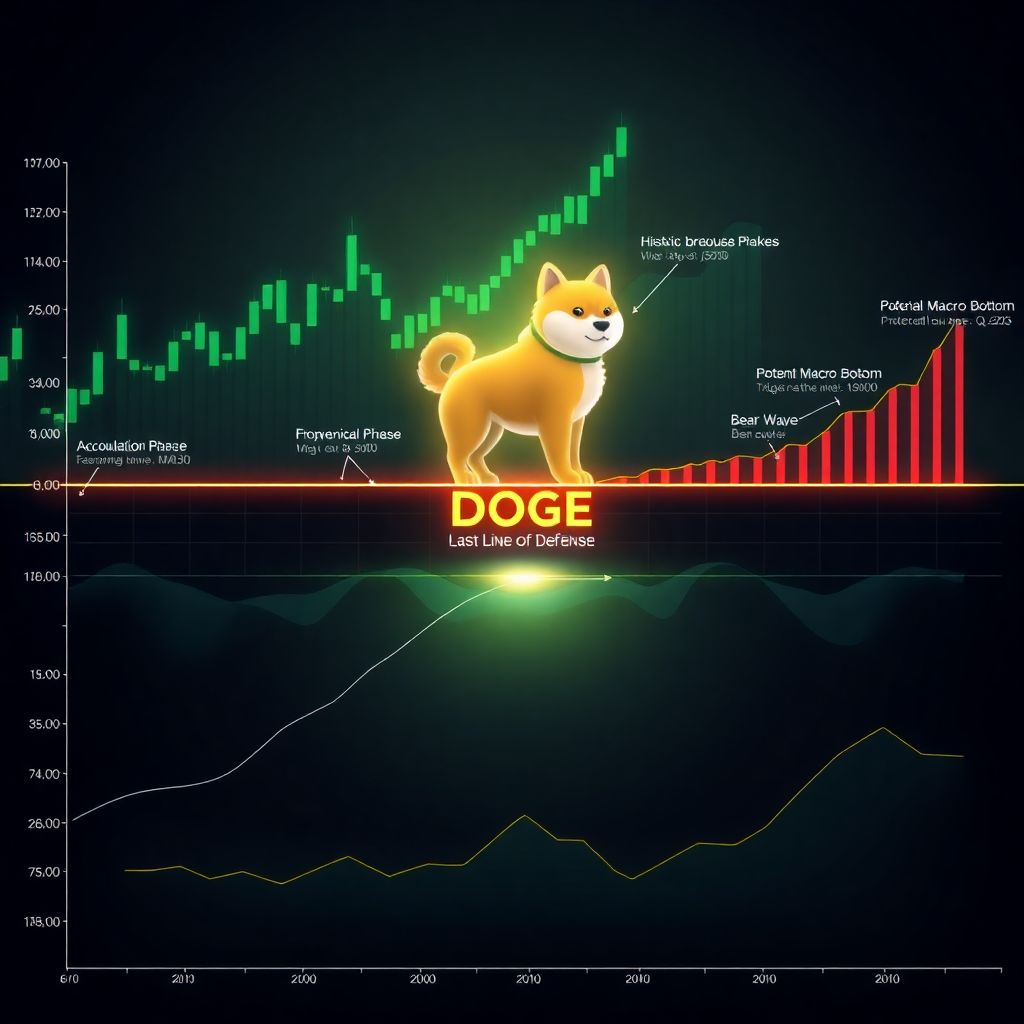
Dogecoin is approaching a critical inflection point as it clings to long-term support at the 350-day moving average (MA350) following October’s violent flash crash. The memecoin has been locked in a tight consolidation band for roughly a month, and the next decisive move from this zone could determine whether DOGE resumes its historic pattern of explosive rallies or sinks into a deeper, grinding bear market.
After a brief surge to a one-month high during the early-January bounce, Dogecoin quickly lost momentum, sliding back to retest the lower boundary of its current range. Buyers stepped in at those levels, helping price recover to the mid-range area, where it is now attempting to reclaim a key technical zone watched closely by traders. The battle around this region has turned into a tug-of-war between bulls betting on a repeat of previous parabolic cycles and bears who see the latest rebound as a temporary pause before another leg down.
Technical analyst Bitcoinsensus argues that Dogecoin is still following a recognizable historical rhythm. According to their long-term chart review, DOGE has repeatedly moved in three stages: a euphoric rally to cycle highs, a sharp correction, and then a long sideways accumulation phase. Once that consolidation matures and broader market conditions improve, the memecoin has historically launched into powerful upside runs that eclipsed prior peaks. Each breakout from a multi-month or multi-year accumulation base has previously translated into dramatic percentage gains.
From this perspective, the current rangebound trading could be interpreted as another accumulation phase rather than a sign of exhaustion. Bitcoinsensus emphasizes that Dogecoin tends to spend more time building bases than many traders expect. Those extended “boring” periods have often preceded some of the asset’s most aggressive rallies as sidelined capital rushes back in when technical resistance finally gives way.
Another analyst, known as Trader Tardigrade, identifies striking similarities between Dogecoin’s current weekly chart and its structure prior to the Q4 2024 breakout that eventually drove price to a multi-year high. Tardigrade points out that the scale and duration of the recent pullback closely mirror the earlier correction: both phases saw deep retracements from local peaks stretched over several weeks, followed by signs of stabilization around long-term moving averages.
In their view, this fractal-like pattern suggests that the latest selloff may already have run its course. If the analogy holds, Dogecoin could be in the latter stages of its corrective phase, with room to challenge and potentially surpass the previous local high in the coming weeks or months. For traders aligned with this scenario, the current consolidation above structural support is less a warning sign and more a potential springboard.
However, not all analysts share this optimistic interpretation. Market watcher TradingShot offers a more cautious – and in some respects, starkly bearish – outlook. Their analysis frames Dogecoin’s recent performance as the opening act of a fresh bear cycle rather than a continuation of an extended bull consolidation. Central to this thesis is the behavior of the 350-day moving average, which has been acting as a crucial support level since the October 2025 flash crash.
Historically, the MA350 on the weekly chart has behaved as a sort of “last line of defense” for Dogecoin during deep corrections. In past downtrends, price has frequently found support around this long-term moving average before eventually carving out a bottom. TradingShot notes that, so far, this dynamic has remained intact: despite increased volatility and selling pressure, DOGE continues to hover above or around this line.
The risk, according to their model, is what happens if that support finally gives way. A clean break and sustained trading below the MA350 would signal that the first leg of the bear cycle has concluded and that a more severe second phase is underway. In that scenario, Dogecoin could be vulnerable to a much deeper retracement, with potential downside extending to levels comparable to or even worse than those seen in the previous two bear cycles.
TradingShot’s use of sine wave analysis further supports a longer, more drawn-out corrective structure. Their cyclical model places a potential macro bottom for Dogecoin around Q4 2026, implying that the market may still be in the early or middle stages of a multi-year downtrend. Under this framework, long-term investors might only start accumulating aggressively closer to that projected low, treating interim rallies as opportunities to reassess risk rather than as definitive trend reversals.
In the near term, weekly price action remains subdued. On higher timeframes, DOGE is trading lower, reflecting the cooling momentum since January’s local peak. Volumes have contracted alongside the consolidation, underscoring the sense of indecision: neither buyers nor sellers have yet asserted decisive control. This kind of environment often precedes sharp moves, as prolonged compression tends to resolve explosively once a catalyst appears.
The clash between these competing narratives raises a practical question for market participants: how should traders and investors navigate such an ambiguous setup? One approach revolves around the MA350 itself. For technically oriented traders, this moving average now functions as a clear dividing line. As long as Dogecoin remains above or holds repeated tests of this level, the bullish camp can argue that the long-term structure is intact. A decisive breakdown, on the other hand, would lend weight to the bearish thesis and likely trigger a reassessment of risk exposure.
Shorter-term traders might also focus on the boundaries of the current trading range. A breakout above the recent one-month high would bolster the case for a trend continuation to the upside, potentially confirming the analogs drawn by Bitcoinsensus and Trader Tardigrade. Conversely, a failure to defend the lower end of the range – especially if accompanied by growing volume on the downside – would hint that the market is preparing for the kind of extended bear phase outlined by TradingShot.
Beyond charts and moving averages, sentiment remains an important, if less quantifiable, factor. Dogecoin’s history is unusual even by crypto standards: originally launched as a joke, it has repeatedly transformed into a high-beta vehicle for speculative manias, often fueled by social media hype and retail enthusiasm. In past cycles, surges in online attention and renewed retail participation have often coincided with or slightly preceded its most pronounced upside moves.
At the moment, sentiment indicators suggest a more muted backdrop. Hype levels are well below the peaks seen during previous euphoric phases, and broader crypto markets have become more selective. This can cut both ways. On one hand, subdued enthusiasm might limit immediate upside, as there is less speculative fuel to drive a parabolic rally. On the other, quieter conditions can provide a more stable environment for long-term accumulation by investors who are less concerned with short-term volatility.
Macro conditions in the wider digital asset market will also likely play a decisive role in which scenario plays out. Historically, Dogecoin’s largest rallies have aligned with broader risk-on phases where Bitcoin and major altcoins were already trending higher. If the overall crypto market resumes a strong uptrend, it could help validate the bullish interpretations and give DOGE the external support needed to replicate its past parabolic advances. If, instead, the sector enters a prolonged correction or risk-off environment, downside scenarios become more plausible, especially if liquidity dries up.
Risk management is crucial in such a binary, “make-or-break” environment. For traders leaning bullish, position sizing and clearly defined invalidation levels around or below the MA350 can help contain losses if the market breaks against them. For those anticipating a deeper bear phase, gradual scaling into positions or waiting for further confirmation of a trend breakdown can reduce the risk of shorting into a consolidating market that suddenly squeezes higher.
Long-term holders, meanwhile, may view the entire range around the MA350 as part of a broader accumulation or distribution band, depending on their conviction about Dogecoin’s future relevance. Those who believe the asset will continue to attract speculative cycles may treat protracted drawdowns as opportunities, while skeptics may interpret any failure to maintain key supports as evidence that previous cycles were driven more by transient hype than by enduring demand.
Ultimately, Dogecoin’s immediate future hinges on how the battle around the MA350 support is resolved. Above it, the narrative of cyclical repetition and eventual parabolic recovery remains viable, supported by historical patterns identified by analysts like Bitcoinsensus and Trader Tardigrade. Below it, TradingShot’s projection of a deeper, more prolonged bear market gains credibility, with the possibility of a cycle low still several years away.
Until the market delivers a clear signal, DOGE remains in a fragile equilibrium: one strong move away from confirming either a resilient accumulation phase with upside potential or a renewed descent into the harsher second stage of a bear cycle. For now, all eyes remain on the long-term moving average that has quietly become the line separating hope of another meme-fueled resurgence from the reality of a potentially protracted downturn.