
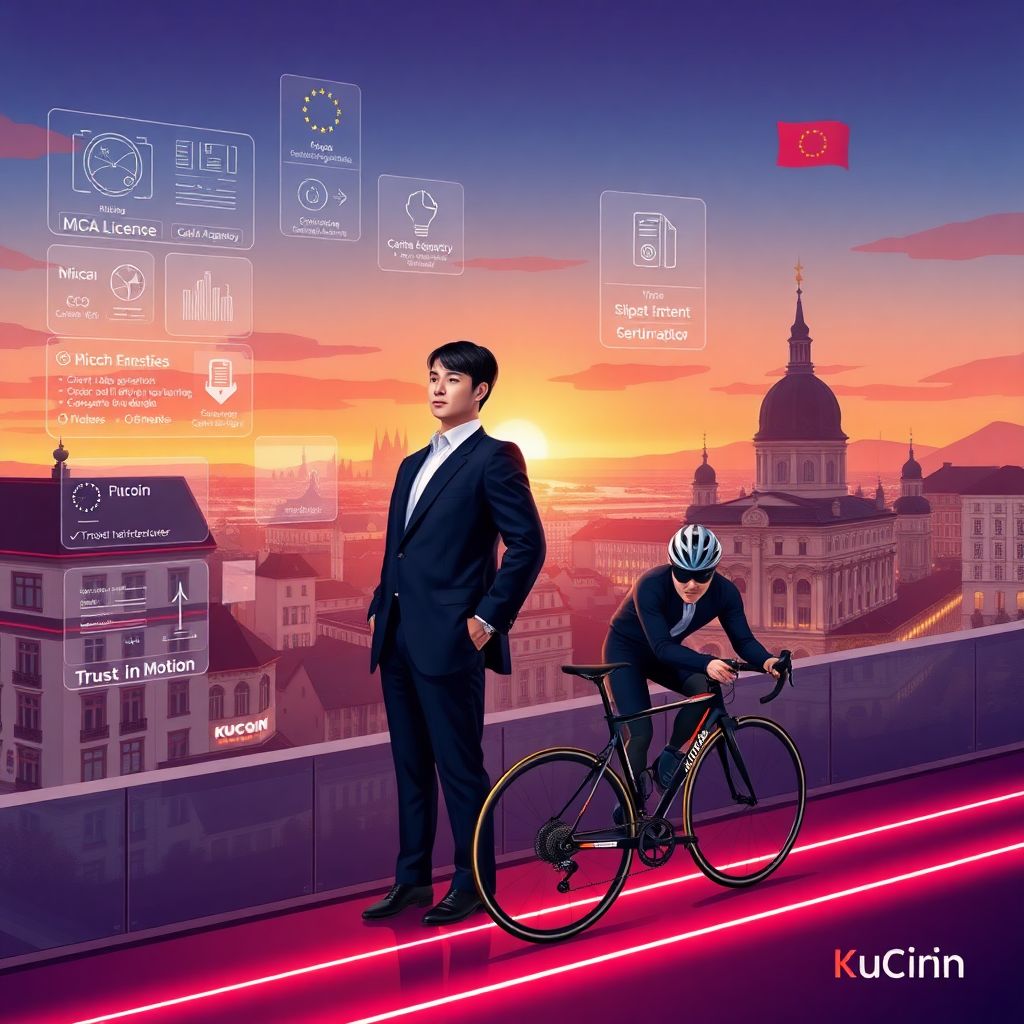
KuCoin CEO: In post‑MiCA Europe, compliance is simply the entry ticket
With the Markets in Crypto‑Assets (MiCA) framework now fully operational, Europe has stepped into a new regulatory phase where crypto asset service providers can no longer rely on ambiguity or “wait and see” strategies. The European Securities and Markets Authority (ESMA), together with national supervisors, has made it clear: platforms serving EU users must either obtain the appropriate licenses or prepare to exit the market as temporary exemptions run out through 2026.
For exchanges that do secure authorization, MiCA introduces demanding rules around capital adequacy, segregation of client assets, disclosure obligations, and governance standards. These measures significantly increase the structural cost of operating in the region and are reshaping the competitive landscape.
Against this backdrop, KuCoin’s leadership has been positioning KuCoin EU as a regulated, long‑term player in Europe. In a discussion following the company’s recent press conference in Vienna and its EU VIP Gala on January 28, CEO BC Wong and KuCoin EU executive Christian Niedermueller outlined how they see the region evolving under MiCA and why the exchange chose Vienna as its European base.
Compliance as the new market baseline
BC Wong is clear that the regulatory transition is not a temporary headwind but a permanent reset for the sector in Europe. As the remaining grace periods expire and supervisory expectations become more granular heading into 2026, he expects the market to shift from a patchwork of approaches to a more unified, rules‑driven environment.
According to Wong, MiCA effectively turns compliance into the minimal condition for participation rather than a source of differentiation. Exchanges that want to be part of Europe’s financial infrastructure will have to live up to stricter governance, risk management, and consumer‑protection standards. Many operators, he suggests, may decide that these obligations are incompatible with their existing model and choose to scale back or withdraw instead of transforming their operations.
Over the next 18–24 months, Wong anticipates a gradual “normalization” of the competitive field. Retail users and institutions alike are expected to migrate towards platforms that can demonstrate regulatory authorization, robust transparency, and the ability to interface with traditional financial institutions. KuCoin EU, he emphasizes, was built with that end state in mind from the outset, embedding compliance and sustainability into the business model rather than bolting them on in response to enforcement pressure.
Balancing MiCA overhead with liquidity, fees, and product scope
MiCA undoubtedly raises the cost structure for exchanges. Capital buffers, internal control functions, reporting, and governance frameworks all introduce additional expense and complexity. Yet Wong frames this not as a drag on innovation, but as a strategic investment in durability.
The real balancing act, he explains, lies in achieving scale and disciplined execution rather than compromising on standards. KuCoin EU leverages the broader KuCoin ecosystem in technology, liquidity infrastructure, and institutional connectivity while aligning its operations with regulatory requirements in the EU. Shared systems, order‑flow aggregation, and cross‑market liquidity support can help offset the higher operating costs that come with licensing.
Wong believes that over time, trust and regulatory clarity will matter more to users than marginally lower fees or broader but unregulated product line‑ups. While some offshore or unlicensed platforms may appear more attractive in the short term, he expects that increasing scrutiny, legal risk, and limited access to traditional financial rails will gradually erode their appeal for mainstream users and sophisticated institutions.
Vienna as a MiCA hub: avoiding fragmentation, anchoring confidence
KuCoin’s decision to anchor its European operations in Vienna is closely tied to how Austria is implementing MiCA. Christian Niedermueller, who helps lead KuCoin EU’s regional strategy, views Vienna not merely as a convenient location, but as a proof point that MiCA can be applied in a structured and scalable way.
For Niedermueller, the significance of Vienna lies in showing that licensing, supervision, and operational setup do not have to be chaotic or fragmented. A strong hub can concentrate regulatory dialogue, compliance expertise, and institutional relationships, supporting deeper, more consistent liquidity. This, in turn, benefits the entire European crypto market by offering a reference model for how MiCA can work in practice.
The aim is not to centralize all crypto activity in one city, he notes, but to avoid a situation where liquidity and compliance standards are scattered across numerous small centers, each with slightly different interpretations and expectations. That kind of fragmentation could weaken market depth, confuse participants, and ultimately undermine MiCA’s ambition of a coherent single market. Well‑run hubs like Vienna, by contrast, help translate the legal framework into a functioning ecosystem.
Sports partnership as a vehicle for trust and education
In parallel with its regulatory push, KuCoin is unveiling a multi‑year partnership with a world‑class professional cyclist, aligning the campaign with its European theme of “Trust in Motion.” Rather than treating the collaboration as a simple branding exercise, the company is attempting to weave compliance and consumer‑protection messaging into the heart of the partnership.
The values KuCoin highlights in this alliance—discipline, accountability, resilience, and long‑term dedication—are intentionally mirrored in how KuCoin EU says it operates under MiCA. The slogan “Trust in Motion” is tied to a perspective in which transparent rules, clear oversight, and explicit protections for consumers are not static promises but an ongoing process of improvement.
KuCoin plans to embed educational components and responsible‑investing messages into its sports content. This includes emphasizing the importance of understanding risk, encouraging users to favor regulated platforms, and explaining in simple language what MiCA‑compliant protections actually mean in practice. The objective is to build trust with both regulators and first‑time retail investors by showing that the brand’s visibility is connected to tangible safeguards rather than hype or speculative promotion.
Using licensing status in EU‑facing marketing
As MiCA reshapes the competitive field, some compliant exchanges are starting to highlight their licensing status as a core part of their marketing message, implicitly contrasting themselves with unregulated competitors. KuCoin intends to follow a similar path but with an emphasis on clarity rather than fear‑based tactics.
In its upcoming EU campaigns and influencer collaborations, KuCoin EU plans to clearly reference its MiCA authorization and the obligations that flow from it—such as asset segregation, fit‑and‑proper management standards, and complaint‑handling processes. However, the messaging is being framed less as “licensed equals safe, unlicensed equals dangerous” and more as an invitation for users to understand the protections and trade‑offs involved.
The company’s goal is to help retail investors and institutions recognize the difference between a regulated venue that answers to supervisors and an offshore platform that may not be subject to comparable rules or scrutiny. By explaining how licensing affects areas like custody, risk management, and recourse in case of disputes, KuCoin aims to make regulatory status a concrete, user‑relevant concept rather than a vague marketing tagline.
MiCA as an institutional gateway
One of the deeper implications KuCoin’s leadership sees in MiCA is its role as a bridge for institutional engagement. Large financial institutions have long cited regulatory uncertainty, unclear asset classifications, and inconsistent supervision as key reasons for staying on the sidelines of the crypto market.
A harmonized EU framework alters that calculus. Under MiCA, institutions can evaluate service providers based on a standardized set of requirements, governance structures, and disclosure obligations. This reduces due‑diligence friction and enables banks, asset managers, and corporates to build structured products, custody offerings, and hedging strategies on top of licensed exchanges.
KuCoin EU is positioning itself for this shift by emphasizing governance controls, risk policies, and operational resilience that can withstand institutional review. By aligning with MiCA from the outset, the exchange is aiming to become a counterpart that traditional players can integrate with their own compliance frameworks, potentially opening the door to greater institutional liquidity and more sophisticated products over time.
Impact on product design and innovation under MiCA
A recurring concern in the industry is whether regulation like MiCA will stifle innovation or narrow the range of products available to EU users. KuCoin’s leadership takes a more nuanced view: while some highly leveraged or opaque products may become difficult to offer under the new rules, the framework also creates clearer boundaries for building sustainable, transparent services.
In practice, this means product teams must factor regulatory requirements into their design process from day one. Questions about asset classification, disclosure, risk warnings, and suitability are no longer afterthoughts—they are core design constraints. For KuCoin EU, that might translate into more emphasis on spot markets, carefully structured derivatives, staking services with clear risk profiles, and educational tools that accompany complex offerings.
The company expects that as MiCA matures, there will be room for innovation in areas like tokenized real‑world assets, compliant yield products, and on‑chain mechanisms that support clearer reporting and monitoring. In that sense, MiCA becomes a framework within which innovation can occur safely, rather than a blanket barrier to new ideas.
Consumer protection and risk awareness as competitive levers
MiCA’s consumer‑protection provisions—ranging from transparent whitepapers to marketing standards and operational resilience—are often treated as mere compliance checklists. KuCoin is betting that they can also become competitive advantages if communicated effectively.
For many first‑time investors, the main barrier to entry is not just volatility, but a lack of trust. High‑profile failures in the industry have underlined the consequences of poor governance and inadequate oversight. By foregrounding measures such as asset segregation, orderly wind‑down plans, and obligations to act in the best interest of clients, MiCA‑licensed exchanges can differentiate themselves from platforms that offer little in the way of structural safeguards.
KuCoin EU intends to build this into its user journeys, making it easier for newcomers to understand not only how to trade, but what protections they have and what risks they retain. Educational content, in‑platform explanations, and transparent disclosures around fees and potential conflicts of interest are all part of that strategy. Over time, this approach could help move the European crypto market away from pure price‑driven competition and towards a more mature model where reliability and protection carry real weight.
The path ahead: consolidation and maturation
Looking forward, KuCoin’s leadership expects a period of consolidation as MiCA enforcement tightens. Smaller or less prepared operators may struggle to meet capital and compliance requirements, while some offshore platforms are likely to curtail their EU presence. This could lead to fewer, but more robust, players serving the region.
For exchanges that embrace the framework, the coming years are likely to be marked by deeper integration with traditional finance, more standardized products, and a user base that increasingly expects regulated protection as a matter of course. In this environment, compliance ceases to be a temporary project and becomes part of the permanent cost structure of doing business.
KuCoin EU’s strategy—building around Vienna as a regulatory and liquidity hub, embedding MiCA into its operations, and tying its brand narrative to trust and accountability—is an attempt to position the exchange on the right side of that transition. In post‑MiCA Europe, the firm’s leadership argues, regulatory alignment is no longer optional. It is the ticket to long‑term relevance in a market that aims to bring crypto closer to the standards of the broader financial system.