
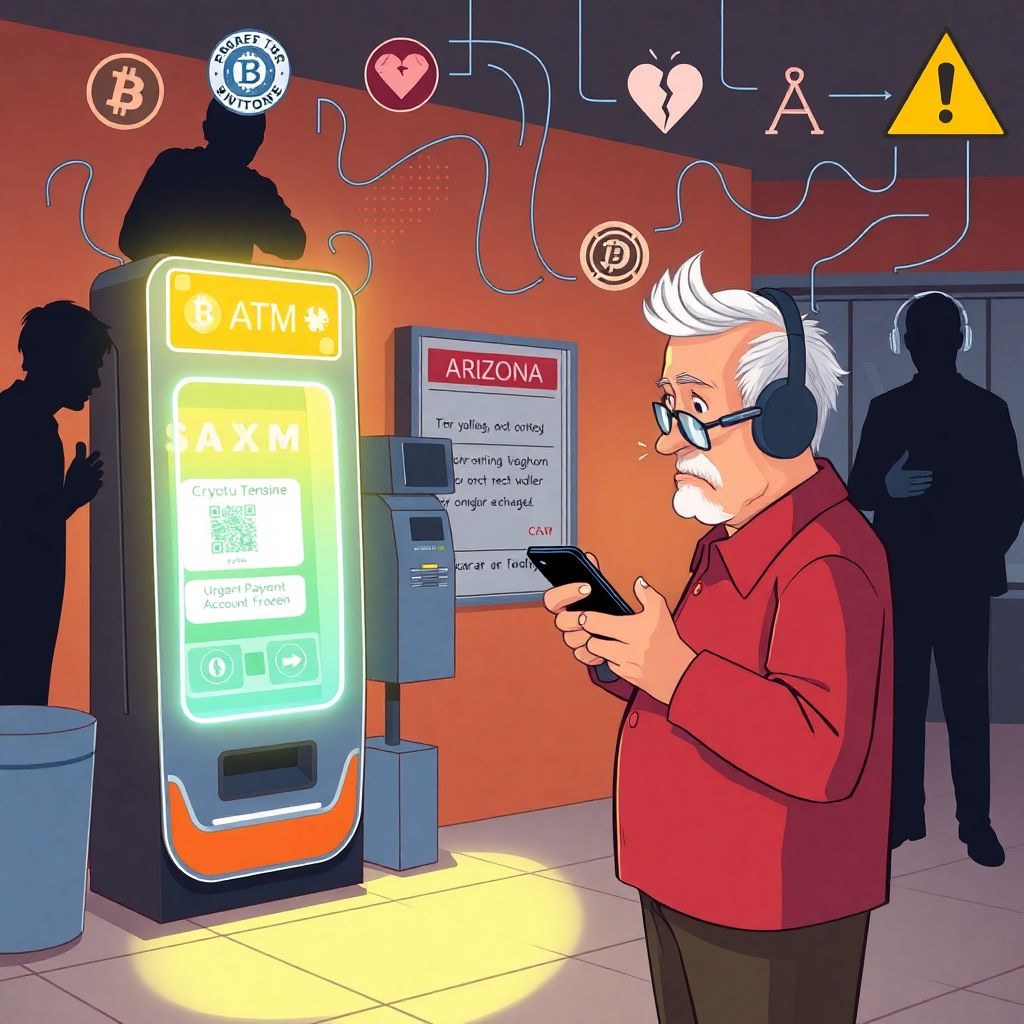
Arizona’s Top Prosecutor Sounds Alarm as Crypto ATM Fraud Targets Seniors
Arizona’s roughly 600 cryptocurrency ATMs have become a lucrative tool for scammers, and older residents are bearing the brunt of the losses. In response, Arizona Attorney General Kris Mayes has issued a sharp public warning and rolled out new mechanisms to help victims fight back.
According to Mayes, Arizonans lost more than $177 million to crypto ATM–related scams in 2024 alone—a staggering figure that underscores how quickly this form of fraud has escalated. The Attorney General stressed that when someone tells you to go to a crypto kiosk or ATM to send money, there is a “very, very high chance” you are being targeted by a scammer.
“My message to Arizonans is this: be careful around the physical cryptocurrency ATMs we’re seeing pop up around the state,” Mayes said in a statement, urging residents to treat any unexpected request for crypto payments as a major red flag.
To respond to the surge, the Attorney General’s Office has introduced a dedicated complaint form specifically tailored to crypto ATM scams. Officials are pressing victims to submit reports as quickly as possible—ideally within 30 days of the transaction—to maximize any chance of freezing or recovering funds before they are fully laundered or moved offshore.
How Crypto ATM Scams Typically Work
Crypto ATMs look and feel similar to standard cash machines, but instead of dispensing dollars, they enable users to purchase cryptocurrencies or load funds onto digital wallets. Scammers exploit this unfamiliar process, especially when dealing with older adults who might be less comfortable with digital finance and more likely to trust authoritative-sounding instructions.
Common scenarios include:
– Imposter scams: A caller pretends to be from a government agency, utility company, bank, or law enforcement. They claim there is a fine, overdue bill, warrant, or tax issue that must be resolved immediately—with payment demanded through a crypto ATM.
– Tech support scams: The victim is told their computer has been hacked or infected with a virus. The “technician” claims that the only way to secure the device or recover stolen funds is to pay via cryptocurrency purchased at a local ATM.
– Romance and relationship fraud: A scammer builds a relationship over time—online or by phone—and then invents an emergency, such as medical bills or travel problems. They pressure the victim to send assistance through a crypto kiosk.
– Prize and lottery schemes: Targets are told they’ve won a sweepstakes or cash reward but must first pay taxes or processing fees using cryptocurrency.
In nearly all of these cases, scammers provide step-by-step instructions: where to find the machine, which buttons to press, what wallet address to scan, and how much money to insert. Once the transaction is complete, the funds are nearly impossible to trace or reverse.
Why Older Adults Are Being Targeted
Fraudsters often zero in on seniors, perceiving them as more financially stable, more trusting of perceived authority, and less familiar with digital assets. Many older Arizonans grew up in an era when a phone call from a “bank representative” or “federal agent” automatically commanded respect, which scammers ruthlessly exploit.
Additionally, the technical complexity of cryptocurrencies—public keys, QR codes, digital wallets—can create confusion. Criminals use that confusion to hurry victims into blind compliance, insisting that there is no time to consult a family member, financial advisor, or local banker.
Some older victims may also be reluctant to admit they don’t understand a process, fearing embarrassment. That silence gives scammers space to dictate every move, from walking into a convenience store to inserting cash into a machine they have never used before.
The Role of the New Complaint Tool
The Attorney General’s newly launched complaint form is designed to collect detailed information about these incidents quickly: which ATM was used, what time the transaction occurred, how much money was sent, what instructions were given, and any contact details for the suspected scammer.
Timing is critical. Crypto transactions settle rapidly, and criminals are adept at moving stolen funds through multiple wallets and exchanges in minutes or hours. Reporting within 30 days significantly improves the odds that law enforcement or affiliated financial partners might flag, freeze, or track suspicious flows of money.
Beyond individual cases, the aggregation of complaints helps authorities see patterns: specific ATM locations that are repeatedly exploited, recurring phone numbers, scripts used by scammers, and emerging tactics. This intelligence can inform enforcement actions, consumer alerts, and possible regulatory changes.
Mounting Scrutiny on Crypto ATMs
The warning from Arizona’s top prosecutor comes amid growing national scrutiny of crypto kiosks. Regulators and law enforcement agencies in multiple states have flagged similar problems: minimal identity checks on small transactions, limited oversight of kiosk operators, and the ease with which funds can be converted into quasi-anonymous digital assets.
While many crypto ATM operators comply with financial regulations and perform know-your-customer (KYC) procedures, scammers deliberately keep each individual payment below thresholds that trigger more intense review. They then instruct victims to complete multiple smaller transactions rather than one large one, making detection harder.
Policymakers are increasingly asking whether additional safeguards are needed—such as stronger age-related warnings on machines, mandatory scam alerts for certain transaction types, or clearer instructions telling users never to send funds at the direction of a stranger.
Key Warning Signs Consumers Should Watch For
Arizona officials emphasize that legitimate businesses, banks, and government agencies do not demand payment through cryptocurrency ATMs. Residents are urged to treat the following as clear danger signals:
– You receive an unexpected call, text, or email demanding urgent payment.
– The person insists you cannot tell anyone else, especially family or bank staff.
– You are told your bank account is “under investigation” and you must move money yourself using a kiosk.
– You’re given a QR code or long string of characters and told to scan or enter it at an ATM.
– The caller threatens arrest, deportation, utility shutoff, or legal action if you refuse.
– The payment is described as a “refundable security deposit” or “temporary transfer” that will supposedly be returned later.
If any payment request involves a crypto ATM and a sense of pressure or secrecy, Arizona authorities say it should be assumed to be fraud until independently verified.
How to Protect Yourself and Loved Ones
The Attorney General’s Office recommends a few basic strategies to reduce the risk of falling victim:
1. Pause before paying: If someone urges you to rush to an ATM, hang up or step away and contact a trusted person—family, friend, or financial advisor.
2. Verify independently: If the caller claims to be from a bank, government agency, or company, find the official phone number yourself (from a statement or card) and call back. Do not use numbers given by the caller.
3. Set family rules: Families, especially those with older relatives, can agree in advance: “We will never send money through crypto ATMs at someone else’s direction without talking to another family member first.”
4. Educate about new scams: Regularly discuss new fraud trends with elderly parents or neighbors so that “crypto ATM payment” immediately triggers suspicion.
5. Trust your instincts: Feelings of fear, panic, or confusion are often intentional. Scammers want you emotional, not analytical. Any demand that you keep the payment method secret is a major warning sign.
What to Do If You’ve Already Sent Money
For those who have already used a crypto ATM under suspicious circumstances, Arizona authorities say it is vital not to remain silent out of shame or fear.
– Contact local law enforcement as soon as possible and explain exactly what happened.
– File a complaint with the Attorney General’s Office using the new crypto ATM scam form, providing timestamps, machine locations, receipts, and any communication with the scammer.
– Notify your bank or card issuer if the funds used at the ATM were drawn from a linked account or credit line.
– Preserve all evidence: call logs, text messages, emails, screenshots, receipts, and photos of the ATM if available.
While crypto transfers are difficult to reverse, swift reporting can still help in certain cases and, at minimum, strengthen future investigations and prosecutions.
Balancing Innovation and Consumer Safety
The rapid growth of physical crypto kiosks in Arizona mirrors a broader shift in financial technology. These machines can offer legitimate benefits: easier access to digital assets for people without traditional bank accounts, faster cross-border transfers, and an on-ramp to the broader crypto ecosystem.
However, as the Attorney General’s warning illustrates, innovation without robust consumer education and safeguards can create fertile ground for exploitation. Older adults, who may already feel overwhelmed by digital change, can be especially vulnerable.
The challenge for policymakers, regulators, and industry participants is to ensure that convenience does not come at the cost of basic security. That may mean clearer on-screen warnings at ATMs, better training for store employees who host machines, and public awareness campaigns calibrated specifically for seniors.
A Call for Community Awareness
Ultimately, Arizona officials stress that combating crypto ATM scams will require more than legal tools and enforcement actions. Families, caregivers, and community leaders all have a role to play in spreading the word that any demand to pay via cryptocurrency—especially through a physical ATM—is almost certainly illegitimate.
By talking openly about these schemes, checking in with older relatives, and encouraging victims to come forward quickly, Arizona hopes to slow the pace of losses and make its 600 crypto kiosks less attractive to criminals looking for their next target.