
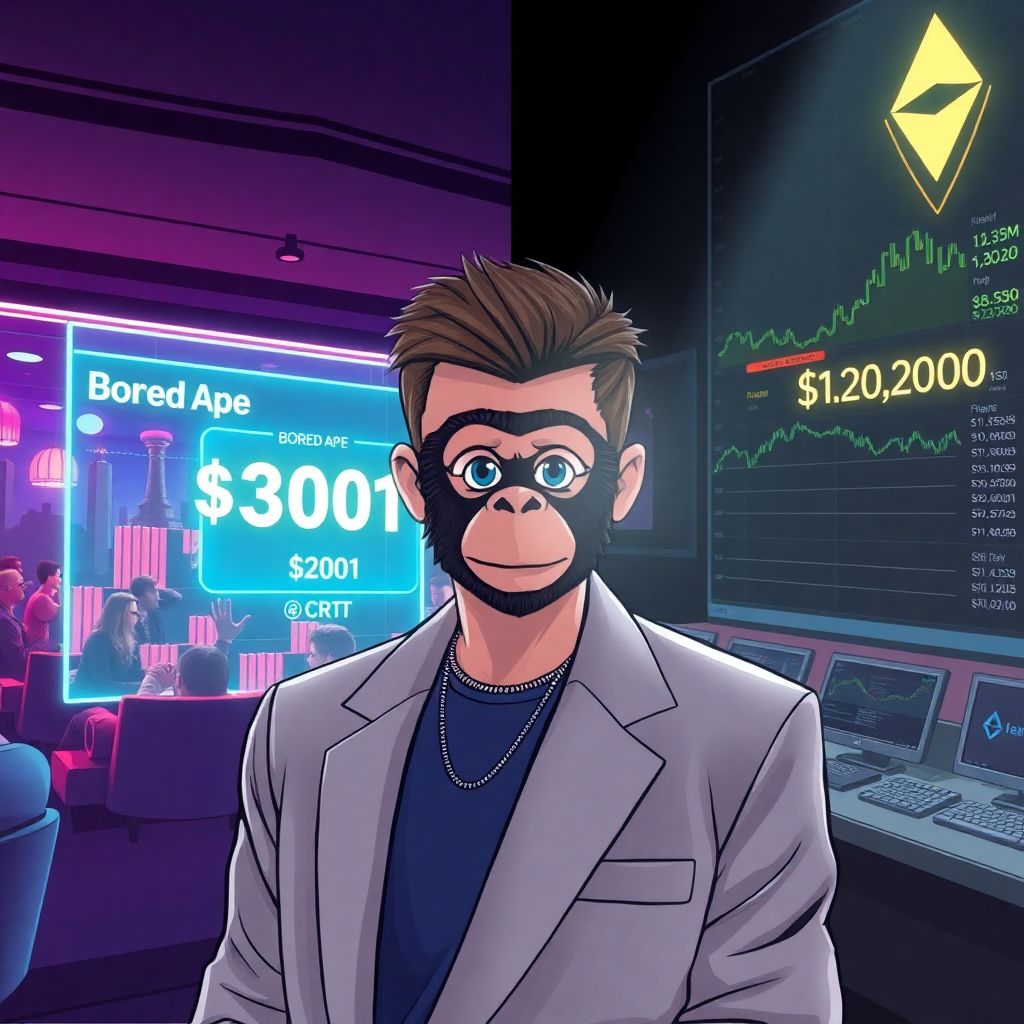
Justin Bieber’s high-profile bet on a Bored Ape Yacht Club NFT has turned into one of the most emblematic losses of the NFT boom-and-bust cycle.
In January 2022, at the peak of NFT mania, the pop star shelled out 500 ETH—worth roughly 1.3 million dollars at the time—for Bored Ape #3001, an Ethereum-based non-fungible token from the now-famous Bored Ape Yacht Club collection. The purchase instantly grabbed headlines, cementing Bieber as one of the most visible celebrity participants in the NFT craze.
Fast forward just a few years, and the picture looks radically different. Comparable Bored Apes with similar characteristics to Bieber’s token are now changing hands for around 12,000 dollars, reflecting a collapse of about 99% from his purchase price if he were to try to sell at current market levels.
Bored Ape #3001 is not among the rarest in the collection. In fact, by the standards of the set’s trait distribution, it is relatively common in terms of its visual attributes. That makes its market value more closely tethered to the overall floor price of the collection than to any special rarity premium. When the floor dropped, so did the theoretical value of Bieber’s Ape.
There is, however, a twist: in traditional art and collectibles markets, provenance—the ownership history of an item—can significantly influence its price. An otherwise ordinary piece can fetch a premium if it was owned by a famous person. The same logic could apply here. The fact that Justin Bieber once owned Bored Ape #3001 could, in theory, allow it to sell for more than a comparable Ape if it were ever listed publicly, especially if marketed as a piece of pop culture history from the NFT bubble era.
Still, even with a possible celebrity premium, the underlying reality is difficult to ignore. Assets with similar traits from the same collection have suffered steep, sustained price declines as enthusiasm around NFTs, and the Bored Ape Yacht Club specifically, has cooled. The broader market no longer resembles the speculative frenzy of early 2022, when buyers were routinely paying six or seven figures for digital avatars.
Bieber’s NFT purchase happened during a period of extreme exuberance in the crypto and NFT markets. Ethereum prices were elevated, social media was flooded with profile-picture collections, and Bored Apes had become the ultimate digital status symbol. Ownership came with a sense of exclusivity, as well as access to online and real-world events. Celebrities, athletes, and influencers rushed in, turning their Apes into profile pictures and signaling membership in a new kind of digital elite.
As macroeconomic conditions tightened and speculative appetite faded, this narrative unraveled. The floor price of Bored Ape Yacht Club NFTs, once held up as a barometer for the entire NFT sector, began to tumble. What had been marketed as “blue-chip” NFTs proved just as vulnerable to market cycles as any other speculative asset. Collections that had commanded millions in daily trading volume saw demand evaporate.
Bieber’s Ape has thus become a kind of case study in how quickly sentiment can turn. At the time of his purchase, people emphasized potential upside, cultural significance, and the supposed inevitability of Web3 changing entertainment and art. In hindsight, the trade looks less like a strategic investment and more like a very expensive snapshot of a specific cultural moment.
The situation also highlights a critical difference between NFTs and traditional investments. NFTs are highly illiquid and extremely sentiment-driven. While a stock represents a claim on a company’s earnings or assets, and real estate has tangible utility, many NFTs derive most of their value from community perception and hype. When the collective mood shifts, prices can collapse with few fundamental anchors to slow the decline.
That said, writing off the entire NFT space based solely on high-profile losses would be an oversimplification. The underlying technology—verifiable digital ownership on a blockchain—remains useful for digital art, gaming assets, music rights, and more. What the Bored Ape saga shows is that technology can be transformative even while early speculative markets around it are wildly mispriced.
For artists and creators, the crash has forced a recalibration. Instead of chasing instant, lottery-like windfalls, many are now experimenting with more sustainable models: smaller collections, long-term communities, utility-focused tokens, or NFTs tied to real-world perks and experiences. Collectors, in turn, are becoming more discerning, focusing less on hype and more on the creator’s track record, the strength of the project’s community, and the actual utility or cultural value of what they are buying.
Celebrity-driven hype is another important lesson. During the peak, endorsements from stars like Bieber helped push prices higher as fans and speculators tried to follow their moves. But star power does not guarantee value. Celebrities can draw attention to a trend, yet they cannot control market cycles, nor can they protect buyers from sharp drawdowns once speculation cools. Bieber’s loss illustrates that even those at the center of the spotlight are not immune.
From an investment perspective, this episode underscores several principles that apply far beyond NFTs:
– Never risk money you cannot afford to lose on highly speculative assets.
– Diversification matters, particularly when dealing with untested markets.
– Popularity and virality are not substitutes for fundamentals.
– Rapid price appreciation often signals increased risk, not guaranteed future gains.
For those still interested in NFTs today, Bieber’s Bored Ape can serve as a cautionary benchmark. Instead of focusing solely on floor prices and celebrity purchases, potential buyers should evaluate long-term narratives: Is there a real need for this token to exist? Does it provide ongoing benefits—access, rights, revenue shares, or utility beyond being a collectible picture? Is the community active and engaged even when prices are down?
The notion of provenance may, in time, give Bieber’s Ape a second life as a collectible artifact from the NFT gold rush. Future collectors of digital history might value it not for its rarity traits, but for its role in a landmark moment when mainstream pop culture collided with blockchain speculation. That kind of historical or cultural value tends to emerge slowly, not in the immediate aftermath of a bubble.
Meanwhile, the plunge from 1.3 million dollars to roughly 12,000 dollars is a stark reminder of how volatile and unforgiving speculative markets can be. For Justin Bieber, the Bored Ape purchase is likely a rounding error in a successful career. For ordinary investors who followed similar trends with their savings, the consequences may have been much more severe.
In the end, Bieber’s Bored Ape encapsulates the arc of the NFT boom: explosive hype, aggressive buying, soaring prices, and then a dramatic correction as fundamentals struggled to justify the valuations. What remains is the technology, the cultural memory of that frenzy, and a set of hard-earned lessons for anyone considering jumping into the next big digital craze.