
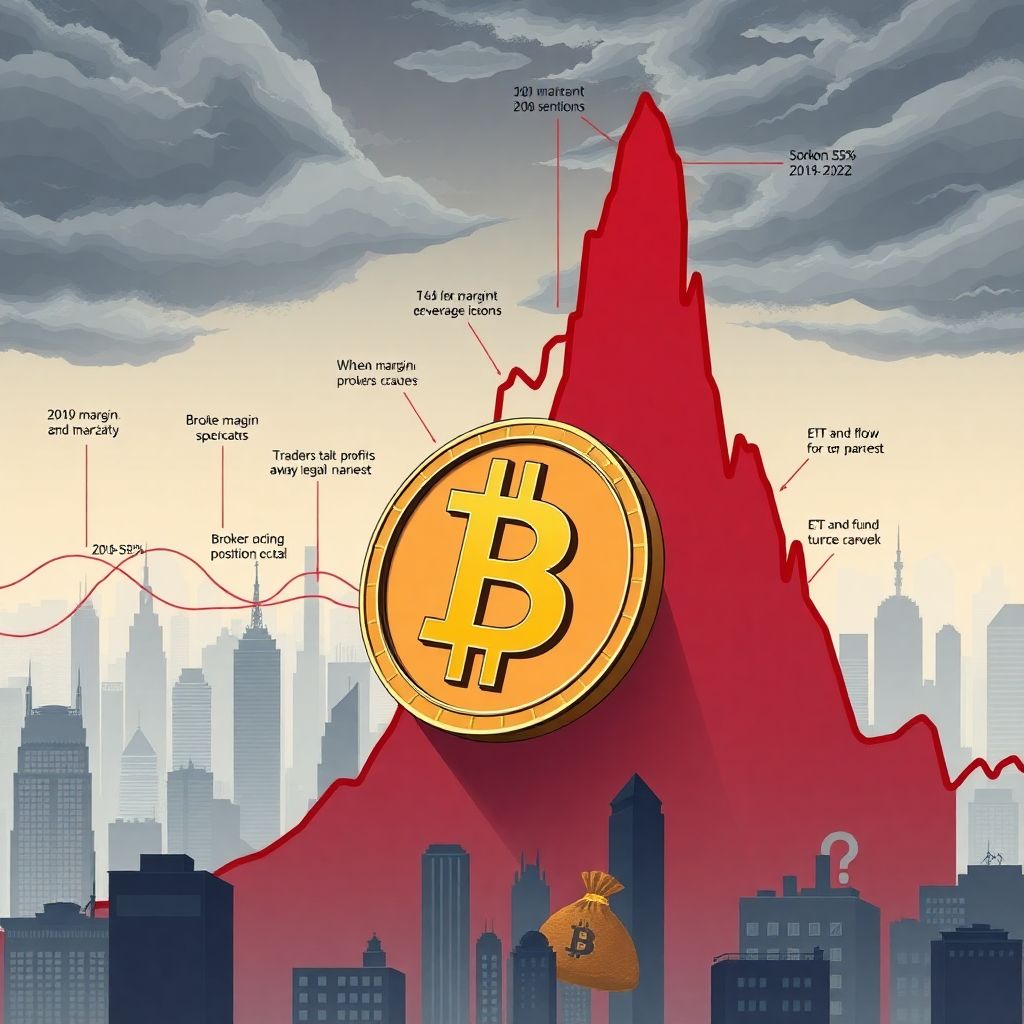
Why crypto is sliding and what could signal a bottom: lessons from past cycles and Bitwise’s Matt Hougan
Bitcoin’s latest drop has rattled even seasoned holders. In just one day it has shed around 14%, and roughly 25% over the past week. From its peak, the current drawdown stands at about 54%, with the coin still trading close to 50% below its all‑time high.
For many investors, the obvious questions follow:
– Why is the market falling?
– How much further could it drop?
– When will the bottom finally be in?
Matt Hougan, chief investment officer at Bitwise, argues that while the exact turning point is impossible to time, the bigger picture for digital assets remains constructive. The current decline, he says, is painful but not unprecedented — and historically, periods like this have often set the stage for outsized gains.
How bad is this drawdown in context?
A 50%–55% decline from the top sounds extreme in most asset classes, but for crypto it is closer to “mid‑range.” Earlier downturns have been much more brutal:
– In 2014, Bitcoin fell about 86% from peak to trough.
– In 2018, the drop was around 84%.
– In 2022, it slid roughly 77% before the next recovery phase began.
By comparison, the current pullback is milder, at least so far. Historical bear markets in Bitcoin typically run around 12–13 months from peak to trough. That pattern suggests this slump may still have room to extend in both time and depth, even if the market has already done a lot of the hard work of repricing.
Hougan’s message: recognize that the current correction is serious, but not unprecedented. Investors should be prepared for the possibility that the market has not yet seen its final low.
Six core forces dragging crypto lower
There is no single cause behind the latest leg down. Instead, analysts — including Hougan — point to a cluster of overlapping themes that together explain much of the weakness. Six stand out:
1. Macro uncertainty and risk‑off sentiment
When global investors get nervous about growth, inflation, interest rates, or geopolitical tensions, they typically move away from volatile assets. Crypto, sitting at the far end of the risk spectrum, often gets sold first. Rising yields or worries about recession can both trigger this “flight to safety.”
2. Excess leverage unwinding
Bull markets in digital assets tend to attract heavy leverage through derivatives, margin, and structured products. When prices start dropping, forced liquidations amplify the move, turning a healthy correction into a steep cascade. The recent slide has all the hallmarks of leverage being washed out.
3. Profit‑taking after a strong run‑up
Before the latest fall, Bitcoin and many major coins had rallied strongly from their prior lows. Long‑term holders and institutional traders who bought earlier in the cycle finally had sizable gains to lock in. Large waves of profit‑taking have added selling pressure at a time when new buyers are more cautious.
4. Regulatory noise and policy ambiguity
On the one hand, regulatory clarity is slowly improving. On the other, each new enforcement action, lawsuit, or policy proposal can spark short‑term fear and confusion. Markets hate uncertainty, and crypto is still in the process of being integrated into existing financial and legal frameworks.
5. Shifts in ETF and fund flows
The arrival of spot crypto products and institutional vehicles has made it easier for large pools of capital to enter — and exit — the market quickly. When flows reverse even modestly, the impact on price can be sharp because liquidity remains thinner than in mature asset classes.
6. Cycles of hype and disillusionment
Every cycle sees new narratives: decentralized finance, NFTs, metaverse, AI‑linked tokens, and more. When expectations outrun reality, disillusionment follows, dragging down not only the over‑hyped niches but also broader sentiment toward the asset class.
Taken together, these forces don’t suggest that something is “broken” in the underlying technology. Instead, they show how a young, sentiment‑driven market reacts when optimism cools and leverage gets squeezed.
Could crypto fall further?
Hougan’s view is cautious but realistic: yes, crypto can fall more from here. History shows that a 54% drawdown is not a hard floor. Previous cycles have not bottomed until losses reached 70%–85% from the top.
There are at least three reasons investors should not rule out additional downside:
– Bear markets often overshoot fair value. Selling tends to intensify just when fundamentals are starting to improve, as fear overwhelms careful analysis.
– Capitulation is usually obvious in hindsight. Final legs down are often marked by panic, heavy media negativity, and declarations that “crypto is finished.” Some participants may argue we haven’t yet seen that kind of universal despair.
– Macro risks remain unresolved. As long as questions about growth, rates, and regulation remain open, each negative headline can trigger another wave of selling.
At the same time, Hougan stresses that the probability of an 80%‑plus crash declines as the market matures. The asset class today is larger, more institutional, and more integrated into mainstream finance than it was in 2014 or 2018. That doesn’t eliminate risk, but it can dampen the most extreme outcomes.
Why many veterans see echoes of 2018 and 2022
For those who lived through earlier cycles, the current mood feels familiar. The 2018 crash followed the ICO boom; the 2022 washout came after the leverage‑fueled excesses of that era. In both cases, brutal declines were followed by powerful, multi‑year rallies:
– Investors who accumulated Bitcoin in the 2018 bear market ultimately saw returns on the order of 2,000% in the following cycle.
– Those who bought aggressively during the 2022 lows have already experienced gains of roughly 300% in the subsequent rebound.
These numbers are not guarantees of future performance. They simply illustrate a pattern: historically, crypto’s deepest drawdowns have tended to precede its strongest advances. The market periodically “resets,” clearing out speculative froth while the technology and infrastructure continue to progress in the background.
The underlying fundamentals remain intact
Despite the price action, core drivers of the crypto story are still moving forward:
– Growing demand for digital money and assets. From cross‑border payments to on‑chain settlement, more people and institutions are experimenting with crypto‑native rails.
– Gradual regulatory clarification. Even though the process is messy, more jurisdictions are defining how digital assets can be issued, traded, and custodied, which ultimately supports institutional adoption.
– Innovation in tokenization. Real‑world assets — from government bonds to real estate and funds — are increasingly being represented as tokens, making settlement faster and more programmable.
– Stablecoins as a key use case. Dollar‑pegged tokens are becoming a major part of digital finance, especially in emerging markets and online commerce.
These trends don’t eliminate volatility, but they do suggest that the long‑term thesis for the asset class is not dependent on any single price cycle.
What might finally mark the bottom?
Timing the exact inflection point is nearly impossible, but past cycles provide clues about what a bottom tends to look like. Several ingredients often appear:
1. Time and exhaustion
Bottoms are rarely formed in a single spike down. They often involve months of sideways trading, with gradually declining volatility as sellers run out of steam. Investors simply grow tired of the asset, news coverage evaporates, and prices stabilize almost by boredom.
2. Diminishing reaction to bad news
In early bear phases, negative headlines can trigger large drops. Near a bottom, the same kind of news generates only mild moves, signaling that the market has largely priced in the worst.
3. Selective strength in higher‑quality assets
The strongest projects and networks often start recovering first, even while the broader market still feels weak. This divergence can be an early sign that the cycle is turning.
4. Fresh long‑term capital stepping in
As valuations become more attractive, new strategic buyers — from institutions to corporate treasuries — may quietly begin accumulating positions, taking the other side of forced liquidations.
On top of these organic dynamics, specific catalysts could accelerate a recovery. Hougan highlights several possibilities:
– Clearer legislation or major policy breakthroughs that reduce legal uncertainty and give institutions a stable rulebook.
– Sustained demand for AI‑linked and infrastructure projects, where crypto plays a clear functional role in data, compute markets, or coordination.
– A broader shift back to risk‑on behavior in global markets, which would support flows into growth and alternative assets, including digital currencies.
Why patience matters more than prediction
Hougan’s core advice is straightforward: accept that short‑term outcomes are unpredictable and focus on whether you believe in the asset class over a five‑ to ten‑year horizon.
Crypto’s history is punctuated by violent swings, both up and down. Investors who tried to perfectly time entries and exits often ended up missing a large share of gains. Those who sized positions appropriately, diversified, and were willing to endure volatility tended to fare better.
In other words, the primary edge in this market may not be superior forecasting, but emotional resilience and discipline:
– Avoid panic‑selling purely on fear.
– Avoid over‑leveraging in pursuit of quick profits.
– Stick to a plan that reflects your risk tolerance and time frame.
Is this a buying opportunity?
Hougan argues that, for long‑term investors who can withstand further drawdowns, periods like the current one have historically been attractive entry points. The reasoning is simple:
– Valuations are much lower than at the top of the cycle.
– Structural drivers like adoption, innovation, and institutional involvement remain in place.
– Many weak hands are forced out during downturns, leaving a higher concentration of committed holders.
That does not mean investors should “go all in” or ignore risk. Prudent strategies in this environment might include:
– Gradual accumulation (dollar‑cost averaging): adding small, regular amounts over time instead of trying to guess the precise bottom.
– Prioritizing quality: focusing on assets with strong network effects, clear use cases, and robust ecosystems rather than short‑lived speculative themes.
– Keeping dry powder: maintaining some cash or stable reserves to take advantage of unusually sharp dips.
Risk reminders in a maturing but volatile market
While the long‑term case can be compelling, crypto remains one of the most volatile corners of global finance. Investors should keep several realities in mind:
– Drawdowns of 50%–80% are not rare events in this asset class; they are part of its historical pattern.
– Regulatory and technological risks are real. Projects can fail, code can break, and rules can change.
– Diversification across asset classes is essential. Crypto should usually be a limited slice of a broader portfolio, not the entire strategy.
The maturation of the market — through better custody, clearer rules, and institutional participation — may reduce some risks over time, but it will not eliminate them.
The bottom line
Crypto is down because multiple headwinds — macro uncertainty, leverage unwinds, profit‑taking, regulatory ambiguity, shifting flows, and fading hype — have converged at once. The current drawdown, while severe, is still smaller than some previous cycles, and history suggests that it may not be over yet.
Yet the same history also shows that deep bear markets have frequently preceded major rallies. With adoption trends intact and innovation continuing beneath the surface, Hougan sees a market that remains fundamentally promising for investors who can think in years, not days.
The timing of the exact bottom will only be clear in hindsight. What investors can control now is their strategy: staying patient, managing risk, and deciding whether the long‑term potential of digital assets justifies enduring the volatility that has always defined this space.