
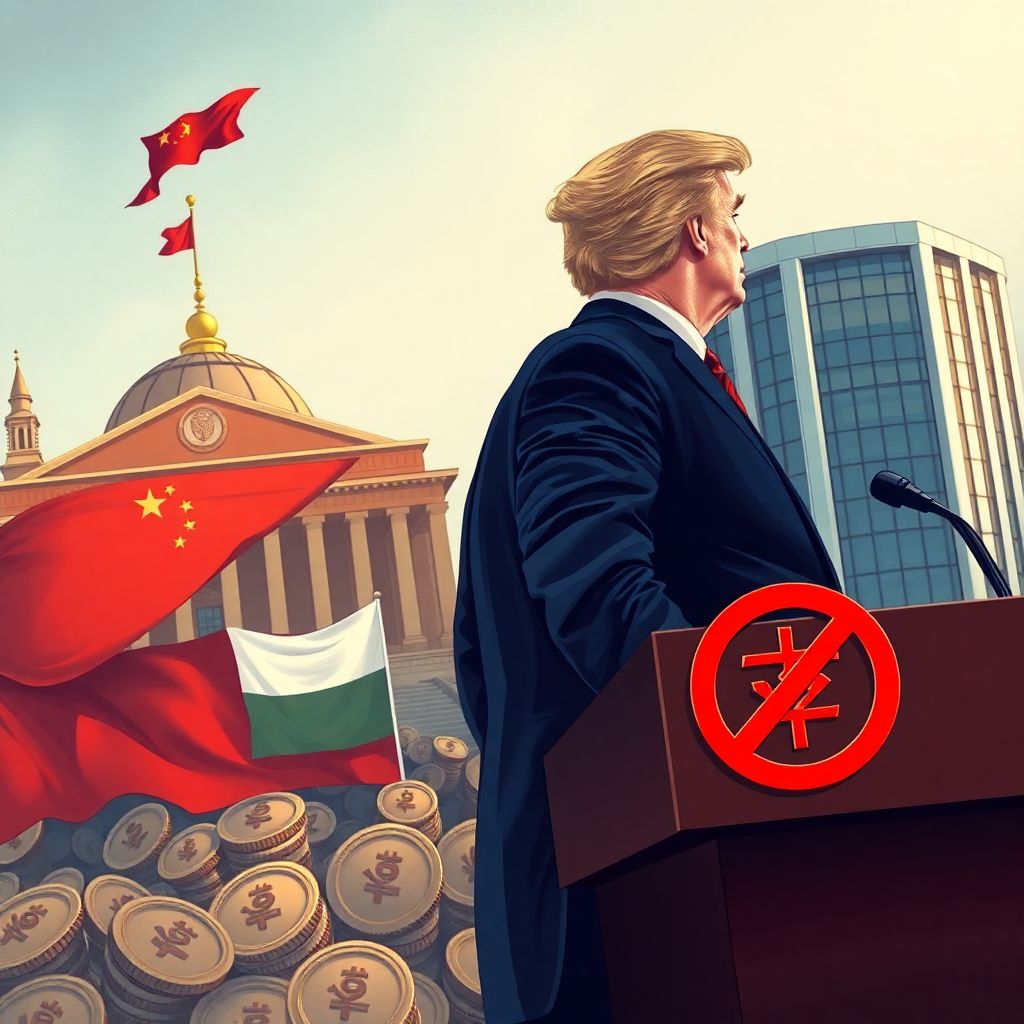
Trump distances himself from UAE’s World Liberty deal as China slams the door on yuan stablecoins, Sberbank tests crypto-backed lending, and USDT climbs to a new record — it was a defining week for digital assets shaped by politics, regulation, and market structure.
Trump rejects knowledge of UAE World Liberty investment
Former US President Donald Trump publicly denied knowing about an alleged investment by entities from the United Arab Emirates in World Liberty Financial, a crypto-focused initiative that has drawn intense media scrutiny.
Reports suggested that investors connected to the UAE had taken a stake in World Liberty, prompting questions about foreign influence and the overlap of politics, fundraising, and digital assets. Trump, however, claimed he had no awareness of such a deal or any stake acquisition, aiming to distance himself from potential controversy and regulatory headaches tied to overseas capital.
The episode underscores how crypto investments linked to high-profile political figures are now examined not only through a financial lens but also as matters of foreign policy and election integrity. Any association between political campaigns, foreign funds, and speculative crypto ventures is likely to trigger future legislative and enforcement interest.
China formally bans yuan-pegged stablecoins
In one of the week’s most consequential regulatory moves, China’s central bank, joined by nine other government agencies, imposed a sweeping ban on unapproved stablecoins tied to the Chinese yuan.
The new rules prohibit the issuance, trading, and promotion of offshore and domestic yuan-linked stablecoins unless they are explicitly authorized by Beijing. This crack‑down extends China’s long-standing anti-crypto stance, which has already outlawed most forms of cryptocurrency trading and mining within its borders.
Authorities framed the ban as a necessary measure to:
– Protect monetary sovereignty of the renminbi
– Prevent capital flight and regulatory arbitrage
– Limit the use of crypto rails to bypass existing exchange and FX controls
The move closes an important loophole for companies and individuals who had been using offshore yuan stablecoins as a quasi-banking system outside of China’s domestic financial controls. It also sends a strong signal to foreign issuers that co‑opting the renminbi for private stablecoin products will not be tolerated.
Sberbank pilots cryptocurrency‑backed loans
In Russia, Sberbank continued its cautious exploration of digital assets by testing loans collateralized with cryptocurrencies. While details remain limited, the pilot program reportedly allows selected clients to post digital assets as security instead of traditional collateral such as property or securities.
This experiment hints at how national champions in heavily regulated markets might try to bridge legacy banking with the crypto economy without offering full-fledged spot crypto trading. For Sberbank, it is a way to:
– Gauge client appetite for crypto-based financial products
– Learn how to manage volatility and risk associated with digital collateral
– Position itself as an innovation leader while remaining aligned with domestic regulation
If such pilots prove successful, other banks in emerging markets may follow, using controlled, collateral-focused products as their first safe entry into crypto finance.
Bithumb flash crash traced to accounting error
South Korean exchange Bithumb experienced a sudden, sharp price move that triggered alarm in markets before being attributed to an internal error. Bitcoin briefly plunged on the platform amid claims tied to a misconfigured or erroneous airdrop allocation of about 2,000 BTC.
Rather than reflecting genuine selling pressure or a security breach, the move appears to have been the result of accounting or operational mistakes, highlighting the fragility of order books when systems malfunction. The episode once again raises concerns about:
– How quickly exchanges can detect and reverse technical anomalies
– Whether circuit breakers and risk controls are robust enough
– How retail traders are protected when price spikes or crashes stem from internal issues rather than fair market activity
For regulators, such incidents strengthen the case for stricter standards around exchange risk management and financial reporting.
Polymarket advances toward native token launch
Prediction market platform Polymarket took further steps toward launching its own token, moving from concept to execution as it refines tokenomics and distribution plans.
A native token could serve multiple purposes within the platform’s ecosystem:
– Incentivizing liquidity providers
– Rewarding accurate forecasters
– Governing key protocol changes
The move also comes amid growing scrutiny of prediction markets and their overlap with regulated derivatives and betting products. As platforms like Polymarket push for growth, they must carefully navigate compliance, especially in major jurisdictions where event contracts can be classified as securities or gaming instruments.
Senator Lummis pushes banks toward stablecoins
In the United States, Senator Cynthia Lummis once again advocated for a more proactive embrace of stablecoins by the traditional banking sector. She argued that well-regulated, dollar‑backed tokens can modernize payments and help preserve the central role of the US dollar in global finance.
Her position reflects a broader push among some lawmakers and industry advocates to:
– Bring stablecoin issuance under clear federal rules
– Allow banks to issue or integrate stablecoins under existing prudential standards
– Ensure that dollar‑pegged tokens remain the dominant stablecoin instruments globally, countering rival currencies or privately controlled alternatives
The policy debate over who should be allowed to issue stablecoins — banks, fintechs, or fully decentralized entities — is set to intensify as volumes and systemic relevance grow.
Gemini retreats from multiple markets
Crypto exchange Gemini continued scaling back its global footprint, withdrawing services from several markets as regulatory pressures and compliance costs mount.
The exits highlight a broader pattern: medium‑sized exchanges are finding it increasingly difficult to maintain licenses, banking relationships, and local compliance teams across dozens of countries. As rules tighten and enforcement actions rise, many operators are:
– Prioritizing a handful of core jurisdictions
– Cutting markets where regulations are unclear or overly burdensome
– Shifting resources to institutional and high‑margin products
This consolidation favors larger, better‑capitalized platforms and could reduce consumer choice in smaller or more complex markets.
Brazil moves to curb algorithmic stablecoins
Brazil took a step toward restricting algorithmic stablecoins, with policymakers advancing proposals to prohibit or heavily regulate such instruments. Unlike fully collateralized tokens, algorithmic stablecoins rely on market incentives, on‑chain mechanics, and sometimes governance tokens to maintain a peg — designs that have come under fire since the collapse of several high‑profile projects.
Brazilian officials cited concerns about:
– Run risk and sudden depegging
– The difficulty of guaranteeing redemption
– Spillover impacts on local savers if such tokens are widely adopted
By drawing a hard line between fully backed and algorithmic models, Brazil is aligning with a trend emerging in multiple jurisdictions: allowing tightly supervised fiat‑backed stablecoins while clamping down on experimental designs that can mask substantial hidden risk.
USDT reaches record market capitalization
Tether’s USDT, the largest dollar‑pegged stablecoin, hit a new all-time high in market capitalization. The milestone underscores how, despite waves of regulatory crackdowns and competition from new entrants, USDT remains the dominant liquidity and settlement tool across many crypto venues.
The record valuation reflects several dynamics:
– Ongoing demand for dollar exposure in regions with weak local currencies
– Use of USDT as base collateral in derivatives markets
– Its role as a bridge asset for cross‑border transfers outside of traditional banking hours
At the same time, USDT’s scale continues to draw regulators’ attention, who are focused on reserves transparency, governance structure, and potential systemic implications if a major stablecoin were to encounter redemption stress.
Ripple integrates with Hyperliquid and secures Luxembourg EMI license
Ripple expanded its footprint on two fronts. First, it integrated with the Hyperliquid exchange, deepening the liquidity and utility available to users of its technology stack. The collaboration aims to streamline trading and settlement, connecting Ripple’s infrastructure with a newer generation of high‑performance trading venues.
Second, Ripple obtained an Electronic Money Institution (EMI) license in Luxembourg, a key regulatory credential in the European Union. An EMI license allows a company to issue electronic money and offer payment services under EU rules, enabling:
– Broader rollout of compliant payment and remittance products
– Easier access to banking, enterprise, and fintech partners in Europe
– A foundation for future tokenized payment solutions aligned with regional regulations
This combination of technical integration and regulatory approval signals Ripple’s strategy of embedding itself into regulated financial plumbing rather than remaining solely a crypto-native project.
Epstein–Coinbase investment link resurfaces
Another story that resurfaced this week was the revelation of a past investment connection involving Jeffrey Epstein and cryptocurrency exchange Coinbase. Historical records indicate that funds associated with Epstein had exposure to an early Coinbase investment, raising renewed ethical and reputational questions for entities indirectly linked to his network.
While the involvement appears to be from an earlier period and not an active relationship, the disclosure adds a layer of complexity to Coinbase’s history and fuels discussion about:
– The due diligence standards applied to early-stage investors
– How legacy ties can create reputational risk many years later
– Whether more transparency around cap tables and LPs should be expected in major infrastructure providers
For the broader industry, it is another reminder that capital sources can become a long-term liability, particularly when they intersect with high‑profile criminal cases.
China’s broader crypto crackdown and tokenization limits
In parallel with the yuan stablecoin ban, China formalized additional restrictions on crypto trading and real‑world asset (RWA) tokenization. While certain forms of blockchain experimentation remain permissible in heavily controlled contexts, authorities are pushing back against any model that resembles open, permissionless trading of digital securities or synthetic claims on domestic assets.
The stance is clear: digital representations of Chinese financial products or properties must remain under direct state oversight. This policy:
– Blocks foreign and domestic platforms from issuing tokenized Chinese RWAs without explicit approval
– Prevents the emergence of parallel, offshore markets in Chinese assets
– Reinforces the state’s control over capital allocation and investor access
For global firms, it marks the end of any lingering hope that China might soon become a major market for public crypto or tokenized assets in their current form.
Market structure and prediction markets face growing scrutiny
Beyond individual headlines, regulators also signaled growing concern with prediction platforms and event-based contracts. Firms like Kalshi indicated they are increasing surveillance and compliance efforts amid rising scrutiny.
Authorities are particularly focused on:
– Whether political, economic, and sports prediction markets constitute regulated derivatives
– The risk that retail users are effectively engaging in speculative trading under the guise of forecasting
– The systemic implications if prediction markets are used for hedging or influencing real-world events
As more capital flows into these platforms, the line between “information markets” and regulated financial products will continue to blur, forcing both startups and regulators to refine their frameworks.
What this week tells us about the future of crypto
Taken together, the week’s events point to a maturing but heavily contested crypto landscape:
– Politics and perception: Trump’s attempt to distance himself from World Liberty Financial shows how politically adjacent crypto projects are now subject to intense reputational and legal risk.
– Regulatory divergence: China’s absolute rejection of yuan stablecoins stands in stark contrast to jurisdictions experimenting with regulated stablecoins and tokenization.
– Institutional creep, not explosion: Moves by Sberbank and Ripple demonstrate that traditional players are entering digital assets through tightly controlled, regulatory‑aligned channels rather than embracing the full open-crypto ethos.
– Stablecoins at the center: From USDT’s record capitalization to Brazil’s stance on algorithmic models and Lummis’s policy advocacy, stablecoins remain the core battleground for the next phase of digital finance.
For investors, builders, and policymakers, the message is clear: crypto is no longer a fringe experiment but a contested layer of the global financial system, where every new product, partnership, or token now exists under the combined spotlight of politics, regulation, and market risk.