
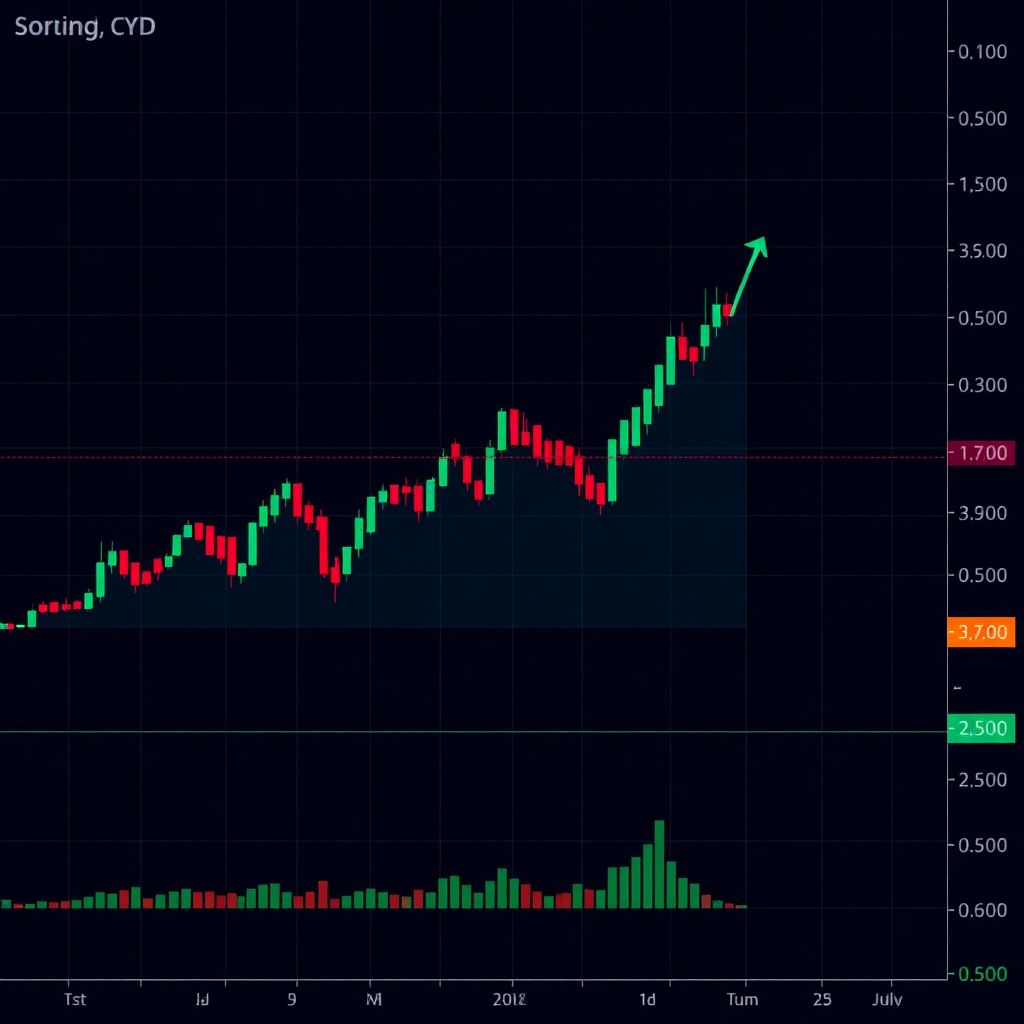
Sonic price targets bullish reversal as RSI divergence emerges at $0.03
Sonic (S) is trading at a make-or-break zone where technical signals are hinting at a possible shift in trend. After a prolonged stretch of selling pressure, the token is beginning to show the early footprints of a bullish reversal, with momentum indicators turning more constructive around a major support area.
Bullish RSI divergence at the value area low
On the chart, the most important development is a bullish divergence on the Relative Strength Index (RSI), forming near the value area low. While Sonic’s price has continued to register lower lows, the RSI has started to carve out higher lows. This disconnect between price and momentum often points to exhaustion in the prevailing downtrend.
In technical analysis, such divergences are frequently seen as the first sign that sellers are losing control. Price may keep pressing lower out of inertia, but the underlying momentum no longer confirms the weakness. When this pattern appears near an established support zone, the probability of at least a corrective bounce – if not a full trend reversal – increases noticeably.
$0.03 emerges as critical support
For Sonic, the $0.03 mark has become a pivotal level. Buyers have stepped in around this price point repeatedly, slowing or halting further declines. Each attempt by bears to push the market decisively below $0.03 has so far been absorbed, suggesting that participants view this area as a fair value zone or a discount opportunity.
As long as Sonic continues to defend this support, the current bullish RSI divergence remains valid. The market is essentially coiled between weakening bearish momentum and a key demand area. The side that breaks first – either bulls losing $0.03 or bears failing to reclaim control – will likely set the tone for the next major move.
Fibonacci confluence reinforces the setup
Adding weight to this technical picture is the alignment of the 0.618 Fibonacci retracement level with the current support structure. The 0.618 retracement, derived from the Fibonacci sequence, is widely regarded by traders as a “golden ratio” zone where pullbacks often conclude and new impulsive moves begin.
When this Fibonacci level overlaps with other key tools – such as the value area low, historical support, or volume clusters – it forms an area of technical confluence. In Sonic’s case, the confluence between $0.03 support, the value area low, and the 0.618 retracement significantly strengthens the argument for a corrective move higher, provided price can continue to hold that floor.
Potential upside: corrective rally toward $0.04
If bulls manage to maintain control above $0.03, the next logical target on the chart sits near $0.04, which functions as a high-timeframe resistance zone. This level is where sellers previously asserted dominance, capping prior rallies and triggering fresh rounds of profit-taking or short entries.
A rotation from $0.03 to $0.04 would not only represent a solid corrective rally in percentage terms, but also mark the first noteworthy higher high since Sonic entered its recent downtrend. Structurally, that would be the first building block of a potential trend change, especially if followed by a higher low and sustained buying pressure.
What invalidates the bullish case?
Despite the constructive setup, the market is not out of the woods yet. A decisive daily close below $0.03 would undermine the current bullish thesis. Such a breakdown would imply that the divergence failed to convert into real buying strength and that bears remain firmly in control of the broader structure.
In that scenario, the RSI divergence would likely be written off as a temporary pause rather than a genuine reversal signal. Traders would then look for lower support zones or additional signs of capitulation before expecting another serious attempt at a bottom.
Fundamental tailwind: USSD stablecoin launch
Beyond the chart, Sonic Labs is also layering in new fundamentals that may eventually reflect in market sentiment. The launch of USSD, a USD-pegged stablecoin backed by tokenized U.S. Treasury assets, introduces a fresh source of reliable, on-chain liquidity for the Sonic ecosystem.
A robust, asset-backed stablecoin can help deepen liquidity pools, facilitate smoother trading, and attract capital that prefers lower volatility exposure while still engaging with the network. Over time, this can create a more resilient environment for Sonic’s native token, particularly during periods of market stress when liquidity usually evaporates.
Strategic direction under new leadership
Sonic Labs is also entering a new chapter under CEO Michael Demeter, who is steering the project with a long-term roadmap focused on sustainable value creation for a layer-1 blockchain. Strategic clarity and a credible vision often influence investor confidence, especially in a space where many projects lack defined, realistic goals.
If the roadmap delivers tangible improvements – such as network performance gains, developer adoption, or novel use cases – it may provide a fundamental backdrop that supports any technical recovery. Markets often respond first to price, but durable uptrends are usually anchored by improving fundamentals.
Short-term trading considerations
For short-term traders, the $0.03-$0.04 band is likely to remain the primary battlefield. Conservative traders may wait for a confirmed close above interim resistance levels within this range before committing, using the bullish RSI divergence and Fibonacci confluence as a backdrop rather than a standalone signal.
More aggressive participants might treat dips toward $0.03 as potential entry points, placing tight invalidation levels just below the support area to manage risk. In both cases, volume confirmation on any upward move will be important: a push toward $0.04 accompanied by rising volume and strengthening RSI would reinforce the case for a more sustainable upside extension.
Medium-term structure and sentiment
From a broader market structure perspective, a move to $0.04 would be more than a simple bounce. It would challenge the pattern of consistently lower highs that has defined Sonic’s recent trajectory. Breaking that pattern is often the first step in shifting sentiment from “sell the rally” to “buy the dip.”
However, a single leg higher does not guarantee a full trend reversal. Many markets form complex bottoming structures with multiple tests of support and resistance. Traders and investors should therefore view any initial rally as a phase within a potentially longer rebuilding process, rather than an instant return to a strong bull market.
Risk management and scenario planning
Given the binary nature of the current setup, risk management remains crucial. The bullish playbook hinges on three core conditions:
– Price holding above the $0.03 support
– The 0.618 Fibonacci retracement continuing to act as a floor
– The bullish RSI divergence maintaining its structure or further strengthening
If these conditions persist, a corrective rally toward $0.04 becomes increasingly plausible. If any of them fail – particularly a clean break below $0.03 on strong volume – traders should be prepared to reassess their bias and anticipate the possibility of further downside.
Outlook: inflection point with asymmetric potential
Sonic now sits at a classic inflection point where technical signals, structural levels, and emerging fundamentals converge. As long as bulls defend $0.03 and momentum continues to diverge positively from price, the stage is set for a potential corrective push toward $0.04 resistance.
The next sessions will be pivotal. A confirmed bounce from this zone could mark the early stages of a broader recovery phase, while a breakdown would postpone any reversal and keep Sonic locked in its downtrend. For now, the market is leaning toward a possible bullish turn – but the final verdict will be written by price action around $0.03.