
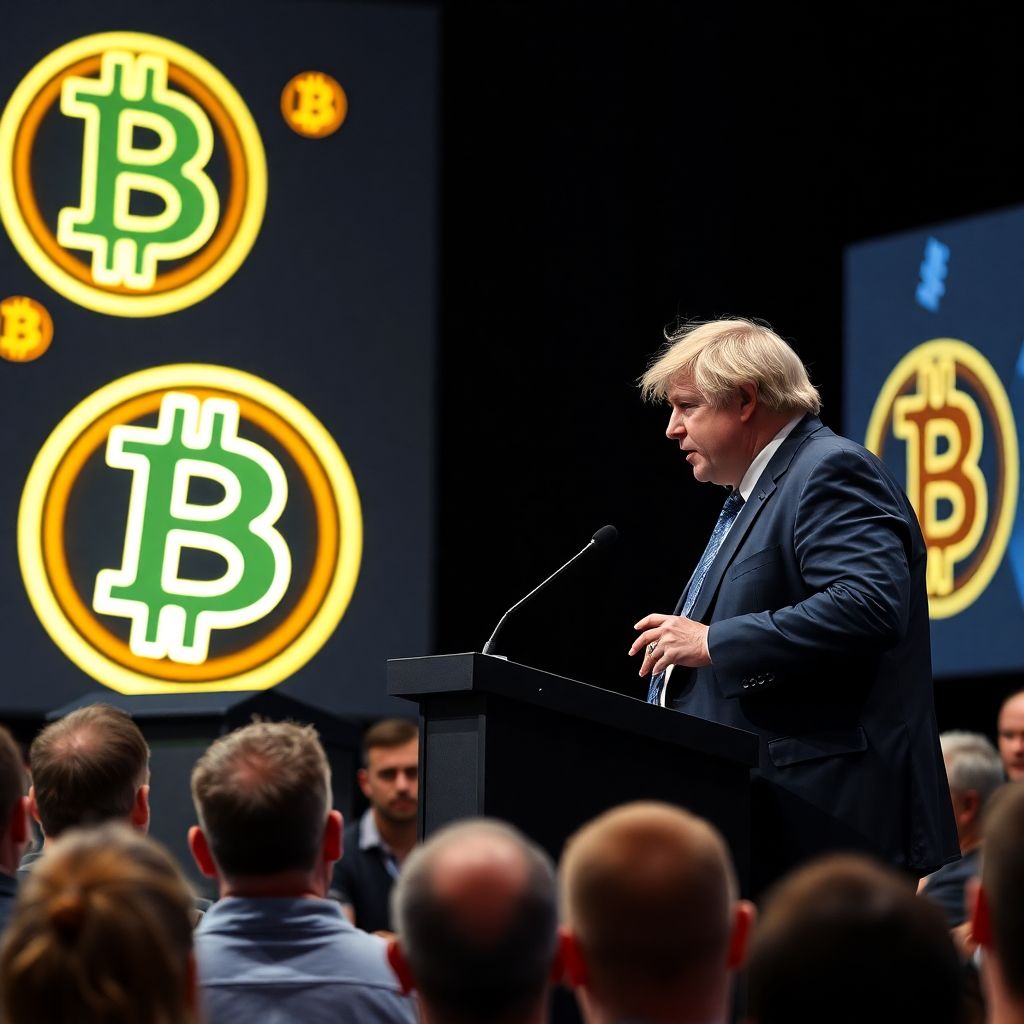
Michael Saylor hits back after former UK Prime Minister brands Bitcoin a Ponzi scheme
Michael Saylor has pushed back forcefully against claims from former UK Prime Minister Boris Johnson that Bitcoin is essentially a Ponzi scheme, arguing that the world’s largest cryptocurrency bears no resemblance to classic fraudulent investment structures.
Johnson, in a recent written commentary, recounted the story of a church acquaintance who had been persuaded to invest in what was presented as a lucrative Bitcoin opportunity. The man allegedly began by transferring £500 to an individual who promised to double his money through crypto trading.
According to Johnson, what followed was a long and painful ordeal. Over the course of three and a half years, amid confusion and repeated assurances, the man’s initial investment snowballed into mounting losses. Instead of growing his wealth, he ultimately found himself down by around £20,000. Johnson said the victim repeatedly paid additional “fees” and charges, believing these payments were necessary to unlock or recover his funds.
The former prime minister used this anecdote as a springboard to challenge not just speculative crypto schemes, but the fundamental premise of Bitcoin and digital assets in general. He drew a sharp contrast between cryptocurrencies and the kinds of assets that are widely recognized as stores of value.
Johnson wrote that he could understand why investors trust gold, pointing to its long history and physical properties, and even acknowledged that collectibles like Pokémon cards have managed to maintain value over time. In his view, both examples offer some form of tangible or culturally established backing that helps explain why people are willing to pay for them.
When it came to Bitcoin, however, Johnson was far more skeptical. He questioned what, if anything, lies behind the digital token, describing it as “just a string of numbers stored in a series of computers.” He emphasized that, unlike conventional money or corporate securities, Bitcoin does not have an identifiable authority, issuer, or institution standing behind it.
Johnson also highlighted the pseudonymous identity of Bitcoin’s creator, Satoshi Nakamoto, as a source of unease. He suggested that a system stewarded-or at least designed-by an unknown figure places extraordinary weight on social conviction rather than formal accountability. In his words, the entire arrangement “depends completely on the collective belief of the Bitcoin holders.”
Building on this criticism, Johnson warned that the growing list of frauds and scams linked to crypto investments could erode public trust not only in those schemes, but in the entire digital asset sector. He claimed he had long suspected that “all cryptocurrencies were basically a Ponzi scheme,” asserting that the system relies heavily on a steady influx of new buyers to sustain prices and to provide exits for earlier participants.
Saylor, a long-time Bitcoin advocate and executive chairman of business intelligence firm MicroStrategy, rejected Johnson’s portrayal in a post on X. He argued that the former prime minister was conflating outright frauds and scam operations with Bitcoin itself, which operates according to transparent, open-source rules.
“Bitcoin is not a Ponzi scheme,” Saylor stated, stressing that a classic Ponzi structure requires a central operator who explicitly promises returns, collects funds from investors, and uses money from newer participants to pay out earlier ones. In his view, that definition simply does not fit Bitcoin.
Saylor pointed out that Bitcoin has “no issuer, no promoter, and no guaranteed return-just an open, decentralized monetary network driven by code and market demand.” There is no central company collecting deposits, no chief executive promising fixed yields, and no contractual obligation for anyone to receive profits. Instead, the asset’s price is determined on open markets, where buyers and sellers interact voluntarily.
He also underscored that while bad actors frequently use the language of Bitcoin or crypto to lure victims into fraudulent schemes, those scams are typically off-chain: they involve fake platforms, counterfeit trading desks, or unregistered funds that merely claim to deal in Bitcoin. The scam, Saylor implied, lies in the intermediaries, not in the underlying protocol.
Saylor’s position is reinforced by his own corporate strategy. MicroStrategy has become one of the most visible institutional holders of Bitcoin, with a multi‑billion‑dollar position on its balance sheet. Rather than presenting Bitcoin as a short‑term speculation, Saylor has repeatedly framed it as a long‑term treasury reserve asset and a potential hedge against inflation and currency debasement.
Johnson’s critique also opened up a broader discussion about the nature of money and trust. He referenced historical examples, including Roman-era coins stamped with the image of emperors, to illustrate how state symbols and authority have traditionally backed currency. The idea, in his view, is that money draws legitimacy from governments and rulers who guarantee its acceptance.
Supporters of Bitcoin counter this narrative by arguing that state backing is a double-edged sword. While fiat currencies are legal tender, they are also subject to monetary policy decisions, political cycles, and the risk of over‑issuance. From the Bitcoin perspective, a decentralized, non-sovereign form of money is precisely designed to remove that political layer and fix the rules of issuance in advance.
In that framework, the “collective belief” Johnson criticizes is not an accident but a feature of all monetary systems. Bitcoin proponents often note that even government fiat money ultimately depends on shared confidence. If people no longer trust a currency-whether due to hyperinflation, capital controls, or political instability-its value can erode quickly, regardless of whose face appears on the notes.
The disagreement between Johnson and Saylor also reflects a deeper divide over what counts as “intrinsic value.” Traditionalists tend to reserve that term for physical commodities like gold, which possess industrial, ornamental, or historically recognized monetary roles. Bitcoin advocates argue that scarcity, security, and utility as a global settlement network constitute their own kind of intrinsic or at least functional value.
Bitcoin’s fixed supply of 21 million coins, enforced by code and cryptographic consensus, is often cited as a core differentiator. While fiat currencies can be created in virtually unlimited quantities by central banks, Bitcoin’s issuance schedule is transparent, predictable, and resistant to unilateral alteration. For many investors, that predictability is a key reason to hold it, especially in times of loose monetary policy.
Critics, however, respond that scarcity alone does not guarantee value; an item can be rare and still unwanted. From that angle, Bitcoin is valuable only as long as enough people agree to want it. Yet the same logic can be applied to gold, art, or even prime real estate, all of which depend on sustained demand and social consensus about their worth.
Another dimension of the debate concerns the role of speculation. Johnson’s example of an investor lured by promises of easy gains underscores how greed and unrealistic expectations fuel riskier behavior in emerging markets. Saylor and other Bitcoin supporters would argue that such schemes exploit human psychology rather than proving anything about Bitcoin’s underlying design.
Regulators around the world have been grappling with exactly this problem: how to distinguish between legitimate, permissionless technologies like Bitcoin and the opportunistic frauds that spring up around them. One line of argument is that more robust regulation of intermediaries-exchanges, brokers, and investment firms-could help protect inexperienced investors without trying to ban core protocols.
The Ponzi label carries strong emotional and legal weight, which is why its use in political discourse draws such sharp reactions. Classic Ponzi schemes, from Charles Ponzi himself to more recent cases, are characterized by active deception, fabricated account statements, and a hidden mechanism where new investor funds are systematically used to pay older participants. Bitcoin’s open ledger, public codebase, and absence of promised returns stand in stark contrast to that model.
At the same time, Bitcoin’s volatility remains a central concern for skeptics like Johnson. Wild price swings, multi‑year cycles of booms and crashes, and the absence of traditional valuation anchors can make it difficult for newcomers to distinguish between temporary drawdowns and permanent losses. That uncertainty makes fertile ground for scammers who promise guaranteed outcomes in an inherently risky market.
For long-term Bitcoin holders, volatility is seen as the price of admission for holding an asset that is still monetizing and finding its place in the global financial system. They argue that early stages of adoption, by definition, involve sharp repricing as new information, capital, and regulatory clarity enter the market.
Ultimately, the clash between Boris Johnson and Michael Saylor is not just a personal spat but a snapshot of a larger global conversation. On one side stand those who see cryptocurrencies as largely speculative, vulnerable to fraud, and detached from traditional notions of value. On the other side are those who view Bitcoin as a once‑in‑a‑generation monetary innovation that removes the need for trusted intermediaries and state-backed guarantees.
Whether one leans toward Johnson’s caution or Saylor’s conviction, the exchange underscores the importance of education and due diligence. Investors enticed by promises of quick profit in “Bitcoin schemes” need to understand the difference between buying and holding BTC directly, and handing funds to opaque operators who may be running outright scams.
As the crypto market matures and institutional participation grows, these debates are likely to intensify rather than fade. Bitcoin’s supporters will continue to argue that its decentralized architecture and fixed supply set it apart from Ponzi schemes and politically managed currencies alike, while critics will keep questioning whether digital scarcity alone is enough to justify its multi‑trillion‑dollar ambitions.