
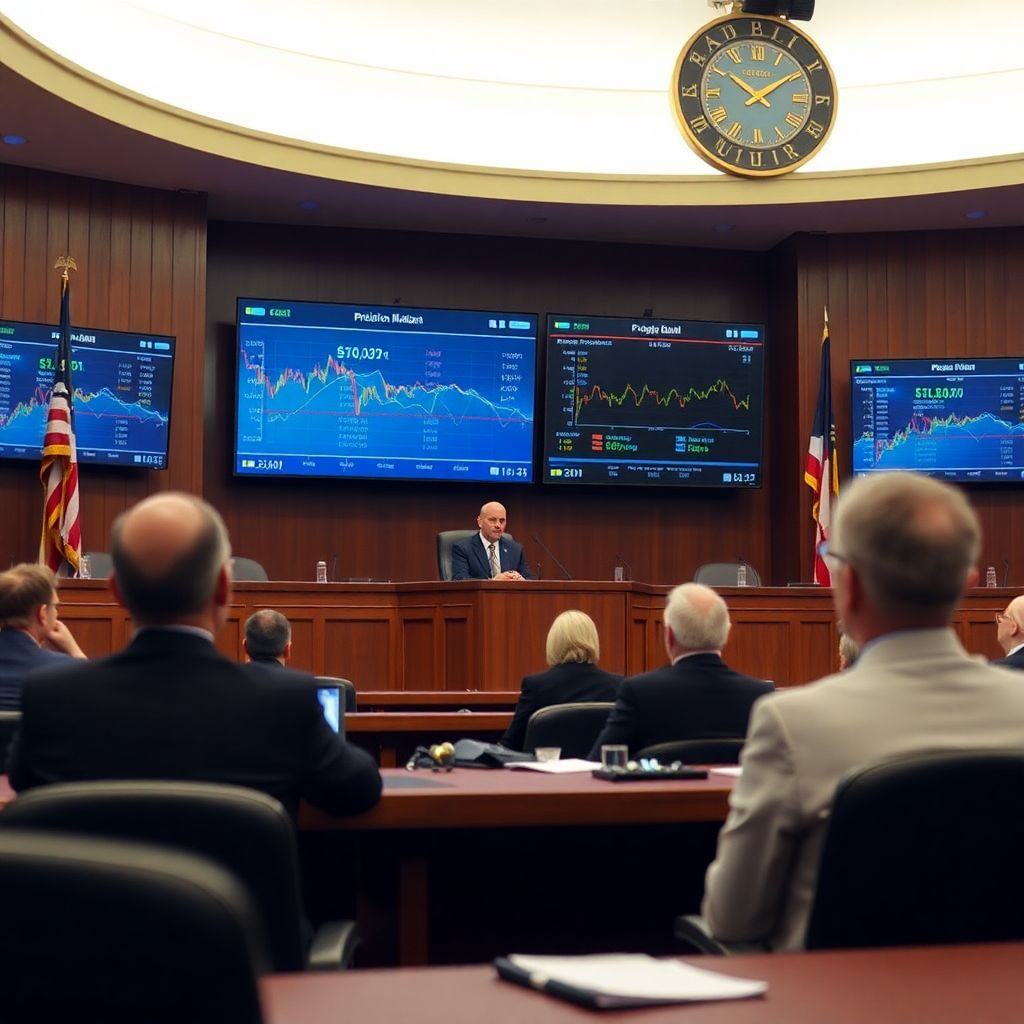
Arizona Targets Kalshi With 20 Criminal Counts, Labels Prediction Market an Illegal Gambling Ring
Arizona prosecutors have launched a sweeping criminal case against prediction market operator Kalshi, accusing the platform of running an unlawful gambling business and facilitating unlicensed election betting in the state.
Attorney General Kris Mayes announced that her office has filed 20 criminal charges against KalshiEx LLC and Kalshi Trading LLC, the entities behind the platform. The charges center on the claim that Kalshi’s so‑called “prediction markets” are, in practice, nothing more than a sophisticated betting service that violates Arizona’s gambling and election laws.
“Kalshi may brand itself as a ‘prediction market,’ but what it’s actually doing is running an illegal gambling operation and taking bets on Arizona elections, both of which violate Arizona law,” Mayes said in a statement. “No company gets to decide for itself which laws to follow.”
Out of the 20 counts, 16 are class 1 misdemeanors tied to betting and wagering activity. The remaining four counts involve alleged violations of state rules governing election‑related conduct, including prohibitions on offering or facilitating wagers on electoral outcomes without specific authorization under Arizona law.
Prediction Markets Under the Microscope
Kalshi presents itself as a regulated marketplace where traders buy and sell contracts linked to real‑world events: economic releases, policy decisions, and political outcomes. Each contract typically pays out a fixed amount if a specified event happens and nothing if it does not, functioning economically much like a binary option.
Proponents of prediction markets argue that they serve an important informational role, aggregating crowdsourced expectations about future events into market prices. These prices are often touted as a kind of “live probability” of outcomes such as interest rate decisions, inflation readings, or election results.
Arizona prosecutors, however, focus less on the informational narrative and more on the underlying mechanics: people risking money in hopes of a financial payoff based on uncertain events. In the state’s view, that looks indistinguishable from betting, especially when it involves elections or political races.
The Core Legal Clash: Gambling vs. Financial Market
At the heart of the case is a fundamental question: Where is the line between a regulated financial instrument and an illegal bet?
Kalshi has publicly framed its business as a highly regulated financial marketplace governed by federal rules, not a casino-style gambling platform. The contracts, the company argues, are structured as financial derivatives whose value derives from measurable real-world events, and they operate within a regulatory framework meant for sophisticated markets rather than entertainment gambling.
Arizona’s complaint, by contrast, treats the activity as classic wagering. Users pay money to “back” an outcome, receive a payout if they are right, and lose their stake if they are wrong. The state’s position is that such arrangements fall squarely within its definitions of illegal gambling when not specifically authorized or licensed, particularly when they involve elections taking place in Arizona.
This conflict underscores a broader tension between federal approval for certain types of markets and state‑level enforcement of gambling laws. Even when a platform seeks to operate under federal financial regulation, states may still claim jurisdiction when residents participate in what local law characterizes as betting.
Election Betting: A Legal and Political Red Line
Election markets are especially sensitive. Many jurisdictions treat wagering on elections differently from other kinds of betting, citing concerns about public trust, interference, or the appearance that electoral outcomes can be manipulated for profit.
Arizona’s charges explicitly point to Kalshi’s allowance of betting on Arizona elections as a key violation. From the attorney general’s perspective, letting traders speculate on whether certain political candidates will win crosses a bright legal and ethical line, regardless of what label the platform uses.
Election wagering also raises broader policy questions:
– Does attaching money to political outcomes incentivize manipulation or misinformation?
– Could deep-pocketed actors use markets to influence perceptions of a race’s momentum?
– Where should regulators draw the line between legitimate hedging or risk‑management and pure speculation on democracy itself?
Those issues are not unique to Arizona, but the state’s charges make it one of the more aggressive jurisdictions willing to take criminal action on the matter.
State Power vs. Federally Regulated Platforms
The Kalshi case illustrates how fragmented the regulatory landscape can be for innovative financial and prediction products in the United States.
Even if a platform operates with some form of federal regulatory blessing in certain areas, that does not grant blanket immunity at the state level. States maintain broad authority over gambling, consumer protection, and election integrity, and they can apply those powers to online services that reach their residents.
For companies like Kalshi, this creates a patchwork of risk. A product that may be permissible in one state could be treated as a criminal offense in another. As more states develop their own frameworks for sports betting, online gambling, and digital asset trading, the legal environment becomes even more complex to navigate.
Implications for Other Prediction Markets
Arizona’s criminal case will be watched carefully by operators and users of prediction markets worldwide. If a court endorses the state’s characterization of such platforms as illegal gambling when they touch elections or certain kinds of events, other attorneys general could follow suit.
Potential ripple effects include:
– Platforms geofencing or outright banning users from stricter states.
– Tighter internal controls on which events can be listed as tradable contracts.
– A shift away from political and electoral markets toward macroeconomic or corporate‑event contracts that are less likely to trigger gambling statutes.
– Greater scrutiny of marketing language that presents these services as recreational “betting” rather than as risk‑management or information tools.
Even if Kalshi ultimately prevails or negotiates a settlement, the mere existence of criminal charges raises the perceived legal risk for investors, users, and competing platforms.
The Crypto and Fintech Angle
While Kalshi is not exclusively a crypto platform, its case intersects with many of the same themes driving regulatory debates around digital assets and decentralized prediction markets:
– Classification battles: Is an instrument a security, a commodity, a derivative, a game, or a bet? The answer often determines which agencies and laws apply.
– Jurisdictional overlap: Federal regulators may treat a product one way, while state regulators frame it completely differently.
– Technological neutrality: Laws drafted for land‑based casinos, horse racing, or traditional finance are being stretched to address web‑based and blockchain‑enabled services that did not exist when the statutes were written.
For decentralized prediction platforms that operate without a central company, the Kalshi case is a cautionary signal nonetheless. Even protocols with no headquarters can find users, developers, or front‑end operators targeted under state laws if authorities decide the activity resembles unlicensed gambling.
User Risk: More Than Just Market Volatility
For individuals who participate in prediction markets, the headline risk is usually financial: mispricing an event, misjudging probabilities, or being caught on the wrong side of a major surprise. The Arizona case highlights an additional dimension-legal risk.
Key concerns for users include:
– Whether participation in certain markets could expose them to scrutiny in states with strict gambling bans.
– How platforms verify user location and whether those controls are robust.
– What happens to user funds if a platform is suddenly forced to halt operations in a jurisdiction because of regulatory action.
While the current Arizona charges are directed at the companies behind Kalshi, the outcome of the case could influence how aggressively authorities pursue related activity going forward, including potential civil or administrative actions involving users or affiliates.
A Test Case for the Future of Event‑Based Markets
Beyond the specifics of Arizona law, this prosecution is shaping up as an important test for the entire concept of event‑based financial markets. If courts uphold Arizona’s framing, regulators in other states and at the federal level may feel emboldened to tighten rules around what kinds of events can be turned into tradable contracts.
On the other hand, if Kalshi successfully argues that its markets are legitimate financial instruments, not wagers, it could strengthen the legal foundation for a broader expansion of event‑driven trading-provided platforms carefully navigate restrictions around elections and other especially sensitive topics.
Either outcome is likely to prompt legislators and regulators to reconsider how existing statutes apply and whether new, more tailored rules are needed for prediction markets.
What Comes Next
The criminal case against Kalshi will move through Arizona’s court system, where prosecutors will need to demonstrate that the platform’s structure and operations meet statutory definitions of illegal gambling and unlicensed election wagering. Kalshi, in turn, is expected to argue that it operates as a financial marketplace within a recognized regulatory framework and that its activities should not be recast as criminal betting.
In the meantime, the charges send a clear signal: states are prepared to challenge the narrative that prediction markets are simply neutral information tools. For platforms straddling the line between finance and wagering-especially where elections are involved-the Arizona indictment underscores how narrow and contested that line has become.