
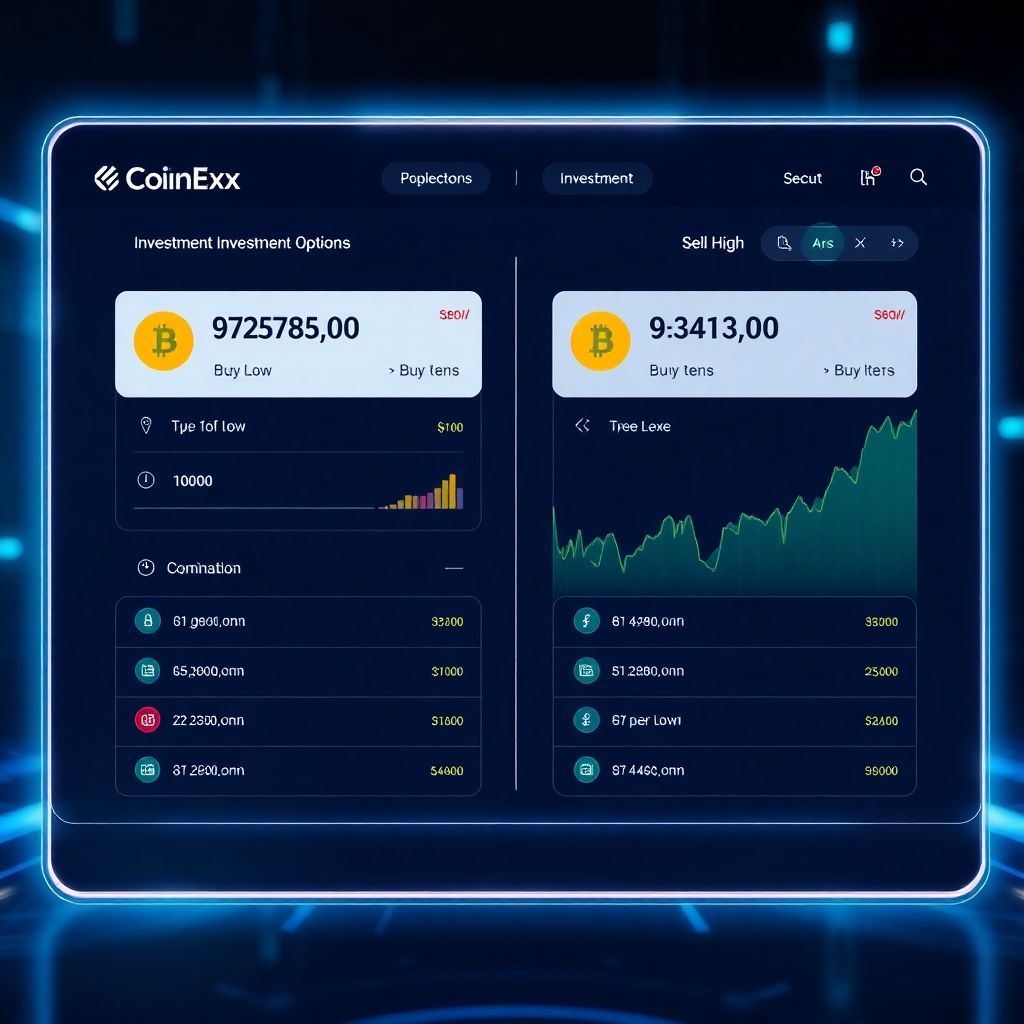
CoinEx is rolling out a new yield product called Dual Investment, designed to help crypto holders earn attractive returns even when markets are choppy or moving sideways. Instead of simply waiting for prices to trend, users can lock in a conditional “buy low” or “sell high” outcome while collecting a fixed yield over a set period.
At its core, Dual Investment is a structured product that lets an investor choose between two scenarios: buying an asset cheaper than it currently trades, or selling it at a higher price than the market is offering today. The twist is that, regardless of which condition they choose, investors earn a predefined yield during the investment period.
The mechanism is straightforward. A user deposits a cryptocurrency – typically USDT or a major coin like Bitcoin – then selects:
– a target price at which they are willing to buy or sell the asset, and
– a fixed investment duration.
Once those choices are locked in, the product runs until maturity. If, during the investment period, the market reaches or passes the chosen target level, the product is settled in the alternate asset. The investor receives their principal converted at the agreed price plus the promised yield. If the target is not hit by the end of the term, the investor simply gets back the original asset they deposited, along with the accrued interest.
A common use case is a “buy low” strategy for Bitcoin. For example, an investor might deposit 10,000 USDT and set a target Bitcoin price of 50,000 dollars when the current market price stands at 55,000. Suppose the product has a seven‑day term and advertises an annual percentage yield (APY) of 90%. Over that one-week period, this translates to roughly 173 dollars in interest.
If, at any time before or at maturity, Bitcoin’s price touches 50,000 or drops below, the Dual Investment product triggers: the 10,000 USDT is automatically converted into Bitcoin at the target price, and the investor receives the equivalent in BTC plus their 173 dollars’ worth of yield (also paid in BTC based on the settlement rate). If the market never pulls back to 50,000, the investor keeps their 10,000 USDT and still pockets the 173 dollars in interest, albeit without acquiring Bitcoin.
The same logic applies in reverse for investors who already hold Bitcoin and want to “sell high.” A Bitcoin holder can deposit BTC, choose a higher target price at which they are prepared to sell, and lock in a yield for the chosen period. If the market reaches that higher price, the position is closed by selling the BTC for USDT at the target level, and the investor receives the proceeds plus yield in USDT. If the price never climbs to that level, the user retains their Bitcoin, which is returned to them with the agreed interest.
This structure is particularly appealing in sideways markets, where prices fluctuate within a band without a clear uptrend or downtrend. Traditionally, traders in such conditions either sit on the sidelines or attempt short‑term trades with varying degrees of success. Dual Investment offers an alternative: holders can commit to conditional buying or selling levels while still generating yield from their idle assets during periods of consolidation.
CoinEx currently offers Dual Investment products for major trading pairs such as BTC/USDT and ETH/USDT. The platform advertises fixed APYs that can reach up to 400% for certain combinations of target prices and durations. Higher yields generally correspond to more aggressive target levels or shorter‑term, higher‑risk structures, appealing to users willing to accept a greater chance that their assets will be converted.
However, alongside the potential for high returns, CoinEx explicitly notes that Dual Investment is a non‑principal‑protected product. In other words, there is no guarantee you will receive back the same asset in the same value terms you initially deposited. Market volatility, sudden price movements, and other unpredictable events may result in outcomes that differ from simply holding the asset on the spot market. For example, if the market rallies sharply after your BTC is sold at a target level, you might miss out on further gains you could have captured by holding.
Another important constraint is liquidity. When funds are committed to a Dual Investment product, they are locked until the end of the selected period. Participants cannot redeem or withdraw their assets before maturity and settlement. This lock‑up means investors should avoid using funds they may need on short notice, as early exits are not available.
From a risk‑management perspective, Dual Investment is best suited to users who have clear views on price ranges and time horizons, and who are comfortable with having their assets automatically converted if the market hits their chosen levels. It effectively formalizes a limit‑order strategy – “I am happy to buy at X or sell at Y” – and layers a yield on top of that commitment.
For long‑term believers in Bitcoin or Ethereum, a “buy low” setup can be a way to accumulate more of the asset at a discount while still earning interest if the market never reaches the planned entry. Conversely, for those looking to trim positions at higher prices, a “sell high” strategy allows them to pre‑define an exit price and collect yield while waiting for that exit to materialize.
Investors should also understand how yield is calculated and what an advertised APY really means over shorter periods. A triple‑digit APY can look dramatic, but over a one‑week or two‑week term, it translates into a much smaller absolute return. For instance, a 400% APY over seven days corresponds to roughly 7.67% of the principal for that week – attractive, but not the same as quadrupling your money in a year on a simple basis. Accurate expectations help traders assess whether the reward justifies the risk.
Another nuance is settlement currency and valuation risk. When a “buy low” order is triggered, you end up holding more of the target coin (such as BTC or ETH). If the broader market then continues to fall, the value of your new holdings can decline, even though you acquired them at your chosen price. Similarly, when a “sell high” condition is met, your crypto is converted to stablecoins like USDT; if the market keeps climbing afterwards, you remain in stablecoins and no longer participate in the rally.
To use Dual Investment effectively, traders should align product parameters with their broader strategy. That includes:
– Setting realistic target prices that they would genuinely be comfortable buying or selling at.
– Choosing tenors (investment periods) that match their liquidity needs.
– Allocating only a portion of their portfolio, so that unexpected market moves do not overly impact their overall position.
In addition, it can be wise to diversify across multiple Dual Investment contracts with different strike levels and durations, instead of concentrating all capital in a single bet. This can smooth out outcomes and reduce the risk that one poorly timed target dominates performance.
Dual Investment can also play a role in income strategies for more advanced users. For example, a long‑term Bitcoin holder might allocate some BTC to “sell high” products at staggered target prices, effectively creating a ladder of conditional exits with yields attached. Similarly, stablecoin holders who intend to gradually enter the market might use “buy low” products at progressively lower prices, earning interest while patiently waiting for dips.
As with all yield‑generating instruments in crypto, due diligence remains crucial. Users should carefully read product terms, understand how settlement works in different market scenarios, and be clear about the risks of non‑principal protection. Dual Investment is not a simple savings account; it is a structured product tied closely to price movements in volatile assets.
CoinEx’s introduction of Dual Investment reflects a broader trend in the digital asset space: exchanges and platforms are creating more sophisticated tools that blur the line between traditional derivatives, yield products, and spot trading strategies. For traders who understand the mechanics and risks, these tools can unlock additional ways to earn from their holdings. For those unfamiliar with such structures, however, starting with small allocations and a conservative approach is generally the most prudent path.
This product is intended for educational and informational purposes rather than as a recommendation. Anyone considering Dual Investment or similar offerings should independently evaluate their financial goals, risk tolerance, and market outlook before committing funds.