
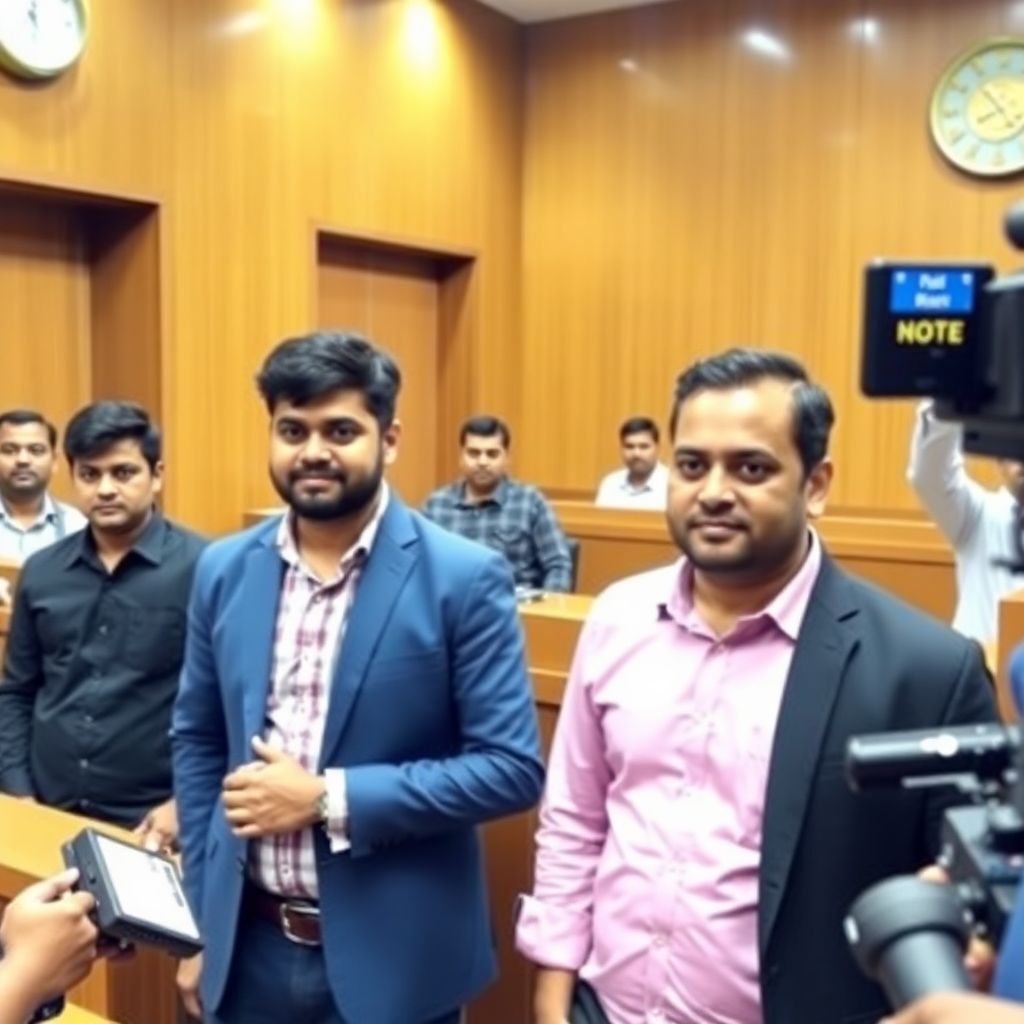
CoinDCX co-founders secure bail as court sees no case in fake platform fraud
CoinDCX co-founders Sumit Surendra Gupta and Niraj Ashok Khandelwal have been granted bail by a magistrate court in Thane, India, in connection with a cheating complaint involving a fraudulent trading platform that allegedly impersonated the crypto exchange.
The case revolved around a fake platform that presented itself as CoinDCX and was allegedly used to defraud an investor of 7.1 million Indian rupees (approximately 71 lakh). Despite the serious allegations, the court found that the evidence did not establish even a basic, initial case against the two founders.
Court finds no prima facie case against founders
In a common order dated March 23, the magistrate court held that the available material on record failed to show a prima facie case implicating Gupta and Khandelwal. This legal standard refers to whether there is enough evidence at first glance to proceed against an accused person; in this instance, the court concluded that threshold had not been met.
The court also noted that the investigating officer explicitly stated he had “no objection” to the release of the co-founders on bail. Additionally, the order emphasized that both Gupta and Khandelwal were not present in Mumbra at the time the alleged offence was committed, a point that further weakened the direct link between them and the incident.
Investor admits others impersonated the founders
The case began when an investor filed a complaint claiming he had been cheated in a deal he believed was associated with CoinDCX. The co-founders were detained for questioning on a Saturday and remained in custody over the weekend, pending the hearing of their bail applications.
During the proceedings, the court recorded a significant admission by the informant (the complainant). It noted that “some other person by representing as accused cheated the informant,” and that the informant had acknowledged this fact before the court. In other words, the complainant conceded that individuals other than Gupta and Khandelwal had posed as them or as authorized representatives of CoinDCX.
This admission became a central element of the bail order, effectively shifting the focus away from the CoinDCX founders and toward the alleged impersonators who executed the fraud.
Fake lookalike website at the heart of the scam
In a March 24 statement on X, CoinDCX said the legal process confirmed that the case was one of third-party impersonation. According to the company, the fraud was carried out through a lookalike website, “coindcx.pro,” which mimicked the branding of the exchange but had no connection with its official operations or infrastructure.
By leveraging a nearly identical domain name and likely similar user interface, the fake platform appears to have convinced the victim that they were dealing with the legitimate CoinDCX exchange. This kind of scheme is typical of phishing and brand impersonation attacks, where fraudsters rely on subtle differences in domain names and visual design to trick users.
Affidavit confirms repayment and misidentification
The magistrate also referred to an affidavit submitted by the informant, which proved decisive in shaping the outcome. In that affidavit, the informant stated that another accused individual, identified as Rana, had repaid the money that had been lost. The informant further clarified that the CoinDCX co-founders were not the people he had met at a café in Kausa Mumbra, where the disputed transaction took place.
The court concluded that the matter had been “amicably settled” between the informant and the main accused. This settlement, combined with the acknowledgement of misidentification and the fact of repayment, led the court to find no reasonable likelihood that Gupta or Khandelwal would interfere with witnesses or tamper with evidence if granted bail.
Bail terms and ongoing obligations
Both Gupta and Khandelwal were released on bail against a bond of 50,000 Indian rupees each. As part of the bail conditions, the founders are required to cooperate fully with the ongoing investigation and any future trial proceedings. They remain subject to the legal process, even as the court’s observations significantly reduce the immediate legal pressure on them.
While the bail order is a relief for the co-founders, it does not automatically amount to a complete closure of the case. Investigators are expected to continue tracing the activities of the other accused individuals linked to the fake platform and to determine whether any broader criminal network or organized scheme was involved.
CoinDCX warns of rising phishing and impersonation scams
CoinDCX later said the incident highlights a broader surge in phishing, impersonation, and domain-spoofing scams across India’s financial and crypto markets. The company urged users to exercise extra caution when accessing trading platforms, always verify website addresses, and rely only on official communication channels and apps.
The exchange emphasized that legitimate platforms will not ask users to transfer funds to personal bank accounts, conduct deals in cafés or informal setups, or bypass standard onboarding and verification procedures. Any such requests, it warned, should be treated as immediate red flags.
A snapshot of wider risks in India’s crypto ecosystem
The case underscores how fast-growing interest in cryptocurrencies in India has created fertile ground not only for innovation but also for fraud. Many new investors are still unfamiliar with basic security practices such as checking SSL certificates, verifying domain names, and confirming whether apps are from verified publishers.
At the same time, the regulatory environment for digital assets in India remains in flux. While authorities have taken steps toward taxation and anti-money laundering compliance, there is still no comprehensive, dedicated crypto law. This legal ambiguity can leave room for scammers to exploit gaps in enforcement and public understanding, often by using the names of well-known exchanges to gain trust.
Legal nuance: bail vs. exoneration
The Thane court’s order is an important reminder that bail decisions are about whether an accused should remain in custody during investigation or trial, not about ultimate guilt or innocence. By ruling that no prima facie case exists at this stage, the court is essentially saying that, based on current evidence, the threshold to continue detaining the founders is not met.
However, the investigation technically remains open. If new evidence emerges, prosecutors could attempt to revive claims or pursue other angles. For now, the court’s findings strongly favor the narrative that Gupta and Khandelwal were wrongly pulled into a dispute stemming from a third-party scam.
How fake platforms typically operate
Cases like this often follow a similar pattern:
1. Domain mimicry: Scammers register a domain almost identical to a popular exchange, changing only a small detail-such as an extra letter, a different top-level domain, or a subtle misspelling.
2. Copycat design: They replicate branding elements, logos, and color schemes so users feel they are on an official site.
3. Social engineering: Victims may be contacted via phone, messaging apps, or email by individuals claiming to be “official representatives,” offering special investment deals or guaranteed returns.
4. Off-platform dealings: Transactions are steered away from the real exchange’s infrastructure, often into bank transfers, stablecoins sent to private wallets, or cash deals at physical locations.
5. Exit and disappearance: Once funds are received, the scammers either shut the fake site, change domains, or simply stop responding.
The CoinDCX impersonation case, involving meetings in a café and a lookalike site, aligns closely with this pattern.
Practical steps users can take to stay safe
For traders and investors, the incident serves as a practical checklist of what to do before depositing funds on any platform:
– Double-check the domain: Type the URL manually into the browser and bookmark it. Avoid clicking on links from unsolicited messages.
– Check for minor variations: Look for extra characters, unusual domain endings, or subtle spelling errors.
– Use official apps only: Download mobile apps from official app stores and verify publisher details.
– Beware of private deals: Treat any offer that involves meeting in person, sending money to an individual, or bypassing normal account processes as suspicious.
– Enable security features: Use two-factor authentication, strong unique passwords, and security alerts where available.
– Verify contact channels: Compare phone numbers and email addresses with those listed in official company materials.
Such habits do not guarantee safety but significantly reduce the risk of falling victim to impersonation schemes.
Industry implications and reputational risk
Even when a company is not directly involved in a scam, brand impersonation can seriously damage its reputation. Investors and the public often struggle to differentiate between the legitimate entity and fraudulent lookalikes, especially in fast-moving sectors like crypto.
For CoinDCX, this case highlights the importance of constant brand monitoring, proactive user education, and visible security communication. Exchanges increasingly find themselves not only building trading infrastructure but also acting as educators and frontline defenders against social engineering attacks.
Growing need for coordinated response
Incidents of this kind point to the need for more coordinated action among exchanges, cybersecurity firms, and regulators in India. Quick domain takedowns, shared blacklists of known phishing sites, and streamlined reporting mechanisms can help reduce the window of time during which scammers can operate.
At the policy level, clearer legal frameworks for digital asset platforms, combined with strong enforcement against impersonation and online fraud, could deter similar schemes. Public awareness campaigns tailored to first-time investors could also play a role in reducing the number of victims.
Looking ahead
With bail granted and the court explicitly recognizing the role of third-party impersonators, the immediate pressure on CoinDCX’s leadership has eased. The focus of the case is now squarely on the individuals who allegedly ran the fake platform and orchestrated the fraud.
For the broader crypto sector in India, the episode serves as a cautionary tale: rapid growth and increased adoption must be matched by rigorous user education, robust security practices, and clear legal safeguards. Without them, even reputable platforms risk being caught in the fallout from scams they did not create-but are forced to answer for in court and in public opinion.