
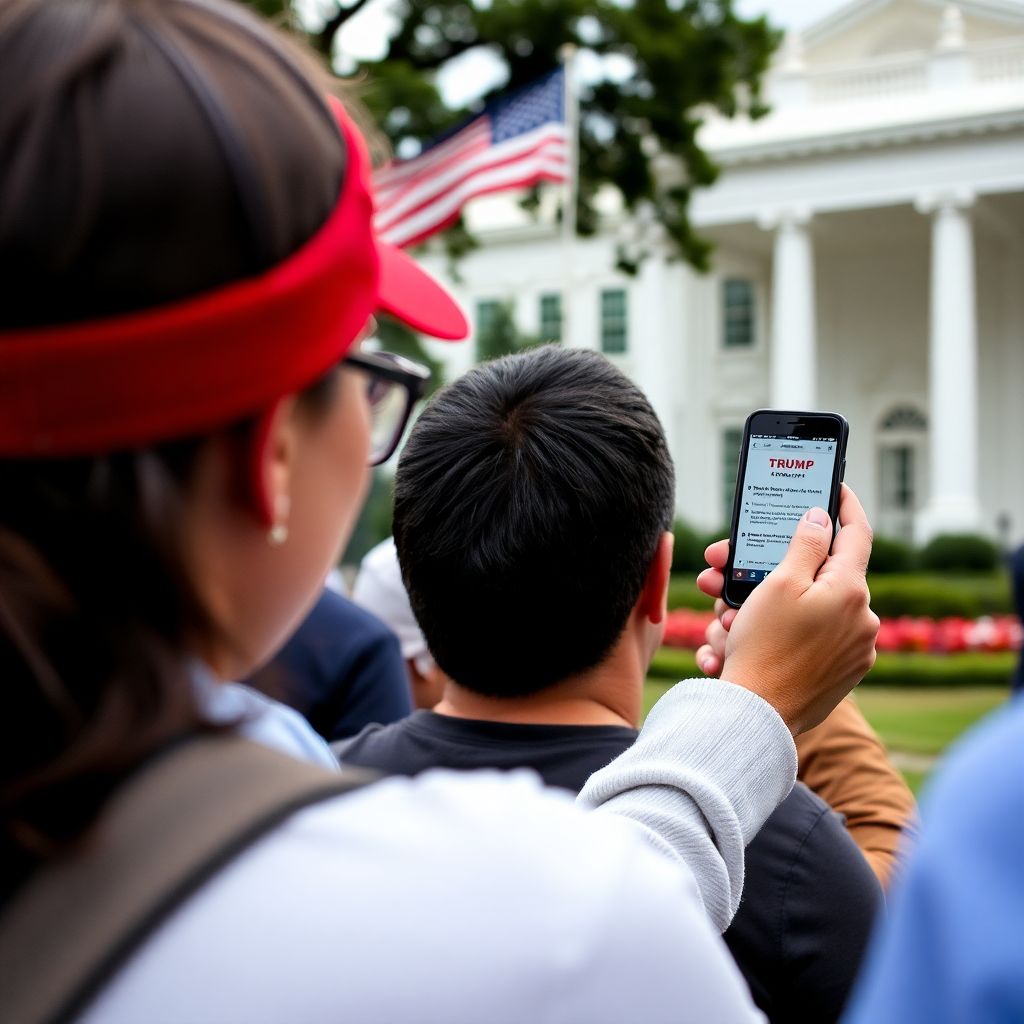
White House unveils official app with real-time policy updates, curated content and ICE tip channel
The White House has rolled out a new mobile app designed to give supporters and observers a direct line to President Donald Trump’s second-term agenda, offering administration updates, curated news, multimedia content and even a pathway to submit tips to U.S. Immigration and Customs Enforcement.
According to the administration, the app is intended to deliver information “straight from the source, no filter,” positioning itself as an unmediated alternative to traditional media coverage. After several short teaser clips on official social channels hinted that “something” was about to launch, the app went live on Friday with the promise of breaking news alerts, live video, a media library and tools for sending feedback to the White House.
Once installed, users are greeted with multiple tabs that organize content into news, livestreams, social feeds and photo galleries. Rather than operating as a fully independent platform, much of the material replicates or repackages existing content already available on the White House website. Policy pages, lists of achievements and highlight reels of the administration’s record all appear within the app’s interface, pointing users back to official government pages.
A prominent feature is the curated news section, which surfaces selected coverage that aligns with Trump’s policy priorities and narrative about his time in office. Instead of offering a broad cross-section of reporting, this area emphasizes favorable stories, administration talking points and articles that underscore key themes such as border security, economic performance and foreign investment.
The app also introduces a “Get in Touch” area within its social section. Here, users can find multiple options to interact with the administration, including a channel to send tips directly to U.S. Immigration and Customs Enforcement via the agency’s official form. The same menu offers shortcuts to text the president, contact the White House and sign up for email updates, extending existing communication channels into a single mobile hub.
Another notable component is an “affordability” page built around handpicked consumer prices. The app highlights a narrow basket of grocery items and other everyday goods to argue that some costs have remained stable or declined. Critics have pointed out that this presentation omits broader categories such as energy, rent and other staples that have risen in price, potentially giving users a selective picture of inflation and cost-of-living trends. A separate border-focused section goes even further, prominently displaying a claim that “0 Illegals Released in Past 10 Months,” reinforcing the administration’s hardline immigration messaging.
The White House has marketed the app as a place to watch speeches, briefings and events as they happen. However, at launch, some promised functionality appeared incomplete. Trump’s Friday remarks to farmers at the White House, for example, were reportedly unavailable in real time on the app during the afternoon event, raising questions about how consistently live content will be delivered and whether the technical infrastructure is ready for heavy, simultaneous viewership.
The timing of the rollout is closely tied to the administration’s broader effort to reframe the debate over inflation and rising costs. While many households continue to grapple with higher prices, officials have repeatedly described recent spikes as temporary, attributing them to “short-term volatility” rather than long-term structural problems. Within the app, the emphasis falls on selective price declines, business expansions and new investment pledges from foreign governments and large corporations, aiming to paint a more optimistic picture of the economy than some independent data might suggest.
Beyond its immediate content, the app reflects a broader shift in how modern administrations manage communication and public perception. By pushing out notifications, videos and curated articles directly to users’ phones, the White House can bypass traditional gatekeepers, set its own news agenda and quickly mobilize supporters around key issues or controversies. At the same time, this raises concerns about echo chambers, as users who primarily rely on the app for political information may receive a heavily filtered version of events that reinforces pre-existing views.
The inclusion of an ICE tip submission path is likely to be among the app’s most controversial features. Supporters may see it as a streamlined way to assist immigration enforcement and report suspected violations. Critics, however, warn it could encourage over-reporting, racial profiling or abuse of the system, especially if people use the feature to lodge unfounded complaints against neighbors or co-workers. Because the app centralizes this tool in a section branded as social engagement, it blurs the line between civic participation and active involvement in law enforcement activities.
Privacy and data collection are also important angles for potential users to consider. While the administration has not publicized detailed technical specifications, apps of this kind commonly track usage patterns, engagement with specific content, and preferences revealed by which tabs or features users access most. That data can be used to refine messaging, test political narratives and segment audiences. In the context of a presidential administration, this raises ongoing questions about how user information is stored, who can access it and how clearly those practices are disclosed.
Historically, modern presidents have experimented with digital tools to stay connected with the public, from email lists and SMS blasts to social media campaigns and livestreamed town halls. What distinguishes this new app is the degree of integration: official statements, campaign-style messaging, curated news, affordability talking points and enforcement-related tools sit side by side in a single environment under the White House brand. This fusion of governance communication and political storytelling underscores how blurred the boundaries between official duties and campaigning have become.
From a user-experience standpoint, early impressions suggest the app functions more as a centralized wrapper for existing content than a fully original platform. That approach can make navigation straightforward for newcomers, but it may disappoint users expecting exclusive materials, interactive features or deeper transparency tools such as searchable archives, data dashboards or policy explainers with multiple viewpoints. Future updates could determine whether the app remains a simple distribution channel or evolves into a more sophisticated civic-engagement tool.
In the broader media landscape, the launch underscores a continuing trend: political leaders are increasingly building their own direct-to-audience ecosystems rather than relying on independent outlets to interpret and distribute their messages. For supporters, the appeal is speed and perceived authenticity. For journalists, researchers and skeptics, the app offers a window into what the administration chooses to emphasize, what it leaves out and how it wants its record to be remembered.
Ultimately, the app’s impact will depend on adoption, regular content updates and the administration’s willingness to address gaps or criticisms, such as incomplete live coverage or selective economic data. As more users download and test the platform, its role-as a straightforward information tool, a political messaging machine, or a bit of both-will become clearer.