
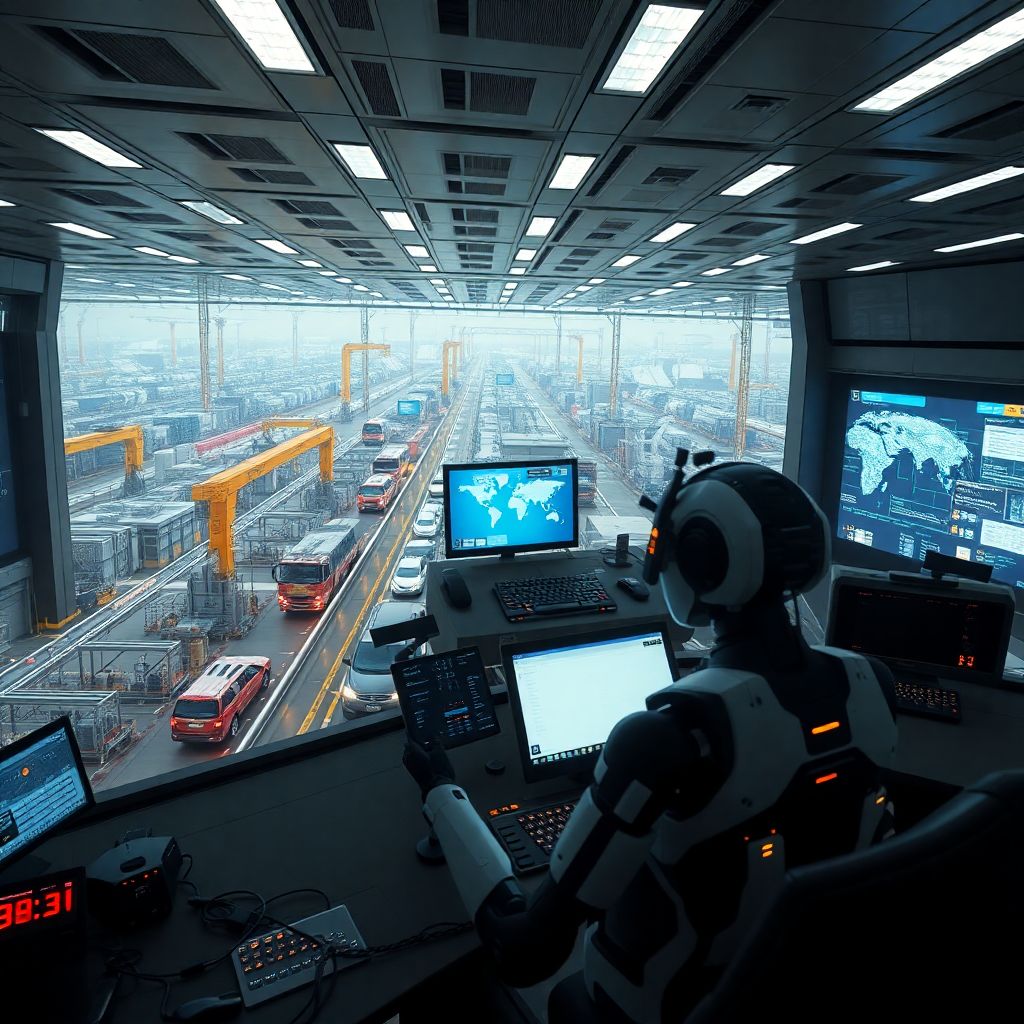
Japan’s corporate heavyweights have decided that the real AI race won’t be won in chat windows.
SoftBank, Sony Group, Honda, and NEC have joined forces to create a new company with a singular ambition: develop a trillion-parameter AI model designed not for conversation, but for controlling the physical world-robots, vehicles, factories, and machines. The project is underpinned by around $6.7 billion in backing from the Japanese government, signaling that this is not just a corporate experiment, but part of a national industrial strategy.
Instead of building a rival to ChatGPT or other text-based assistants, the consortium is targeting what many researchers now call “Physical AI.” The vision: AI systems that don’t just understand language, but can operate robot arms, steer autonomous cars, coordinate warehouse fleets, and optimize entire production lines in real time.
Japan believes it is uniquely positioned for this pivot. For decades, the country has led in robotics, precision manufacturing, and industrial automation-areas where the ability to move, manipulate, and control is at least as important as the ability to generate text. In that context, a trillion-parameter model becomes less a talking brain and more a universal control layer for machines.
Who’s doing what in this alliance
While the companies share a common goal, they’re not playing identical roles:
– SoftBank is expected to be one of the central drivers of AI development and infrastructure. With its history of big technology bets and ownership stakes in telecoms and cloud infrastructure, SoftBank is positioned to provide both funding power and computing resources.
– NEC, with its long history in computing, telecoms, and AI research, is set to co-lead the core model design and training. Its expertise in enterprise systems, security, and public infrastructure makes it a natural partner for building robust, large-scale AI platforms.
– Honda plans to apply the AI in autonomous driving and mobility. For a carmaker under pressure to move beyond traditional combustion engines and maintain global competitiveness, an in-house path to advanced autonomy is strategically crucial.
– Sony brings its strengths in robotics, sensors, and gaming hardware. From entertainment robots to sophisticated image sensors used worldwide, Sony understands how to build machines that perceive and act in complex environments. Its gaming division also offers deep expertise in real-time simulation, physics engines, and interactive environments-ideal sandboxes for training physical AI.
This division of labor underscores what makes the project distinctive: it is not about building a generic, text-first chatbot and then searching for use cases. It is about starting from the hardware and industrial applications and working backward to the AI model that can power them.
Why a trillion-parameter model for machines?
Trillion-parameter models have become shorthand for cutting-edge AI: massive neural networks that can capture complex patterns across huge datasets. Until now, most of the public conversation has centered on language models-systems that write code, summarize documents, or answer questions.
But for physical systems-robots, vehicles, drones, industrial arms-the problem is at least as complex, just in different dimensions:
– They must interpret high-dimensional sensor data: video from cameras, LiDAR, radar, audio, force sensors, and more.
– They have to make decisions in real time, sometimes in safety-critical environments.
– They must learn to generalize across physical contexts: different lighting conditions, surfaces, weather, layouts, and human behaviors.
– They need to coordinate multiple subsystems-perception, planning, motion control-into coherent action.
A large, multi-modal model with trillions of parameters offers a way to unify these tasks in a single brain-like system, rather than stitching together dozens of narrow, brittle algorithms. The same core model that helps a car detect pedestrians could, in theory, also control a warehouse robot navigating aisles or a robotic arm assembling electronics-provided it is trained on rich, diverse physical data.
Japan’s strategic pivot: from office work to factory floors
Much of the global AI narrative has focused on knowledge workers: automating writing, coding, customer service, and design. Japan’s strategy implicitly asks a different question: what if the biggest productivity gains come from machines, not keyboards?
Japan has a shrinking, aging population and a longstanding dependence on exports of high-end manufactured goods. That combination creates both a pressure and an opportunity:
– Labor shortages in logistics, caregiving, and manufacturing increase the demand for automation.
– High-value manufacturing requires precision and reliability that advanced robotics can deliver.
– Deep industrial know-how means Japan can embed AI into real-world production faster than regions with less mature manufacturing ecosystems.
By focusing on Physical AI, Japanese leaders are betting that the next wave of global competitiveness will come from factories and robots enhanced by powerful AI controllers, not just from software platforms headquartered in Silicon Valley.
Not another ChatGPT clone
The consortium’s messaging is clear: this is not about catching up in the chatbot race. Japan is not trying to displace existing leaders in general-purpose text models. Instead, it’s carving out a differentiated space where its existing strengths actually matter.
This approach carries several advantages:
– Less direct competition with U.S. and Chinese AI giants that have already sunk billions into language models and online platforms.
– Closer alignment with domestic industry needs: automakers, electronics manufacturers, logistics firms, and infrastructure providers.
– Greater defensibility: expertise in sensors, robotics, manufacturing, and real-world deployment is harder to copy than cloud-based APIs.
In other words, while others focus on AI that lives on screens, Japan wants AI that lives in factories, cars, and robots.
Physical AI: what it might actually look like
The term “Physical AI” can sound abstract, but its applications are concrete. A trillion-parameter model in this context might:
– Coordinate an entire factory: optimizing robot movements, conveyor belt speeds, energy usage, and inspection routines in real time, reacting to delays or quality issues before they become costly.
– Power autonomous vehicles: not just driving on highways, but handling dense urban traffic, mixed road conditions, and complex interactions with pedestrians and cyclists.
– Run logistics centers: orchestrating fleets of mobile robots, sorting systems, and loading bays, while dynamically adjusting to surges in demand.
– Assist in healthcare and caregiving: enabling assistive robots that safely help patients move, fetch items, or monitor basic vital signs without constant human supervision.
– Enable consumer robots and devices: from home assistants that can actually manipulate household objects to entertainment robots that respond naturally to humans and their environment.
Crucially, such systems need not be “chatty.” They might communicate with operators and engineers through dashboards, alerts, and programming interfaces, but their main function is to observe, decide, and act in the physical world.
The role of simulation and gaming
Sony’s gaming heritage could become an important advantage. Training physical AI purely in the real world is slow, expensive, and potentially dangerous. That’s where high-fidelity simulation comes in.
Game engines and simulation platforms can:
– Create rich virtual environments to train robots and vehicles before they ever touch a real road or assembly line.
– Model physics, collisions, and constraints with increasing realism, helping AI learn nuanced behaviors.
– Generate synthetic data at scale, covering rare or dangerous scenarios-like near-collisions, equipment failures, or extreme weather-without real-world risk.
Sony already builds hardware and software optimized for real-time 3D worlds. Those same capabilities can be adapted to simulate warehouses, factories, urban streets, and even hospitals, feeding invaluable training data into the trillion-parameter brain.
Government backing and national resilience
The roughly $6.7 billion in government support is not just about funding research. It also reflects geopolitical concerns and a desire for technological sovereignty.
Large AI models require:
– Massive compute infrastructure: data centers, accelerators, and high-speed networks.
– Secure access to data: industrial, transportation, and sensor data that are often sensitive.
– Long-term investment cycles: beyond what a single corporation might be willing to shoulder alone.
By supporting a domestic AI and robotics ecosystem, Japan is seeking to reduce dependence on foreign AI providers and chipmakers, ensure that critical industrial capabilities remain under local control, and position itself as a leading exporter of AI-driven machinery and systems.
Challenges: hardware, data, and global competition
The ambition is enormous, and so are the obstacles.
– Compute and chips: Training a trillion-parameter model demands cutting-edge accelerators and power-hungry data centers. Japan will need to navigate a hardware landscape dominated by a small number of global suppliers and subject to geopolitical constraints.
– Data collection: Physical AI needs diverse, high-quality data from factories, roads, robots, and sensors. Collecting, cleaning, and labeling that data-while preserving privacy and trade secrets-is a complex undertaking.
– Integration with legacy systems: Many Japanese factories run on a patchwork of older machines, custom software, and proprietary standards. Plugging a cutting-edge AI brain into that environment will require painstaking engineering and close collaboration with industrial partners.
– Global competition: The same trend toward Physical AI is being explored elsewhere-in autonomous driving firms, industrial automation companies, and robotics startups worldwide. Japan must move quickly enough to turn its theoretical advantage into real products and standards.
What this means for Japan’s industrial future
If the project succeeds, it could redefine Japan’s role in the global economy. Rather than primarily exporting cars, electronics, and machinery as standalone hardware, Japan could export integrated AI-powered systems:
– “Smart factories in a box” for emerging economies.
– Turnkey autonomous logistics solutions for ports and warehouses.
– Modular robotic platforms for healthcare, retail, and construction.
– AI control systems that other manufacturers license and embed in their own equipment.
This would shift Japan up the value chain-from hardware provider to system orchestrator-giving it a bigger slice of the long-term economic upside from AI-driven automation.
Why the world should pay attention
The move by SoftBank, Sony, Honda, and NEC is more than a national initiative. It crystallizes a broader shift in the AI conversation:
– From screens to sensors and actuators.
– From emails and documents to robots and production lines.
– From productivity tools for office workers to autonomy and intelligence for machines.
As language models continue to evolve, a parallel revolution is beginning in the physical world. Japan is betting that its future lies not in trying to build the most talkative AI, but in building the one that can most effectively see, move, and act.
In that sense, the trillion-parameter model envisioned by Japan’s new AI alliance is not here to chat at all. Its real job will be to quietly run the engines of the next industrial era.