
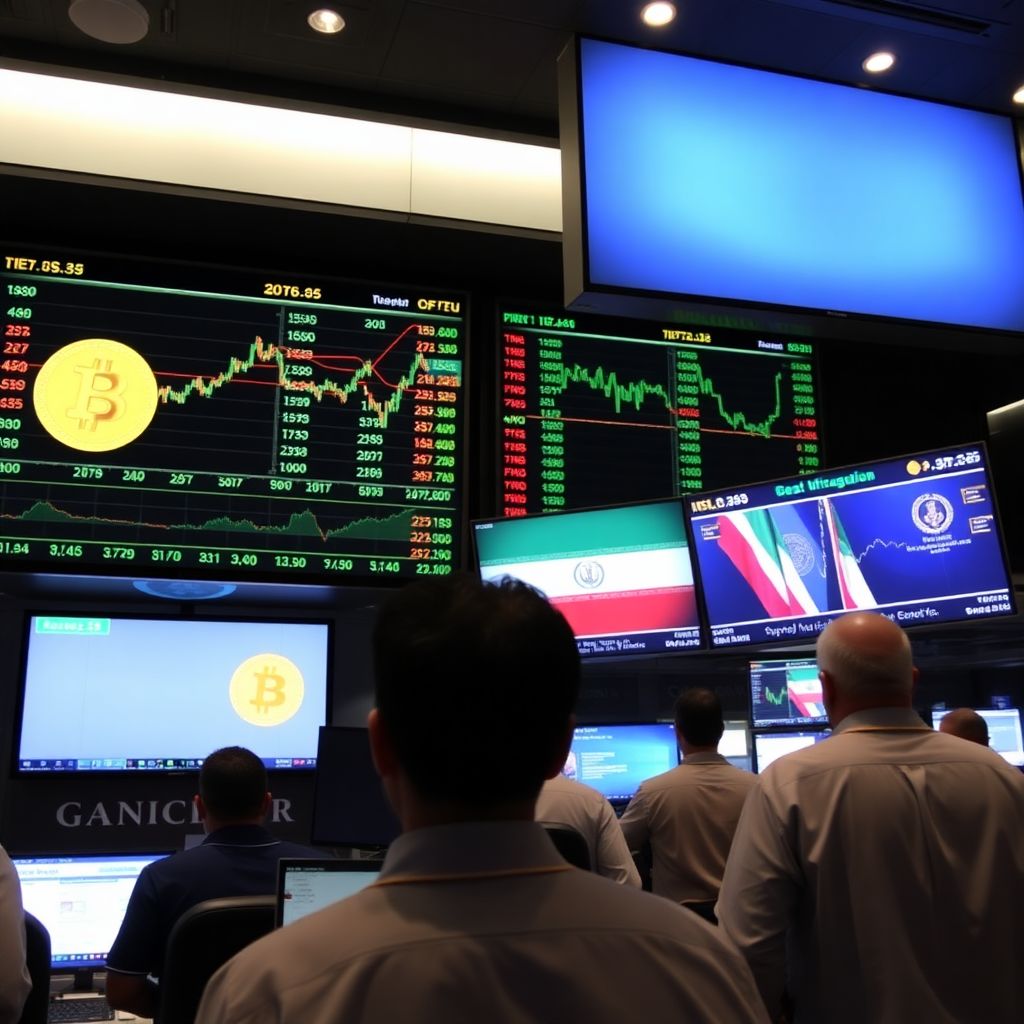
Bitcoin price reclaims $76K as traders weigh fragile U.S.-Iran peace prospects
Bitcoin climbed back above the $76,000 threshold on Tuesday, as buyers stepped in following a brief pullback and global markets fixated on a possible peace agreement between the United States and Iran. The prospect of a breakthrough – or a breakdown – in negotiations is shaping near‑term expectations for the world’s largest cryptocurrency, with traders eyeing both a run toward $80,000 and the risk of a sharp correction.
According to intraday market data, Bitcoin (BTC) advanced roughly 2% on Tuesday, reaching a session high near $76,483 before consolidating around $76,150 by press time. The move followed aggressive dip‑buying below $74,000 on Monday, a level that attracted demand as geopolitical headlines injected new volatility into risk assets.
Geopolitics take center stage for BTC
The latest price swing comes as investors closely monitor reports around an emergency peace summit in Islamabad, where the U.S. has sought direct engagement with Iran. Market sentiment wavered after reports suggested that Iranian officials might skip the talks, while the U.S. continues to enforce a naval blockade on Iranian shipping through the Strait of Hormuz – a critical chokepoint for global energy flows.
Tensions escalated further on Monday after U.S. forces intercepted and seized an Iranian vessel allegedly transporting military equipment. In response, Iran launched targeted missile strikes on regional naval assets, deepening concerns that the conflict could spill over and disrupt broader security in the region.
Diplomatic efforts to de‑escalate remain fragile. Tehran has stressed that it will not accept negotiations conducted under pressure or in the shadow of constant military threats. That hard line keeps markets on edge: a credible path to de‑escalation could support risk appetite, while any sign of talks collapsing could trigger a flight to safety and renewed turbulence in both traditional and digital assets.
Negotiation deadline extended, but patience wears thin
U.S. President Donald Trump had initially set Tuesday as a final deadline for reaching a framework agreement with Iran. However, amid ongoing back‑channel discussions and pressure from allies to avoid a wider regional conflict, the White House has reportedly extended that deadline to Wednesday evening, Washington time.
Despite Trump’s repeated public claims that Iran is close to accepting a deal, signals from Tehran tell a different story. Iranian officials have indicated they are willing to move forward only if their own red lines and conditions are fully addressed. This divergence between political messaging and on‑the‑ground reality adds another layer of uncertainty for global markets already fatigued by months of tension.
Previously, Iran had put forward a list of demands as prerequisites for any final agreement. These included multi‑billion‑dollar reparations for war‑related damage to civilian infrastructure and a guarantee that it would be allowed to continue uranium enrichment for what it describes as peaceful energy generation. Washington, however, has rejected any scenario in which Iran retains nuclear capabilities, with Trump calling this a “non‑negotiable red line.”
With the U.S. signaling that further extensions are unlikely beyond the current Wednesday deadline, traders are bracing for heightened volatility in the hours and days ahead, both in energy markets and in high‑beta assets such as cryptocurrencies.
Strait of Hormuz disruption rattles energy markets
The conflict has already had tangible economic consequences. The Strait of Hormuz, one of the world’s most important maritime corridors for oil shipments, has been effectively blocked for more than ten days. This disruption has choked off a significant portion of global energy supplies, forcing importers to draw down inventories and explore alternative routes and suppliers.
Economists warn that a prolonged stalemate could trigger a broader economic slowdown. Higher logistics costs, increased insurance premiums on shipping, and uncertainty about long‑term supply have all contributed to heightened anxiety among policymakers and investors. Some analysts are even discussing the possibility that a drawn‑out conflict could tip the global economy toward recession if energy flows are not restored.
Curiously, despite the ongoing blockade, oil prices eased on Tuesday, offering some relief to energy‑dependent economies. Benchmark WTI crude slipped back to about $86 per barrel, while Brent crude fell below $95. Traders cited expectations of a possible diplomatic breakthrough, as well as demand concerns linked to weaker industrial data in several major economies.
Bitcoin benefits from risk rotation as oil and gold retreat
Bitcoin appears to be one of the beneficiaries of this shifting macro backdrop. The pullback in crude, coupled with a notable drop in gold prices, has coincided with renewed inflows into BTC. Some market participants interpret this as a rotation of capital from traditional safe‑haven assets into what many see as a high‑beta, high‑conviction store of value with a distinct geopolitical hedge narrative.
Gold, which often rallies during crises, has notably underperformed in this latest phase of tension. As bullion prices fell, Bitcoin’s rebound above $76,000 suggested that a subset of investors may be re‑evaluating how they diversify geopolitical risk. For these investors, Bitcoin’s fixed supply and global, censorship‑resistant nature remain attractive traits, especially when trust in state actors and legacy financial systems is under strain.
From a sentiment perspective, the swift recovery from below $74,000 reinforces the perception that investors continue to “buy the dip” in BTC, confident that structural drivers such as institutional adoption, spot ETF flows, and post‑halving supply dynamics will support higher prices over the medium term.
Key price levels: $80K upside vs. $75K downside
Short‑term, however, Bitcoin’s trajectory appears closely tethered to the outcome of the U.S.-Iran talks. Many derivatives traders and technical analysts are framing the next 24-72 hours as a pivotal window, with clear scenarios on both sides of the ledger.
If negotiators manage to strike even a preliminary deal, easing fears of a broader military confrontation and restoring the flow of oil through the Strait of Hormuz, risk assets could enjoy a relief rally. In that environment, Bitcoin bulls are likely to target the $80,000 region as the next upside objective, particularly if improved macro sentiment coincides with positive on‑chain and ETF inflow data.
Conversely, if Iran continues to reject the proposed terms or if talks collapse outright, markets may pivot quickly to a risk‑off stance. For Bitcoin, a failure to hold the $75,000 zone – widely viewed as a major psychological and technical support – could open the door to deeper losses. A breakdown below that level might trigger forced liquidations in over‑leveraged futures positions and spill over into altcoins, potentially aggravating a broader market sell‑off.
How professional traders are positioning
Derivatives desks are already adapting to the binary nature of the current environment. Options markets have seen rising implied volatility around the negotiation deadline, with traders favoring strategies that benefit from large price swings in either direction rather than betting exclusively on a bullish or bearish outcome.
Some institutional desks are reportedly implementing “straddle” and “strangle” strategies on BTC options, expressing a view that the magnitude of the move – not the direction – will be the main profit driver. At the same time, futures funding rates have cooled from recent extremes, suggesting that overly aggressive long positioning has been partially flushed out, which can reduce the risk of a violent long squeeze if prices retreat.
Spot market flows also hint at caution. While there is clear demand on dips, large holders appear more inclined to wait for geopolitical clarity before making fresh, outsized allocations. This creates a relatively fragile equilibrium: Bitcoin can grind higher as long as no negative shock hits, but remains vulnerable if headlines turn sharply worse.
The macro narrative: BTC as hedge, risk asset, or both?
The current episode underscores an ongoing debate about Bitcoin’s role in global markets. On one hand, proponents argue that BTC acts as a hedge against geopolitical instability, fiat debasement, and capital controls. On the other, historical data shows that during acute crises, Bitcoin often trades more like a high‑beta risk asset, falling alongside equities as investors rush to cash and traditional safe havens.
The U.S.-Iran standoff captures this duality. Some investors are clearly using Bitcoin as an alternative store of value amid fears of a broader regional conflict. Yet at the same time, the asset’s sensitivity to broader risk sentiment – and its correlation with macro variables such as liquidity conditions and interest rate expectations – means that a severe global downturn could still drag prices lower, at least temporarily.
For now, the market appears to be threading the needle: pricing in enough fear to validate Bitcoin’s hedge narrative, but not so much that it triggers wholesale deleveraging across all risk assets.
What retail investors should watch in the coming days
For non‑professional traders, the coming days may be especially tricky. The mix of fast‑moving geopolitical developments and highly leveraged crypto markets can produce large, sudden price moves that are hard to navigate without a clear plan.
Key factors to monitor include:
– Official statements or leaks regarding the status of U.S.-Iran negotiations
– Any shift in the status of the Strait of Hormuz blockade
– Sudden spikes in oil prices, which may signal an escalation rather than a resolution
– Changes in Bitcoin derivatives metrics, such as funding rates and open interest
– Large on‑chain flows from long‑term holders or major entities that could indicate profit‑taking or panic
Given this backdrop, risk management becomes paramount. Position sizes, the use of stop‑loss orders, and a realistic understanding of one’s own risk tolerance are often more important than attempting to predict headlines.
Longer‑term implications for crypto markets
Beyond the immediate price action, the episode could have lasting effects on how institutional investors view Bitcoin. Each new geopolitical crisis that coincides with BTC resilience or renewed inflows tends to strengthen the perception of Bitcoin as a strategic macro asset rather than a speculative curiosity.
If a deal is reached and Bitcoin manages to hold or build on its gains, it may reinforce the narrative that BTC can thrive in an environment of shifting power dynamics and distrust in traditional systems. If, instead, a breakdown in talks leads to heavy selling, analysts will be watching how quickly the market stabilizes and whether long‑term holders step in to absorb supply.
In either case, the ongoing conflict and its economic repercussions serve as a reminder that Bitcoin no longer trades in isolation. Energy markets, geopolitics, monetary policy, and investor psychology are increasingly intertwined in shaping its price path.
Outlook: volatility ahead, direction undecided
As of now, Bitcoin sits near $76,000 with a cautiously bullish undertone, supported by dip‑buying, easing oil prices, and some rotation out of gold. Yet the market’s confidence remains conditional on what happens next in Washington and Tehran.
A credible peace framework could clear the way for an assault on the $80,000 level, accompanied by renewed optimism across the crypto complex. A collapse in talks, continued military escalation, or prolonged disruption in the Strait of Hormuz, however, could push BTC back below key supports and ignite a broader wave of de‑risking.
Market participants should prepare for heightened volatility in the very near term and remember that no outcome is guaranteed. All trading involves risk, and decisions should be made with careful consideration of personal financial circumstances and objectives.