
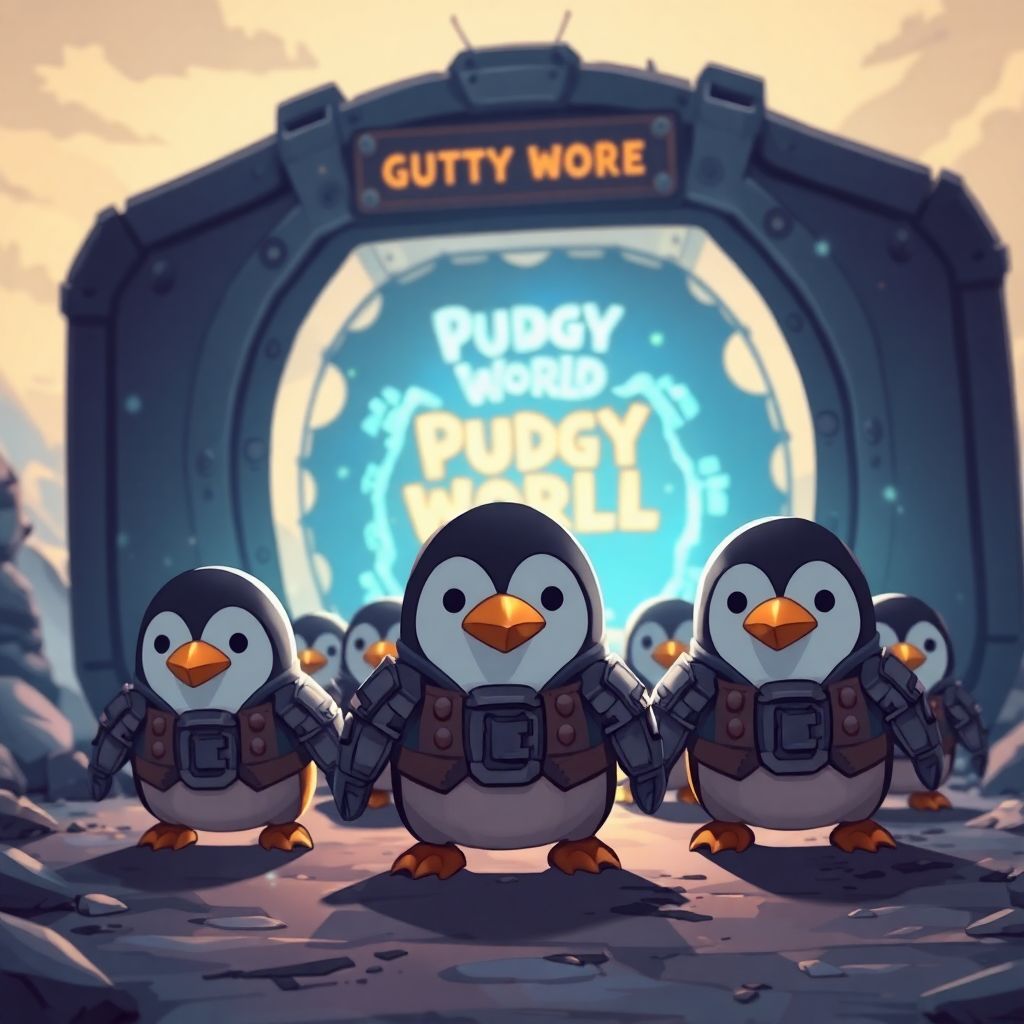
Pudgy Party, the mobile battle royale title set in the Pudgy Penguins universe, has been quietly discontinued less than a year after its global launch and removed from both iOS and Android app stores.
The shutdown was confirmed via the game’s official X account, where the team behind the Pudgy Penguins brand explained that the decision was driven by a strategic shift in priorities. Instead of spreading resources across multiple products, the company plans to concentrate its efforts on Pudgy World, its expanding digital experience built around the same IP.
According to the statement, Pudgy World is now positioned as the central pillar of the brand’s gaming strategy. The team described it as a rapidly growing project that offers one of the “most fun and novel web experiences” currently available, emphasizing that-unlike past collaborations-this title is fully owned and controlled in-house. That ownership, they wrote, gives them “everything we need to make it the flagship gaming product of the Pudgy Penguins universe.”
Pudgy Party itself was a colorful, fast-paced mobile game that translated the recognizable penguin characters into a multiplayer battle royale format. Co-developed with Mythical Games, the studio known for titles like FIFA Rivals and NFL Rivals, the game was designed to feel familiar to fans of social party games while still carrying the distinctive charm of the Pudgy Penguins brand.
Launched globally last August, Pudgy Party followed the formula popularized by titles like Fall Guys: groups of players competed through a series of chaotic mini-games and obstacle-filled courses, racing to be among the last remaining contestants. The sessions were short, social, and geared toward casual play, aligning with mobile gamers’ preference for quick, repeatable experiences.
Despite this accessible design and the strength of the underlying brand, the game’s lifecycle ended far sooner than typical for mobile live-service titles. There was no lengthy wind-down period or advance roadmap to a sunset; instead, the game was suddenly shut down and is now no longer available to download. Existing users effectively saw the door close on one of the key gaming extensions of the Pudgy Penguins IP in under a year.
The pivot to Pudgy World suggests that the team views a unified, deeply integrated digital environment as more strategically valuable than juggling multiple games that compete for attention, budget, and development resources. For a brand built around a strong core community and collectible culture, concentrating all interactive experiences into a single flagship product can make it easier to deliver consistent updates, narrative cohesion, and more ambitious features.
From a business perspective, maintaining a live mobile title like Pudgy Party is more than just keeping servers online. Successful mobile battle royale and party games require constant content drops, balance patches, event cycles, and marketing pushes to retain players in an intensely competitive environment. For a web3-native brand with limited bandwidth, spreading effort across multiple titles can dilute impact and slow progress on the most promising project.
In contrast, Pudgy World is framed as a long-term, evolving platform-something closer to an expanding digital ecosystem than a standalone game. While details of its full feature set vary over time, the team’s messaging clearly positions it as the primary destination where the Pudgy Penguins universe will grow, experiment, and interact with its audience. Owning the technology stack and IP outright gives them more flexibility to integrate web3 elements, experiment with digital ownership, and react quickly to user behavior.
For players who invested time or emotional attachment into Pudgy Party, the abrupt shutdown may feel jarring. Sudden closures are a recurring risk in the modern gaming landscape, especially for live-service and mobile titles whose economics can shift quickly. Without advance migration plans or in-game mechanisms to transition progress to another platform, users are often left with little more than memories and screenshots once a game goes dark.
At the same time, this move reflects a broader trend in web3 gaming: teams are increasingly consolidating around fewer but deeper products. Early experiments scattered across multiple small games are giving way to more ambitious, flagship experiences where digital assets, characters, and player identity can have longer lifespans. For brands like Pudgy Penguins, that means choosing where to invest: a lightweight mobile party game with limited extensibility, or a scalable digital world that can support more forms of engagement and monetization.
The collaboration with Mythical Games on Pudgy Party was notable, as it paired a crypto-native brand with an established game developer experienced in sports and competitive live titles. However, partnering with an external studio can introduce constraints around updates, revenue sharing, and long-term control. By contrast, Pudgy World being “wholly ours,” as the team put it, appears to be a central reason for the strategic shift: full ownership makes it easier to align game design, brand storytelling, and on-chain strategy without compromise.
In the larger context of NFT and blockchain gaming, Pudgy Party’s short lifespan highlights how experimental many of these projects still are. Teams are testing formats, platforms, and monetization models, and not all experiments will persist. The rapid rise and fall of certain games can be seen less as failure and more as iteration, as brands discover which experiences actually resonate and sustain engagement beyond an initial novelty phase.
For players and collectors following the Pudgy Penguins ecosystem, the key takeaway is where the brand itself is clearly signaling its future: Pudgy World. New features, narrative developments, and digital interactions are likely to concentrate there, rather than being fragmented across multiple side projects. Anyone interested in where this IP goes next-whether from a gaming, cultural, or web3 standpoint-will increasingly find that story unfolding inside that single, evolving environment.
Looking ahead, the Pudgy Penguins team will be judged less on the premature end of Pudgy Party and more on what they can build with a focused roadmap for Pudgy World. If they can successfully blend accessible gameplay, strong character-driven branding, and meaningful digital ownership, the decision to sunset a nearly new mobile game could ultimately be remembered as a necessary consolidation step rather than a misstep.
In the meantime, Pudgy Party will stand as a brief chapter in the brand’s history: a bold attempt to bring its penguin avatars into the crowded mobile battle royale space, cut short in favor of betting everything on a more ambitious, fully owned digital world.