
Alibaba Is Building Qwen‑Robot: A Software Stack for the Coming Robot Economy
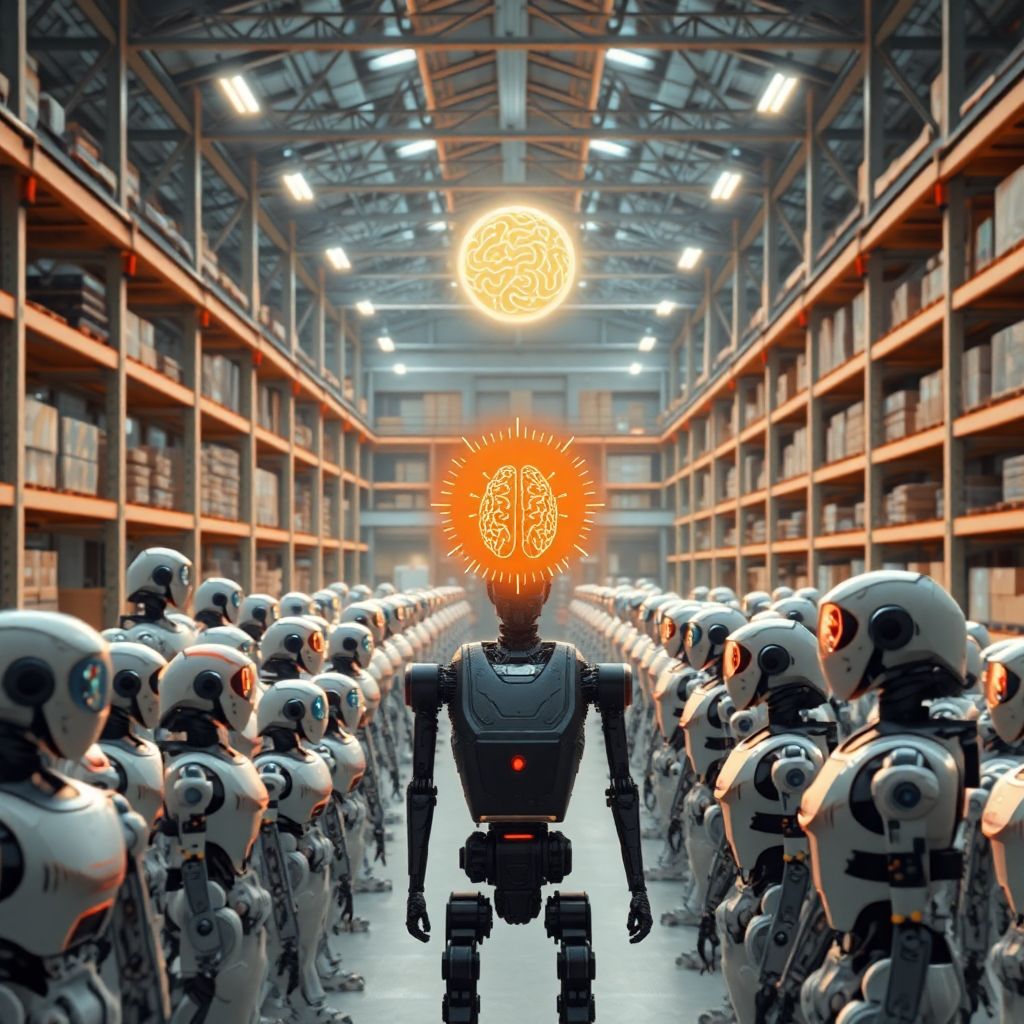
Alibaba is quietly positioning itself at the center of the next major computing shift: from screens to machines. Its Qwen research team has unveiled Qwen‑Robot, a three‑part “full stack for embodied intelligence” that aims to become for robots what Android became for smartphones-an operating layer that everyone builds on top of.
Instead of building humanoid hardware to compete with industrial arms and warehouse bots, Alibaba is targeting the software brain that will coordinate, train, and control them. If the bet pays off, Qwen‑Robot will be the layer that turns general‑purpose AI into practical, physical labor at industrial scale.
—
What Qwen‑Robot Actually Is
Qwen‑Robot is not a single model, but a suite of three tightly related foundation models, each responsible for a different pillar of robotic capability:
– Qwen‑RobotNav – navigation and mobility
– Qwen‑RobotManip – manipulation and interaction with objects
– Qwen‑RobotWorld – a physics‑accurate simulation environment
Each of these can operate on its own, but together they form a vertically integrated stack: a digital world where robots can be trained, a brain that learns to move around that world, and hands that can act within it.
This is what Alibaba means by “embodied intelligence”: not just a chatbot in a browser, but AI with a body, a point of view, and the ability to take actions that change the physical environment.
—
Qwen‑RobotNav: Teaching Robots to Move Like They Understand
Qwen‑RobotNav is described as the “gateway to mobility.” Under the hood, it unifies multiple navigation challenges that were historically solved with separate systems:
– Following natural‑language instructions (“Go to the third shelf on the left and wait”)
– Point‑to‑point navigation in unfamiliar spaces
– Path planning that avoids obstacles and respects dynamic changes
– Spatial reasoning in cluttered or partially observed environments
– Coordinating sensors (cameras, LiDAR, depth) into a coherent world model
Traditional robots in factories or warehouses often rely on fixed maps and rigid pathways. Qwen‑RobotNav is built for a messier world: changing layouts, moving people, incomplete information, and loosely defined tasks.
By training a single foundation model on diverse navigation tasks instead of hand‑coding every behavior, Alibaba is trying to create a general‑purpose navigation layer any robot can plug into-whether it’s a delivery bot, a warehouse runner, or a service robot in a hospital.
—
Qwen‑RobotManip: From Picking Boxes to Doing Real Work
If navigation is how a robot gets somewhere, manipulation is what it does once it arrives.
Qwen‑RobotManip is designed to handle the physically demanding part of robotics: picking, placing, grasping, pushing, opening, assembling, and generally interacting with the real world in ways that are safe and reliable.
Key ambitions of Qwen‑RobotManip include:
– Handling a wide variety of objects with different shapes, textures, and fragility
– Executing multi‑step tasks (e.g., open drawer, take object, place carefully)
– Adapting to errors and uncertainty: what if the object slipped, or the table moved?
– Learning from demonstration, simulation, and real‑world feedback
Historically, manipulation systems have been brittle and heavily customized: a line of robots might be tuned to move exactly one type of box in exactly one factory. Qwen‑RobotManip aims to break that pattern by serving as a general model that can be fine‑tuned but doesn’t have to be rewritten for every new object or environment.
In other words, Alibaba wants a “ChatGPT of hands” for robots: a generic manipulation brain that can be quickly adapted to many industries with modest additional training.
—
Qwen‑RobotWorld: A Physics Playground for Training Robot Brains
Qwen‑RobotWorld is the least visible piece to end users, but arguably the most strategic. It is a simulation layer that models the physics and dynamics of the real world with high fidelity.
Its roles include:
– Generating enormous amounts of synthetic data for training navigation and manipulation models
– Stress‑testing robots in rare or dangerous scenarios (slippery floors, collisions, crowded spaces)
– Letting developers prototype robotic workflows without deploying real hardware
– Providing a shared “virtual reality” in which robots can be trained before they ever touch a factory floor or city street
The simulation‑to‑reality gap-where behaviors that work in a simulator fail in the real world-is one of the core problems in robotics. Alibaba’s pitch is that Qwen‑RobotWorld, co‑designed with the Nav and Manip models, can shrink that gap by ensuring the simulator and the control models are aligned from day one.
This is where the “full stack” claim becomes significant: rather than gluing together third‑party simulators and independent control systems, Alibaba is building an end‑to‑end pipeline where simulation, training, and deployment share common assumptions and data formats.
—
Why This Looks Like an “Android Moment” for Robotics
Calling Qwen‑Robot an “Android moment” is more than marketing language. The comparison highlights a potential shift in how the robot industry is structured:
– Today: Most robotics companies build vertically integrated systems-hardware, proprietary control software, custom tools, all tightly coupled.
– Desired future: A shared operating layer (like Android for phones) that can run on many different devices, so hardware makers and app developers can innovate independently.
Alibaba is staking its claim as that shared layer: it wants robotics manufacturers, logistics companies, and industrial integrators to treat Qwen‑Robot as the default intelligence platform.
If it succeeds, hardware vendors could focus on building better arms, legs, wheels, and sensors, while Alibaba provides the “mind” and the digital training ground. The value then concentrates in the software and cloud stack-exactly where Alibaba is strongest.
—
Alibaba’s Strategic Advantage: A Complete AI‑to‑Cloud Stack
One critical point in all of this: Alibaba is currently the only major player in China that spans the entire modern AI stack:
– Chips and accelerators for training and inference
– Cloud infrastructure to host large‑scale robot simulations and data
– Foundation models like Qwen for language, vision, and now embodiment
– Serving platforms and tooling to deploy models into real‑world applications
– Enterprise and industrial relationships across e‑commerce, logistics, retail, and manufacturing
This means Alibaba can do what only a few global companies can: design robotics systems holistically, from the data centers that simulate millions of virtual robots down to the real‑time control loops running in a factory.
For China’s industrial base, that matters. Local companies looking to automate warehouses, ports, and production lines get a full‑stack AI partner within the same regulatory, linguistic, and ecosystem context, rather than depending entirely on overseas suppliers.
—
What “Embodied AI” Changes for the Economy
Running large language models in chatbots or productivity tools is one thing; embedding them in machines that move heavy objects, operate around people, and manage high‑value inventory is another.
The shift from “AI that talks” to “AI that acts” has profound implications:
– Labor markets: A growing share of repetitive, physical, and semi‑skilled tasks can be offloaded to fleets of cloud‑connected robots.
– Capital allocation: Companies may direct investment away from purely digital automation toward large‑scale physical automation platforms.
– New services: On‑demand robotics-“robots as a service”-could become as standard as cloud computing is today.
– Geopolitics of supply chains: Countries that control robot operating systems and hardware stacks gain leverage over global logistics and manufacturing flows.
Qwen‑Robot is Alibaba’s attempt to ensure that, as this robot economy forms, a Chinese technology giant is supplying the core operating intelligence.
—
From Foundation Models to Industrial Workflows
The Qwen‑Robot Suite is still at a foundational stage, but its real impact will be measured by how easily it can be woven into industrial workflows.
Potential near‑term applications include:
– Smart warehouses: Robots that can autonomously reconfigure their paths when layouts change, pick items from mixed‑item bins, and work collaboratively with human staff.
– E‑commerce logistics: End‑to‑end automation from inbound sorting to last‑mile delivery robots that can interpret instructions and navigate complex environments.
– Retail and hospitality: Service robots that can move through crowds, understand spoken requests, and manipulate objects in public spaces.
– Light manufacturing: Flexible robotic cells that can be re‑tasked via high‑level instructions instead of reprogrammed from scratch.
By releasing Qwen‑Robot as a modular stack, Alibaba is signaling that it wants third‑party developers and integrators to treat it as infrastructure, not a closed, pre‑packaged product.
—
Why Simulation‑First Robotics Is a Big Deal
One of the most important conceptual shifts in Qwen‑Robot is the emphasis on simulation‑first development.
Instead of training robots almost entirely in the real world-where experiments are slow, expensive, and sometimes dangerous-Qwen‑RobotWorld lets Alibaba and its partners:
– Generate rare failure modes at scale before they happen in production
– Rapidly iterate on control strategies in software without stopping factory lines
– Pre‑train general‑purpose capabilities (like grasping or navigation) that can then be refined on‑site with a fraction of real‑world data
This mirrors how self‑driving car companies learned they could log millions of virtual miles much faster than real ones. In robotics, where every accident can be physically destructive, this approach is even more valuable.
If Qwen‑RobotWorld achieves high‑fidelity reality matching, it becomes not just a simulator but a core asset: a digital twin environment where the robot economy can be rehearsed before it deploys.
—
The Competitive Landscape: Beyond Hardware Arms Races
While many robotics headlines focus on humanoid prototypes, high‑end sensors, or bespoke arms, Alibaba is betting that the defensible moat lies in software and platforms.
Key differentiators it is pursuing:
– Unified models instead of fragmented pipelines for each robot type
– Generalization across domains, not just highly scripted single‑purpose tasks
– Tight coupling of simulation and control models, reducing integration friction
– Cloud‑native scaling, treating robot intelligence as a service rather than only as on‑device software
This positions Alibaba less as a robot maker and more as the infrastructure provider behind fleets of robots made by others.
—
What Comes Next for Qwen‑Robot
The launch of Qwen‑RobotNav, Qwen‑RobotManip, and Qwen‑RobotWorld is an opening move, not the endgame. The logical next steps for Alibaba likely include:
– Expanding supported robot platforms-from mobile bases to arms to complex articulated systems
– Deep integration with its logistics and e‑commerce operations as live testbeds
– Tooling for developers to fine‑tune Qwen‑Robot models on proprietary data with minimal friction
– Safety, compliance, and monitoring layers so enterprises can trust large‑scale deployment
– Incremental fusion of language, vision, and control, enabling robots that understand spoken or written instructions and translate them into actions end‑to‑end
If the company can show that Qwen‑Robot reduces deployment time, lowers integration costs, and improves reliability compared to bespoke robotics stacks, it will have a powerful argument for becoming the de facto operating system of the robot economy-at least within its home market, and potentially far beyond.
—
Alibaba is not just chasing the current AI wave of chatbots and copilots. With Qwen‑Robot, it is aiming at the next frontier: AI that leaves the screen, steps into the physical world, and starts doing real work. The companies that control the software brains of those machines will sit at the center of a new layer of economic infrastructure-and Alibaba clearly intends to be one of them.