
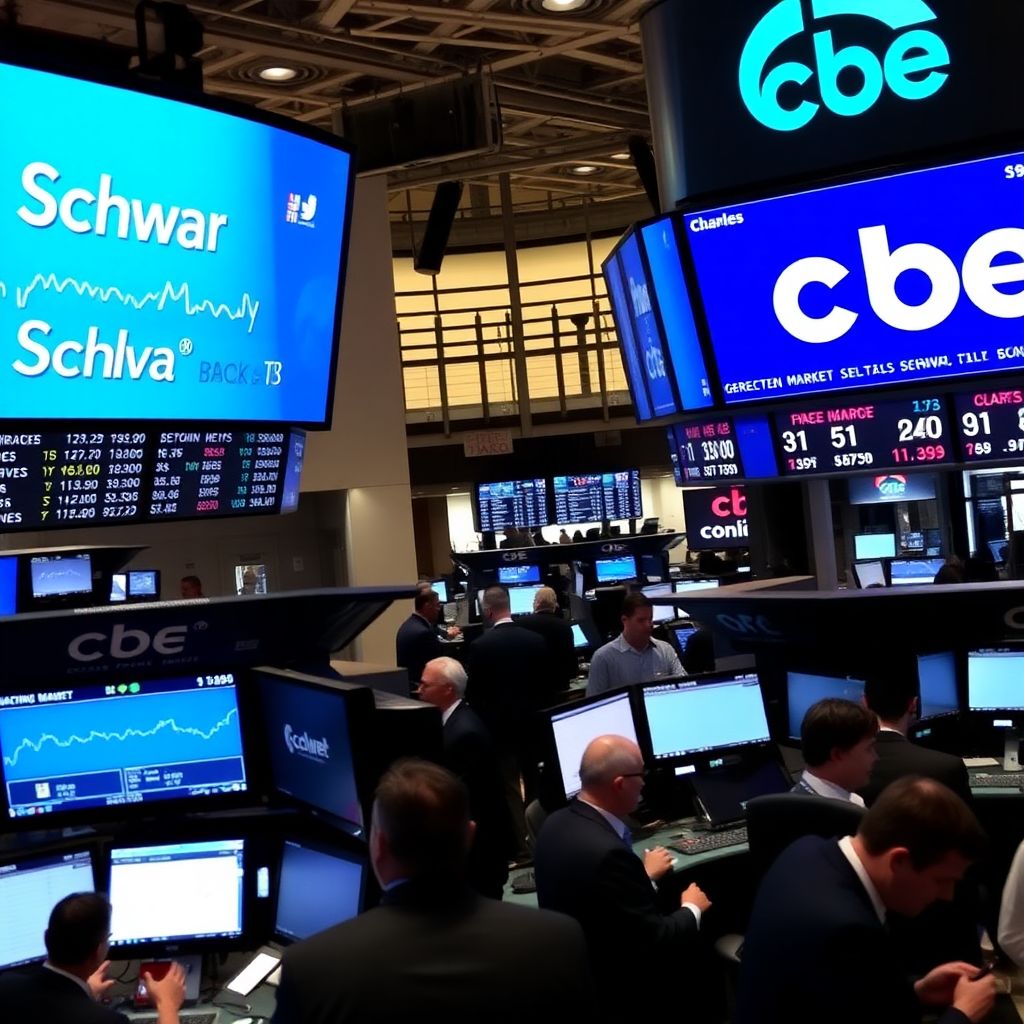
Charles Schwab, one of the largest financial institutions in the United States, is preparing to enter the rapidly expanding prediction markets space, according to a report from the Wall Street Journal. The brokerage firm plans to collaborate with Cboe Global Markets to introduce contracts tied to the performance of the S&P 500 index, giving traders a new way to speculate on the direction of one of the world’s most closely watched equity benchmarks.
Hints about this move surfaced earlier in the year during Schwab’s first quarter earnings call. At the time, CEO Rick Wurster signaled that prediction markets were on the firm’s roadmap, saying the company would “likely have prediction markets” among its offerings. However, Wurster was careful to distinguish between financial-focused products and the more controversial prediction markets that allow users to bet on political outcomes, sports events, or entertainment results. Schwab’s plans, at least for now, are firmly in the realm of traditional finance.
According to the report, Schwab intends to use Cboe’s infrastructure to list contracts that function much like prediction markets for the S&P 500. These contracts would allow participants to effectively place wagers on where the index will trade at a certain time or within a specific range, similar in spirit to how prediction platforms let users buy and sell shares tied to the probability of future events. In practice, the products are expected to resemble simplified, event-style contracts on asset prices rather than conventional options or futures.
The S&P 500, which tracks a curated basket of the largest publicly traded companies in the United States, is already the backbone of countless investment products, from index funds to derivatives. By introducing prediction-style contracts tied to this index, Schwab appears to be targeting a segment of traders that want a more accessible, binary, or event-driven way to express views on market direction-without necessarily engaging with complex derivative structures.
From a structural perspective, these S&P 500 prediction contracts will likely mirror features common in existing financial prediction markets. Participants may buy positions that pay out based on whether the index closes above or below a certain level, hits a particular target, or remains within defined boundaries. Unlike traditional stock purchases, where investors gain exposure to ownership and long-term appreciation, these contracts would be purely outcome-based instruments focused on short- to medium-term scenarios.
Wurster’s earlier comments underscore Schwab’s strategy to stay within the regulatory comfort zone. While there has been intense scrutiny around prediction platforms that host markets on elections, public policy, or social issues, financial markets tied to established indices occupy a more familiar category for regulators. By limiting its initial offering to contracts referencing the S&P 500-and partnering with an established exchange operator like Cboe-Schwab is positioning this venture as an extension of mainstream capital markets rather than an experiment on the fringes of speculation.
The partnership with Cboe is also significant. Cboe has decades of experience listing and clearing equity index derivatives, including options and futures on the S&P family of indices. Leveraging this infrastructure means Schwab does not need to build an entirely new trading venue from scratch. Instead, the firm can plug into a battle-tested exchange framework for listing, trading, and settling these contracts, while focusing its efforts on distribution, client access, and integration into its existing brokerage platform.
For Schwab’s customer base, the introduction of S&P 500 prediction markets could broaden the toolkit available to both active traders and sophisticated retail investors. Instead of only buying index funds, trading ETFs, or using options spreads, traders would have the option to take very targeted positions on near-term moves in the benchmark. For example, a participant might enter a contract speculating that the S&P 500 will close above a specific level by the end of the trading day, the week, or another defined period. The payoff would depend entirely on whether that condition is met.
This model can make market participation more intuitive for some investors. Prediction-style contracts are often structured in a way that makes the risk-reward profile very transparent: typically a capped gain and a fixed maximum loss, based on how much is staked. That clarity could appeal to users who find traditional options pricing and Greeks overly complex, yet still want more precision than simply going long or short on an index fund.
At the same time, Schwab’s move underlines how the boundaries between traditional finance and the prediction market ecosystem are blurring. Until recently, prediction markets were mostly associated with smaller, often niche platforms focused on elections, macroeconomic releases, or cultural events. The entry of a household name like Charles Schwab, focusing on regulated financial underlyings, suggests that the core mechanics of prediction markets-trading on the probability of future outcomes-are becoming more widely accepted as a legitimate financial product design.
However, this development also raises questions about investor protection and appropriate use. While outcome-based contracts can be easier to understand than complex derivatives, they still involve speculating on short-term price movements-an activity that carries substantial risk, especially for inexperienced traders. Schwab will likely need to implement robust risk disclosures, educational materials, and possibly suitability checks to ensure that clients understand that these instruments are not long-term investment vehicles but speculative tools.
From a regulatory standpoint, the key issue will be how these contracts are classified and overseen. When they are tied to a widely recognized financial index and traded through a major exchange, they tend to fall squarely under existing derivatives or securities frameworks. That differentiates them from markets on political elections or non-financial events, which have often triggered intense regulatory debate over whether they constitute gambling, off-exchange derivatives, or something else entirely.
For professional traders and institutions, the new S&P 500 prediction contracts could serve as a complementary hedging or speculative instrument. Unlike traditional futures or options, which may have larger contract sizes or more complex payoffs, prediction-style contracts can be designed with smaller notional values and straightforward payouts. This opens the door to more granular hedging strategies or high-frequency, event-based trading around economic data, central bank meetings, or earnings cycles that tend to move the index.
Retail investors might see these products as an entry point into more active trading strategies. Yet this is a double-edged sword. While small, transparent contracts can help users manage risk in a controlled way, they also make it easier to place frequent bets that can quickly accumulate losses. How Schwab structures fees, margin requirements, and educational content will play a crucial role in determining whether these markets foster responsible participation or fuel excessive speculation.
Strategically, Schwab’s decision to experiment with prediction markets reflects a broader competitive landscape. As fintech platforms and alternative venues introduce novel ways to trade on future outcomes-sometimes with gamified interfaces-established brokerages are under pressure to innovate while still maintaining regulatory discipline. Offering S&P 500 prediction markets allows Schwab to respond to evolving client demand for more flexible, event-driven products without venturing into politically sensitive or legally ambiguous territory.
There is also a technological angle. Integrating these contracts into Schwab’s digital platforms will likely require user interface updates, new order types, and enhanced analytics for probability-based trading. Over time, that infrastructure could be repurposed for other forms of event-based products tied to interest rates, volatility indices, or sector benchmarks, should Schwab decide to expand beyond the S&P 500 once the initial rollout is tested and refined.
For long-term investors, the arrival of S&P 500 prediction markets does not fundamentally change the rationale for traditional portfolio strategies based on diversification, asset allocation, and time in the market. These contracts are not designed to replace index funds or retirement accounts. Instead, they add a speculative layer on top of the existing market structure, catering primarily to clients who want to express short-term views or fine-tune exposure around key events.
Looking ahead, the success of Schwab’s initiative will depend on several factors: regulatory reception, customer appetite, product design, and the broader market environment. In periods of heightened volatility, demand for tools that allow precise, time-bound bets on index levels tends to increase. Conversely, in calm markets with low realized volatility, interest could wane unless the contracts are structured attractively enough in terms of pricing and payout.
In essence, Charles Schwab’s push into S&P 500 prediction markets with the backing of Cboe represents a significant step in bringing event-style financial products into the mainstream. By anchoring the concept in a familiar index and established exchange infrastructure, the firm is attempting to bridge the gap between innovative prediction mechanisms and the conservative expectations of traditional brokerage clients. Whether this experiment evolves into a core product line or remains a niche offering, it marks an important moment in the ongoing evolution of how investors and traders bet on the future of financial markets.